
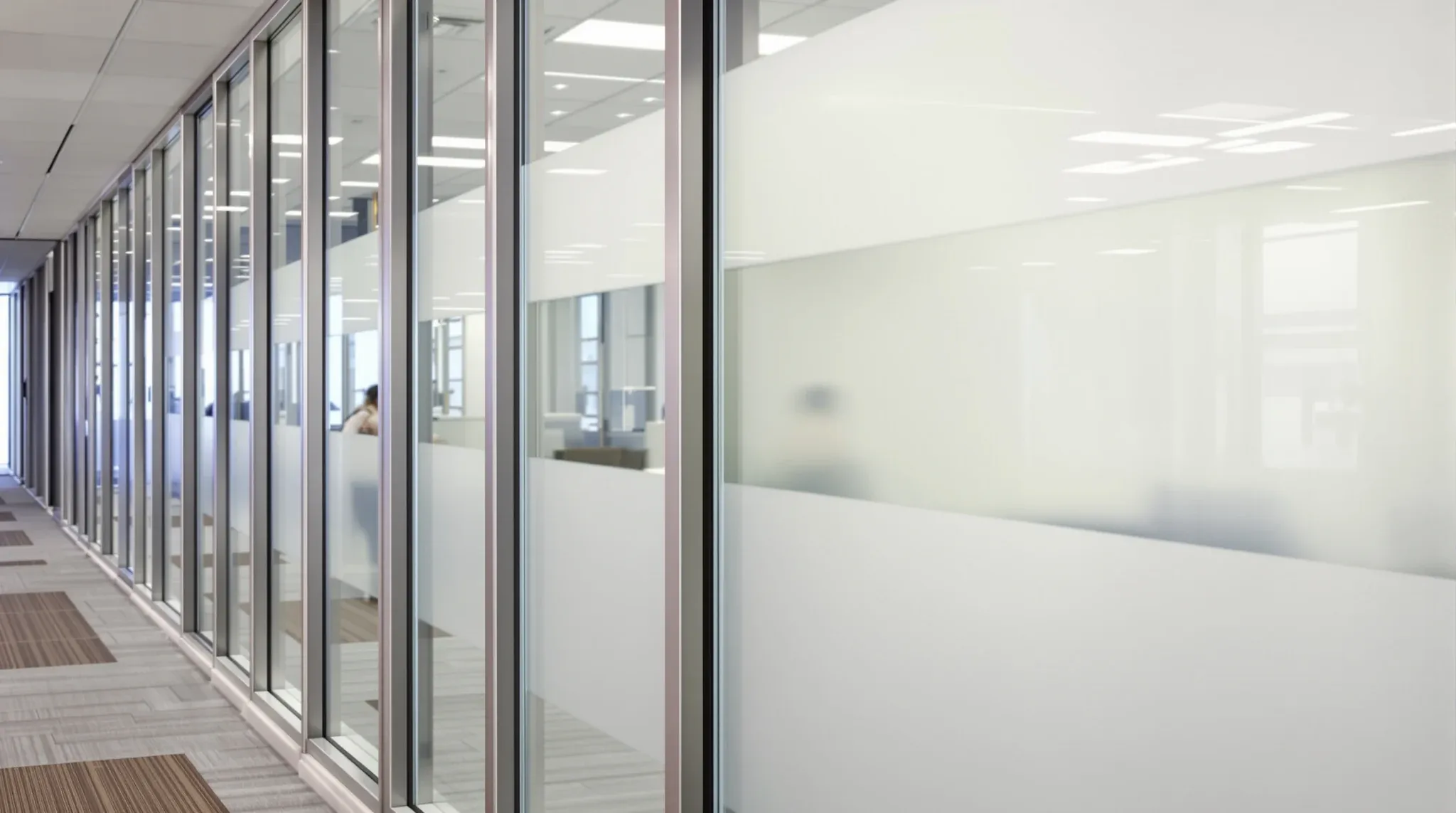
A Sydney tenant agreeing to a lease renewal often wants the office to feel different at the start of the new term without taking the whole fitout apart to get there. The cheapest version of that refresh, on a floor with existing glazed partitions in good frames, is to swap the glass panels and leave the frame, base track, head track and door hardware as they are. Done well, the floor reads as a quietly refreshed space; done poorly, it reads as new glass dropped into tired surrounds.
The decision is not whether the swap is possible. The decision is whether the existing frame, the existing fixings, and the existing surrounding finishes will still look right once the new glass goes in. When they will, the refresh is one of the most cost-effective things a tenant can do on lease renewal. When they will not, swapping the glass alone is the wrong scope.
The Signs That The Frame Is Healthy Enough To Keep
We walk the existing partition before any swap is committed. The first check is the head and base tracks: are they straight, level, and rigidly fixed back to slab and floor, or do they show movement when pressed firmly. A track that has moved over the lease will let the new glass sit slightly out of plumb, and the result reads as a faintly leaning wall to anyone walking past.
The second check is the side jambs and corner joints. Where two glass panels meet at a junction, the existing detail tells us whether the new glass will sit cleanly into the same condition or whether the junction needs reworking. Corner and junction details are the first thing the eye sees on a refreshed wall, and a clean original junction is one of the genuine signs the frame is worth keeping.
The third check is the door, its frame, and its hardware. A door that closes cleanly into a frame that has held its shape suggests the surrounding glazing system has held its geometry. A door that catches, drags or sits proud of its frame tells us the rest of the system has probably moved too, and a glass-only swap will look forced. Where the door has shifted over the lease, the conversation usually expands to include rehanging.
What “Frame Stays” Actually Means Across System Types
Glass partition systems are not all the same. A demountable system designed for re-glazing makes the swap straightforward: the panels release from the track, the new panels slide in, the gaskets reseat, and the room is closed in. A traditional silicone-jointed frameless system requires the existing silicone to be cut out, the panels lifted, the tracks cleaned, and a new silicone bead struck once the new panels are in. The two systems use the same words but run very differently on site.
Framed glazing systems with a visible aluminium surround sit in a third category. The frame stays in place, the existing glass releases through the frame’s designed access route, and the new glass beds back in with new gaskets. The choice of silicone joints versus dry gaskets on the original install determines how clean the swap is, because dry-gasket systems were built for component replacement, and silicone systems were not. Before we quote a glass-only refresh, we identify which system the partition is, because the build hours diverge significantly between them.
When The Swap Is The Right Answer And When It Is Not
The swap is the right answer when the look is dated but the geometry has held, when the tenant has a clear visual change in mind (low-iron glass, a tint, a frosted band, a fritted pattern, a new branding film), and when the frame system supports panel replacement without scaffolding the whole surround. It is also the right answer when programme matters more than freshness, because a glass-only swap on a system designed for it can be done over a weekend or two evenings without touching the rest of the office.
It is not the right answer when the frame has visibly aged, when the surrounding plasterboard returns are scuffed enough that new glass will throw them into sharper relief, or when the tenant’s real wish is for the office to look new, not refreshed. In those cases, replacing the partition entirely is the more honest scope, even though the cost is higher. We will say so before we quote the swap; pushing through a glass-only refresh on a tired surround tends to produce a result that pleases no-one.
The Trade-Offs The Lease-Renewal Decision Actually Involves
On a like-for-like clear glass replacement, the swap saves a meaningful share of what a full partition replacement would cost, the works are quick, and the floor stays operational. The trade-off is that anything fixed to the existing frame stays as it was: hardware, finger pulls, locks, signage backing, switchable-glass wiring routes. If any of those are part of what the tenant wants to refresh, the swap stops being a simple swap.
On a feature glass replacement (clear to fritted, clear to low-iron ultra-clear, clear to tinted, clear to switchable), the cost of the glass itself usually rises, sometimes substantially, and the lead time on the new panels can be eight to twelve weeks from order to site. The trade-off is the visual upgrade against the lead time and the holding cost of an order placed before the work can land.
The Build Sequence When Only The Glass Moves
The sequence is short but precise. First, we protect the surrounding floor and adjacent finishes; glass refits are clean work, but the existing tracks have years of carpet dust, sealant residue and minor damage that show once you start touching them. Second, we release the existing panels from the system. On dry-gasket systems this is a clean lift; on siliconed systems, the bead is cut, the panel is lifted out, and the track receives a careful sealant strip-back before the new panel goes in.
Third, the new panels arrive and go in. The geometry is checked against the existing tracks panel by panel, and any rectifications to the track (small shim, packer, or sealant cleanup) happen at the moment of fit, not afterwards. Fourth, the new perimeter detail goes on: new silicone, new gasket, new finish trim where required. Fifth, the room is cleaned down and handed back. The whole sequence on a typical four-to-six-panel boardroom front is comfortably two to three days on site, plus the time to order the new panels, which is usually the longer wait.
Any film, branding overlay, or signage on the original glass does not transfer with the swap. The new panels arrive without films applied unless the order is placed for pre-applied film, which is sometimes cheaper than on-site application and sometimes not, depending on the film type and the panel size. We confirm with the tenant before the order is placed whether the existing branding is being repeated, refreshed, or removed entirely, because a film decision made after the panels arrive on site usually adds a separate trade visit and a day of work that could have been built into the initial install. Panel sizing on the new order also has to honour the existing track and frame opening dimensions exactly, which we confirm by site-measuring rather than relying on as-built drawings, since most as-builts on an aged partition no longer match the actual geometry.
How The Change Reads On The Floor
The honest test of a glass refresh is what the floor feels like when people walk in on the first day after the work. New glass against a clean, plumb, undamaged surround reads as a tightened space. New glass against a tired surround reads as a patch. The difference between the two outcomes is set during the walk-through before the swap, not in the install itself.
Where the surround has aged unevenly, sometimes the cleanest answer is to combine the glass swap with a paint refresh of the surrounding plasterboard returns and a touch-up to the door frame finish. That keeps the scope close to a glass-only swap on the bill while letting the new glass land into surfaces that match its freshness. The conversation is worth running upfront so the refresh produces a result that justifies the spend.
What The Work Costs And What Shifts The Price
A like-for-like clear glass swap on a dry-gasket system is among the lowest-cost refresh moves a tenant can make on lease renewal. The price moves on three things. The first is the system type: dry-gasket replaces in hours, silicone systems take longer. The second is the glass spec: clear is one price band, low-iron and laminated are a second band, switchable is a third. The third is whether the surrounding finishes get touched up at the same time, because adding paint or door rework to the scope changes the labour mix.
What does not usually move the price meaningfully is the panel count, within reason. Once the trade is on the floor, the marginal cost of additional panels is small. Where the price moves sharply is at the boundary between “glass only” and “glass plus surround”. Knowing which side of that boundary the refresh actually sits on is the part worth getting right before the order is placed.
If a Sydney office is heading into lease renewal and the partition frames are still in good shape, we can walk the existing system, confirm whether a glass-only swap will land cleanly, and price the re-glazing work against the existing frame.
📞 Call us on 1300 60 93 93