
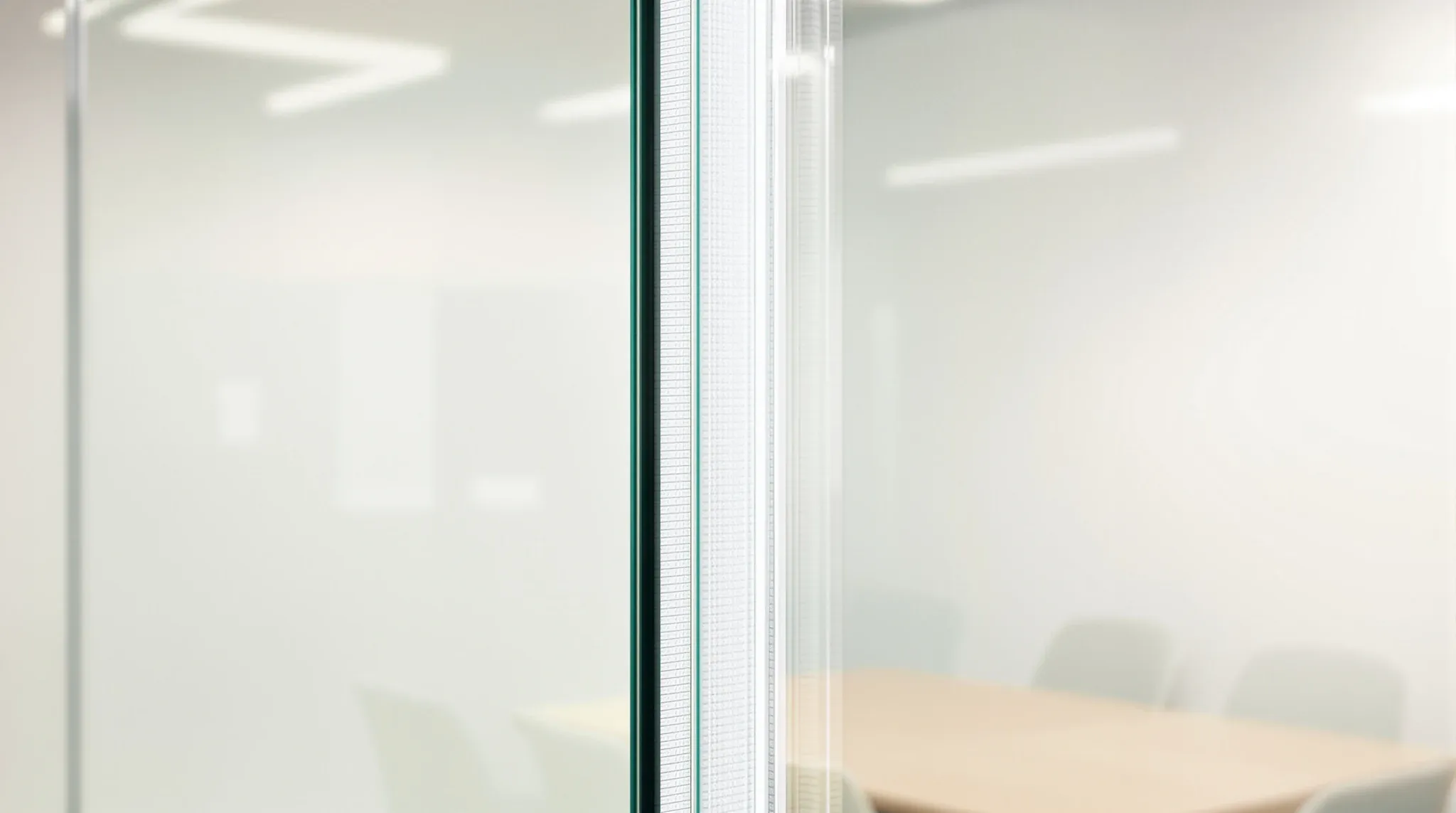
Between the vertical panes of a frameless glass partition, something has to seal the gap. The two options used in commercial offices are a silicone joint, applied wet on site and tooled smooth, or a dry gasket that clips or presses into a channel profile and holds the panes in alignment without any liquid sealant at all. Both can work. They are not interchangeable.
The short version is that silicone gives a cleaner visible finish and a slightly better acoustic seal when it is done well, and a dry gasket is more tolerant, easier to maintain, and less dependent on the skill of whoever was on site that day. The right choice for a given fitout depends on what the room is being used for, who will maintain it, how often a pane might need to be replaced, and whether the finish is the thing being bought or the function is.
What Each Joint Method Actually Is
A silicone joint is a bead of structural or weather-grade silicone applied between two panes along the full vertical edge, usually around ten millimetres wide, tooled once to give a flat or concave surface. The silicone carries some of the load of keeping the panes aligned and provides the airtight seal between them. On a frameless run, it is often the only thing bridging the gap between adjacent panes.
A dry gasket is a pre-formed rubber or polymer strip that sits between the panes inside an aluminium or steel channel profile, or in a purpose-designed slot that runs the full vertical length of the joint. The gasket does the sealing; the channel does the alignment work. Nothing is applied on site beyond positioning the panes into the profile.
The two approaches are sometimes combined. A modern channelled frameless system can carry a gasket for alignment and a very fine silicone joint for the visible finish, where the gasket does the structural job and the silicone is purely cosmetic. This hybrid is increasingly common in higher-end offices and is often what tenants actually get when they specify “silicone joints”, without necessarily realising it. Where the brief sits on the line between frameless and framed glass systems, the joint choice often decides how frameless the finish actually reads.
Where Silicone Joints Shine And Where They Frustrate
Silicone has two genuine advantages. The first is visual. A silicone joint, when it is applied by someone who does this work every week, reads as a clean vertical line of roughly the same width as the glass edge, and it disappears against the glass unless a viewer is looking for it. A well-tooled silicone bead on a frameless boardroom wall gives the spec-grade frameless look that designers are typically specifying when they brief “frameless glass partitions with minimal vertical framing”.
The second is acoustic. Silicone, fully applied and cured, makes an airtight seal. On a rated acoustic partition where every millimetre of gap is a path for sound, silicone closes those gaps more completely than most gasket profiles. The improvement is not dramatic, typically a decibel or two in lab-equivalent conditions, but it is measurable and it is consistent along the full run.
The frustrations are operational. Silicone is a wet trade, which means it is applied on site, which means the quality of the joint depends on site conditions, operator skill, and the sequencing of other trades around it. A silicone joint tooled at eleven in the morning with warm dry air behaves very differently to one tooled at four in the afternoon with humidity rising. If the glass is dusty when the bead goes on, the adhesion is compromised. If the operator tools the bead twice because the first pass was not clean, the finished line looks subtly different to every other bead in the room. None of these are catastrophic. All of them become visible on a well-lit wall under direct lighting.
Silicone also ages. Modern neutral-cure silicones hold their colour for years, but they will eventually discolour, shrink at the edges, or pick up cleaning residue that changes their appearance. Replacing a silicone bead is a small job but it is a disruption to the occupied space because the old bead has to be cut out, the joint cleaned, and the new bead applied and tooled while the adjacent area is protected.
What Dry Gaskets Trade Away And What They Give Back
A dry gasket is a less glamorous detail. The rubber sits in a channel and you can see it. The joint is a visible line perhaps three to five millimetres wide, with a matte rubber finish that reads as a deliberate architectural line rather than as a hidden seal. On a well-designed system the gasket is colour-matched to the glass edge so the visual contrast is low, but it is never invisible in the way a good silicone joint is.
What the gasket trades away in finish, it gives back in tolerance and maintenance. A gasket compresses when the panes are installed, which means small variations in pane alignment are absorbed inside the channel. A silicone joint cannot do this; if the panes are ten millimetres apart at the top and twelve at the bottom, the silicone bead will show the taper. A gasketed system brings the panes into parallel alignment and hides the variation inside the profile.
Replacement is dramatically simpler. If a pane is damaged, the installer releases the gasket, lifts the pane out, fits the new one and re-seats the gasket. No silicone to cut out, no cure time to wait for, no adjacent areas to protect. For offices where glass partitions are expected to be rearranged or replaced during the lease, the gasket approach genuinely reduces the cost and disruption of those changes.
Acoustic performance is usually close to, but not quite as tight as, a well-applied silicone joint. For meeting rooms and general office partitions, the difference is not material. For purpose-built acoustic rooms, audio suites, or boardrooms where the full rated performance is being relied on, silicone still has the edge when it is done correctly.
Acoustic Performance: What The Joint Actually Changes
Acoustic performance on a glass partition is determined by the pane itself (single or laminated, thickness, interlayer), the perimeter seals at head and floor, and the vertical joints between panes. The vertical joints are the smallest contributor but they are the one most commonly undermined on site, which is why retrofitting acoustic upgrades to existing glass partitions so often focuses on resealing the jointwork before anything else.
A rated acoustic partition loses its rating wherever the seal is broken. A silicone joint that skins over before it is tooled, that lifts off the glass because the edge was dusty, or that is missed in a two-centimetre stretch at the top because the operator ran out of reach, all compromise the rated performance. A gasket system with the gasket correctly seated and the channel aligned delivers a consistent but slightly lower acoustic number. In practical terms, a good gasket installation often beats a rushed silicone installation.
For tenants commissioning a rated acoustic partition, the decision should depend on how confident the specification is in the installer. A trusted commercial glass installer with a history of clean silicone work in occupied offices will deliver a better acoustic result with silicone. A generalist installer who handles glass as part of a broader scope will often deliver a better acoustic result with a gasketed system because the gasket is less operator-dependent.
Maintenance, Replacement And Repair Over The Lease
Lease terms in commercial Sydney offices are usually five to seven years. Over that period, glass partitions will typically face three maintenance events. A pane will get damaged and need replacing. A joint will start to show wear, discolouration or cleaning damage. A room will need to be reconfigured because the business has changed. How easy each of those events is to handle depends directly on the joint type.
A silicone-jointed partition makes pane replacement a moderately involved job. The silicone has to be cut out carefully to avoid damaging the adjacent pane, the new pane has to be handled in while the adjacent panes are braced, and a new silicone bead has to be applied and tooled to match the original. It can be done cleanly but it takes longer and costs more than an equivalent gasket replacement. Joint refresh is a straightforward cut-and-reapply job but it is disruptive to the occupied space.
A gasket-jointed partition makes all three events easier. Pane replacement releases the gasket, swaps the pane and re-seats. Joint refresh is a gasket swap, which is a cleaner and faster job than a silicone refresh. Reconfiguration is the easiest of all, because panes can often be reused in a new layout when they were cut to sensible modular sizes.
For a tenant whose lease is five years and who has no plans to change the layout, the maintenance difference is modest and silicone remains a credible choice. For a tenant who expects to grow, restructure, or reconfigure inside the lease, the gasket approach usually pays for itself through the reduced cost and disruption of those changes.
Choosing Between Them On An Actual Brief
On a boardroom wall in a client-facing reception zone, where the finished look is the thing being bought and the room is rarely reconfigured, a silicone joint is usually the right choice. The visual payoff is real and the maintenance profile is acceptable.
On a bank of meeting-room partitions in an open-plan floor where rooms are added, moved or repurposed across the lease, a dry gasket is usually the better economic decision. The finish is slightly less hidden, but the rooms stay usable without repeated on-site silicone work every time something shifts.
On a rated acoustic room where the partition is doing genuine acoustic work and the rating has to hold, the answer depends on installer confidence. A trusted specialist silicone installation is the stronger acoustic result; a good gasket installation is the safer default where installer skill cannot be guaranteed.
On a retrofit where existing walls are slightly out of square and the new glass is being married into imperfect base conditions, a gasket is usually more forgiving. A silicone joint will show every variation in pane alignment; a gasket absorbs most of them inside the profile. A genuinely commercial-grade partition system will specify which jointing method it is certified with, and the certification is part of what the tenant is paying for.
The specification call is worth making deliberately, not letting it default. A brief that simply says “frameless glass partitions” will be priced by the installer with the joint method they prefer, which is often not the one that suits the tenant’s actual use case.
If you are scoping a glass partition package for a Sydney commercial office and the choice between silicone and gasket is still open, we can walk you through which one suits the room, the finish, the acoustic requirements and the way you expect to use the space over the lease. Standalone partition scopes and full fitouts are both in our glass partitions service, and the specification conversation is the right place to sort this out before the shop drawings are signed.
📞 Call us on 1300 60 93 93