
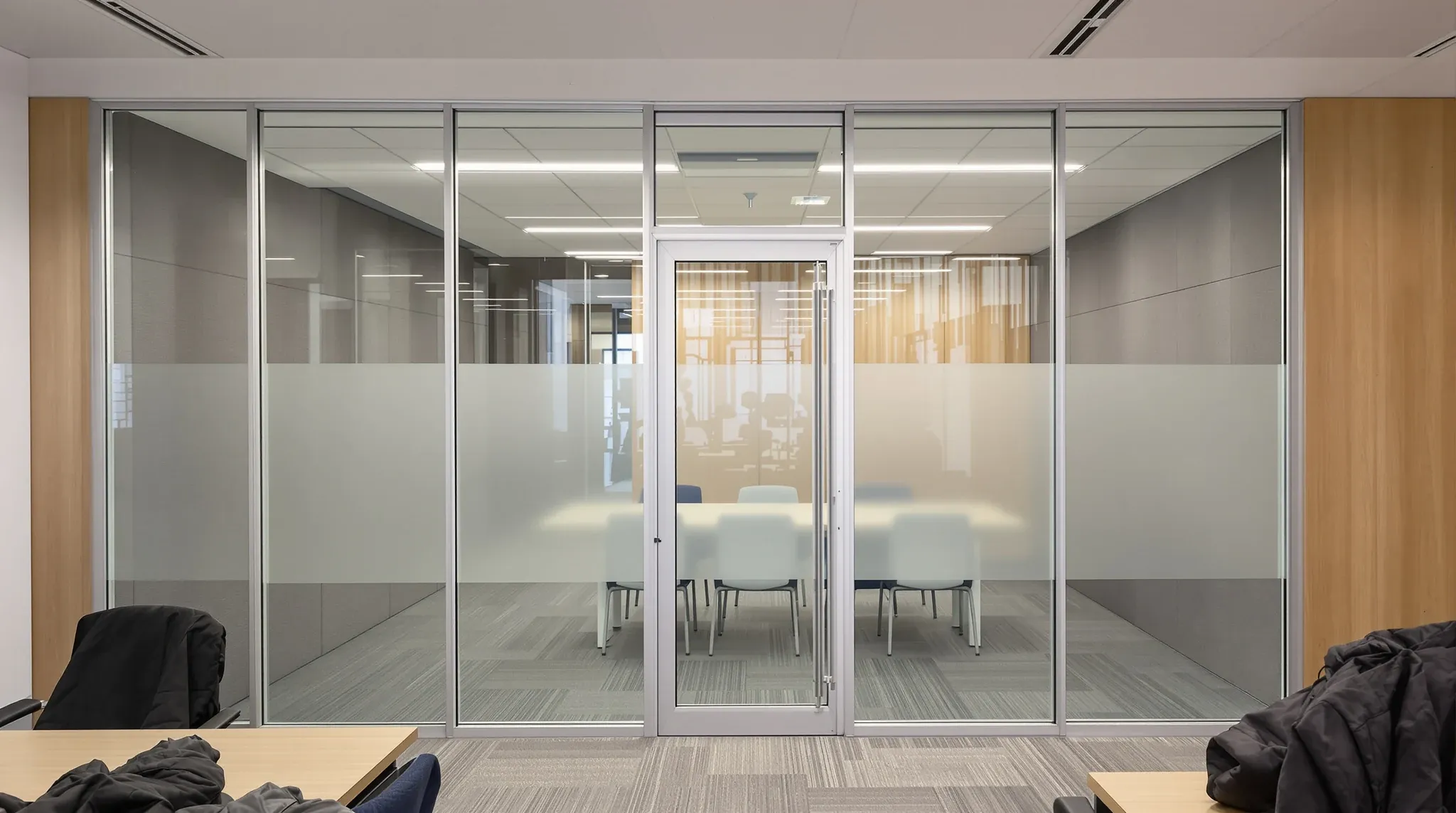
Glass offices that were designed for openness and collaboration sometimes end up in workplaces that need more acoustic privacy than the original design anticipated. Teams change, meeting culture evolves, confidentiality requirements tighten, and rooms that were perfectly adequate when the fitout was new start attracting consistent complaints about noise, distraction, and lack of speech privacy. The question becomes whether the existing glass partitions can be improved without ripping them out and starting again.
The answer depends on what is causing the acoustic problem, where the sound is actually getting through, and what level of improvement is realistic given the constraints of the existing installation. In some cases, meaningful improvement is achievable through targeted upgrades. In others, the limitations of the existing system mean that genuine privacy requires more fundamental changes that go beyond what a retrofit can deliver.
This article looks at the realistic options for retrofitting acoustic improvements to existing glass partitions, what each option actually achieves, and where the common expectations do not match the physical reality.
Why Glass Rooms Become Acoustically Inadequate Over Time
Glass partitions installed during the original fitout are specified based on the anticipated use at that time. A meeting room designed for four-person project updates has different acoustic requirements than the same room being used two years later for client negotiations, HR conversations, or video calls with external parties on speaker. The partition has not changed, but the expectation of what it should deliver has shifted.
Workplace density changes also affect perceived acoustic performance. When the open plan adjacent to a glass meeting room was sparsely occupied, the background noise level was low enough that any sound leaking through the partition was masked. As headcount increases and the open plan fills up, two things happen simultaneously: the noise level outside the glass room rises, making it harder to hear inside, and the occupants inside raise their voices to compensate, making the sound leakage more noticeable to people outside. The partition performance has not changed, but the acoustic environment around it has shifted in a way that exposes its limitations.
Seal deterioration also plays a role. Glass partition door seals, particularly drop seals and compression seals, wear over time. A door that sealed well on installation may have developed gaps after thousands of open-close cycles. These gaps are rarely visible to the casual observer, but they represent a direct sound path that bypasses the glass panels entirely.
Identifying Where the Sound Is Actually Leaking
Before investing in any acoustic upgrade, the first step is to identify where the sound is actually getting through. In many cases, the glass panels themselves are not the primary weak point. The sound is leaking through the door, over the top of the partition through the ceiling void, through service penetrations, or through gaps at the junction between the glass system and the adjacent walls or ceiling.
A simple diagnostic is to stand outside the glass room during a meeting and listen for where the sound is loudest. If the sound is strongest near the door, the door seals are the primary issue. If the sound seems to come from above the partition, the ceiling flanking path is the dominant route. If the sound is relatively uniform across the glass face, the glass panels themselves may be the limiting factor.
This diagnostic matters because the upgrade path is different for each leak source. Spending money on the glass panels when the real problem is the door seals will produce minimal improvement. Conversely, replacing door seals when the ceiling void is the dominant flanking path will not solve the problem either. Effective acoustic retrofit starts with accurate diagnosis.
Upgrading Door Seals and Hardware
Door seals are the most cost-effective acoustic upgrade for existing glass partitions. The door is almost always the weakest link in the acoustic envelope because it must open and close regularly, which means it cannot be sealed as permanently as the fixed glass panels. Over time, the seals that maintain the acoustic closure degrade, and sound leaks through the gaps.
Replacing or upgrading the perimeter seals, adding or adjusting the drop seal at the base of the door, and installing an acoustic sweep or threshold seal can produce measurable improvement at a relatively low cost. For sliding glass doors, upgrading the track seal and ensuring the door overlaps the frame correctly can close gaps that have developed through regular use.
Door hardware can also contribute to acoustic improvement. Self-closing mechanisms that ensure the door fully latches every time it is closed prevent the common scenario where the door is left slightly ajar, which destroys the acoustic seal entirely. Magnetic catches that hold the door firmly against the frame seals provide a more positive closure than gravity-dependent systems.
Addressing the Ceiling Flanking Path
In offices with suspended ceiling systems, the void between the ceiling tiles and the structural slab above provides an unobstructed path for sound to travel over the top of the glass partition. If the glass system terminates at the ceiling grid and does not extend to the slab, sound enters the ceiling void on one side of the partition and exits on the other side, bypassing the glass entirely.
Addressing this flanking path in a retrofit is more complex than upgrading door seals, but it is often the single most effective improvement available. Options include installing an acoustic barrier above the glass partition within the ceiling void, using a mass-loaded vinyl curtain or dense mineral wool batt that spans from the top of the glass framing to the underside of the slab. This barrier does not need to be a full wall; it needs to be heavy enough and continuous enough to significantly reduce the sound energy passing over the partition.
The challenge with ceiling void treatment is access. The work requires lifting ceiling tiles, working above the partition, and ensuring the barrier does not interfere with services running through the void, including air-conditioning ductwork, fire sprinkler pipes, and electrical cabling. In some cases, the ceiling void is too congested with services to accommodate a retrofit barrier without significant services relocation, which changes the cost equation substantially.
Secondary Glazing and Film Options
For glass rooms where the panels themselves are the primary acoustic limitation, secondary glazing is the most effective upgrade. This involves installing a second layer of glass on the inside of the existing partition, creating an air gap that significantly improves the acoustic performance. The principle is the same as double-glazed glass partition systems, but applied to an existing single-glazed installation.
Secondary glazing can improve the acoustic performance of a glass partition by 8 to 12 decibels, which is a substantial and perceptible improvement. However, it adds visual bulk to the partition, reduces the clear width of the room, requires careful detailing to maintain a clean appearance, and must be integrated with the existing framing and door system. It is not a simple stick-on solution; it is a construction activity that requires design, fabrication, and skilled installation.
Acoustic film applied directly to existing glass panels is sometimes proposed as a lower-cost alternative to secondary glazing. The reality is that acoustic films provide minimal improvement because the mass they add to the glass is small relative to the mass of the glass itself. A 10mm glass panel weighing approximately 25 kilograms per square metre will not be meaningfully improved by adding a film that weighs less than one kilogram per square metre. The film may add a marginal improvement at very specific frequencies, but for speech privacy across the audible range, the improvement is unlikely to be perceptible.
Sound Masking as a Complementary Strategy
Sound masking systems introduce a low-level background noise into the space that raises the ambient noise floor outside the glass room. This does not reduce the amount of sound passing through the partition, but it reduces the intelligibility of that sound by masking it with a consistent, unobtrusive background signal. The effect is that conversations inside the glass room become less distinguishable to people outside, even though the physical sound transmission has not changed.
Sound masking is not a replacement for acoustic improvement in the partition itself, but it is a useful complementary strategy, particularly in offices where the ambient noise level is low and the glass room’s acoustic limitations are being exposed by the quiet surrounding environment. A well-tuned masking system can deliver a perceptual improvement equivalent to 3 to 5 decibels of additional acoustic performance, which is often enough to shift a glass room from uncomfortable to acceptable for general meeting use.
The limitation of masking is that it does not help with confidentiality for highly sensitive conversations. If the acoustic requirement is that no words should be intelligible outside the room under any circumstances, masking alone will not achieve that. It works best for rooms where the privacy need is moderate and the goal is to reduce distraction rather than prevent eavesdropping.
When Retrofit Is Not Enough
There are situations where the existing glass partition system cannot be upgraded to meet the required acoustic standard, regardless of how many improvements are made. A single-glazed partition system with a non-acoustic door and no provision for ceiling void treatment has a performance ceiling that may be 10 or more decibels below what the room needs. In those cases, the retrofit options described above will improve the situation but will not resolve it.
When the gap between the current performance and the required performance is too large for retrofit measures to bridge, the conversation shifts to replacement. This may mean replacing the glass partition with a higher-specification glass system, replacing it with plasterboard for rooms that need the highest privacy, or redesigning the room layout so that the most sensitive spaces are served by solid walls and glass is reserved for rooms where the acoustic demand is lower.
The decision between retrofit and replacement should be based on an honest assessment of the gap between current and required performance, not on a hope that incremental upgrades will deliver transformative results. Spending progressively more on retrofit measures that each deliver small improvements can end up costing as much as a well-planned replacement that delivers the full performance in one step.
If your glass offices are not performing acoustically and you want a realistic assessment of what is achievable, we can help. We work with existing partition systems and new installations to deliver the acoustic performance each room actually needs.