
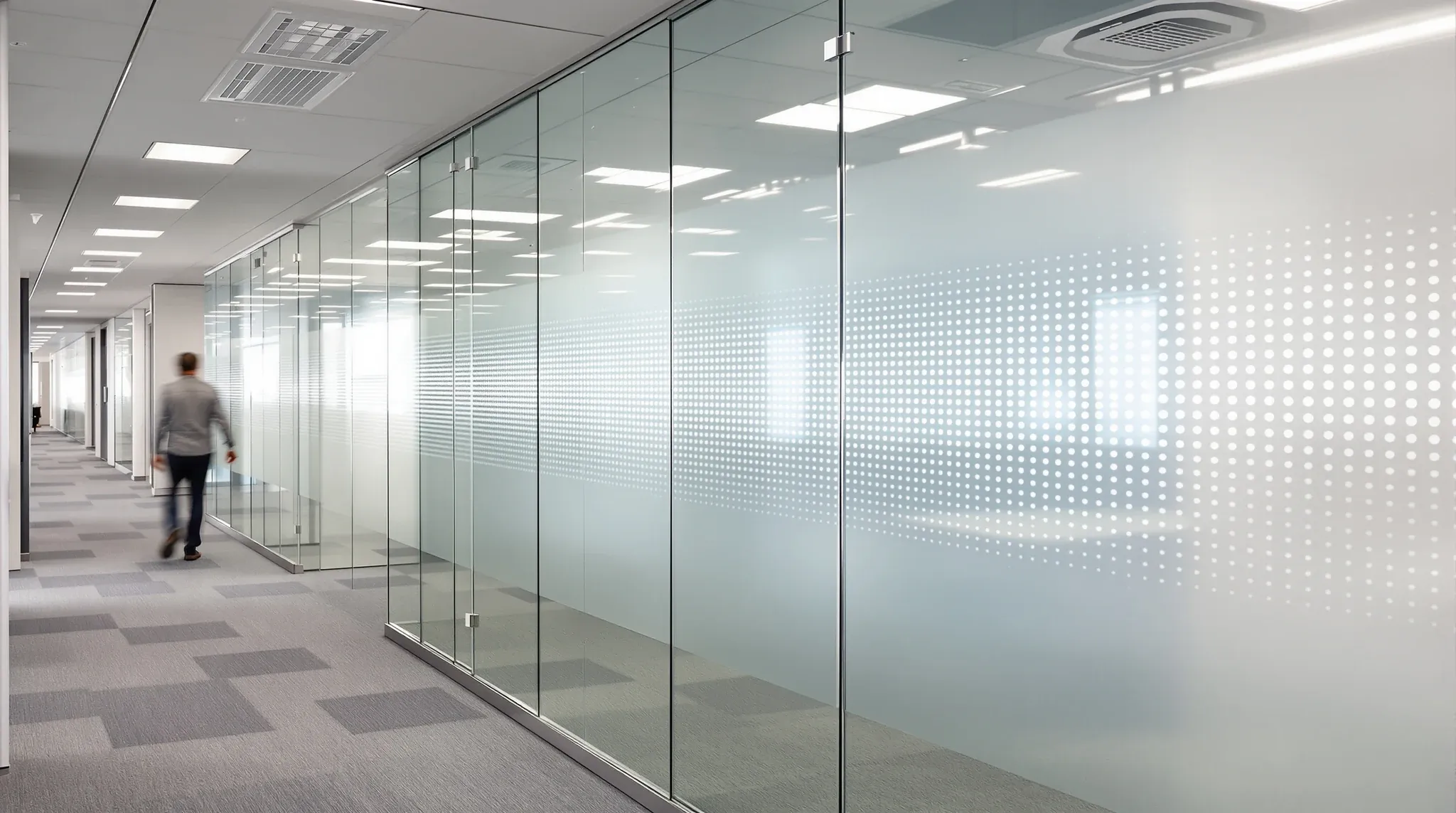
Manifestation on glass partitions is one of those fitout details that rarely gets attention until it causes a problem. The rules exist for a straightforward safety reason: full-height clear glass is difficult to see, and people walk into it. In commercial offices, where visitors, clients, and staff move through unfamiliar spaces regularly, unmarked glass creates a genuine collision risk that building certifiers and workplace safety requirements are designed to prevent.
Despite the simplicity of the underlying principle, manifestation is one of the most commonly mishandled elements in commercial glass partition fitouts. It gets applied too late, applied incorrectly, or specified in ways that conflict with the design intent of the glass. The result is either a compliance issue that delays the occupation certificate or a visual outcome that the tenant did not anticipate and does not want to live with.
What Manifestation Actually Means in Office Glass
Manifestation refers to any visual marking applied to glass that makes the panel visible to people approaching it. In an office context, this typically means a band, pattern, or graphic applied to full-height glass partitions at a height where it intersects the normal line of sight of someone walking toward the panel. The purpose is to prevent accidental collision by making the glass obviously present rather than invisible.
The requirement applies to internal glass partitions in commercial buildings, not just external glazing. Any full-height glass panel that someone could reasonably walk into – whether it is a partition wall, a sidelight next to a door, or a glass screen separating circulation zones – needs manifestation unless it has other visible features, such as door handles, visible framing, or mullions at regular intervals, that make the glass apparent.
In practice, the distinction between glass that needs manifestation and glass that does not comes down to whether a reasonable person approaching the panel at normal walking speed would recognise that a physical barrier exists. Framed glass partitions with visible aluminium mullions every 900mm to 1,200mm often satisfy this requirement without additional treatment because the framing itself makes the glass visible. Frameless glass panels with minimal or concealed hardware almost always require manifestation.
The Standards That Apply to Internal Glass Partitions
The relevant Australian Standard for glass in buildings provides guidance on where manifestation is required and how it should be applied. Building certifiers assess compliance against these requirements during the fitout approval and occupation certificate process, and non-compliance can delay handover or trigger rectification works.
The general requirement is that manifestation markings should be located between 900mm and 1,000mm above the finished floor level. Some applications also require a second band at a lower height, typically between 500mm and 600mm, to ensure the glass is visible to children and people using wheelchairs. In commercial offices, the lower band is less commonly required unless the space has a public access component or is subject to specific accessibility standards.
The markings themselves need to provide sufficient visual contrast against the background behind the glass. This means the design needs to be visible whether the space behind is light or dark, occupied or empty. Frosted bands, coloured dots, or applied graphics that rely on contrast with a specific background condition can fail the intent of the requirement if the background changes throughout the day as lighting and occupancy shift.
Common Mistakes Offices Make with Manifestation
The most frequent mistake is treating manifestation as an afterthought rather than a design decision. When manifestation is left until the end of the fitout, the options are limited to whatever can be retrofitted to installed glass. That often means adhesive vinyl strips or dots applied by a signage company after the partitions are in place, which rarely integrate well with the overall design of the glass system.
Another common error is specifying manifestation at the wrong height. Markings applied too high or too low may not intersect the line of sight of someone approaching at normal walking speed, which means they fail the safety intent even if they technically fall within the allowable height range. The correct position depends on the adjacent floor level, the approach angle, and whether the glass is on a level change or adjacent to stairs.
Using manifestation treatments that deteriorate over time is a third issue. Frosting, applied film, and digital print all have different longevity profiles, and choosing a treatment based purely on initial appearance without considering how it ages in an office environment can lead to peeling, discolouration, or fading that eventually renders the manifestation non-compliant. Vinyl adhesive films in particular are susceptible to edge lifting in spaces where cleaning chemicals are used regularly on the glass.
Occupation certificate delays caused by manifestation errors are avoidable but surprisingly common. Certifiers check manifestation as part of the final inspection, and non-compliant glass is a straightforward fail item. Rectifying it at that stage is more disruptive and more expensive than addressing it during the design phase.
How Manifestation Affects Design Choices
The requirement for manifestation inevitably affects how glass partitions look, and the design conversation needs to account for this from the outset rather than trying to minimise it after the fact. The most successful glass partition designs treat manifestation as a design element rather than a compliance burden, integrating it with the branding, privacy strategy, and visual identity of the office.
For offices that want maximum transparency, a simple frosted band or row of dots at the required height provides the minimum necessary marking while preserving the open, connected feel of the glass. The band is typically 50mm to 100mm wide, and the dots are usually 10mm to 15mm in diameter at regular spacing. These minimal treatments satisfy the compliance requirement without dominating the visual character of the partition.
For offices where privacy is also a consideration, the manifestation requirement creates an opportunity to combine compliance with functional privacy treatment. A frosted band at eye height provides both collision prevention and a degree of visual screening for seated occupants behind the glass. Extending the frosted treatment over a broader area of the glass, or incorporating the company logo into a frosted panel, addresses both requirements simultaneously and tends to produce a more cohesive design outcome than treating them separately.
Material Options for Manifestation Compliance
The main options for manifestation treatment on glass partitions are acid etching, sandblasting, applied vinyl film, and digitally printed graphics. Each has different characteristics in terms of durability, appearance, cost, and replaceability.
Acid etching and sandblasting produce a permanent frosted finish directly on the glass surface. These treatments cannot peel, fade, or lift, which makes them the most durable option over the life of the partition. The trade-off is that they cannot be changed or removed without replacing the glass panel, which means the manifestation design needs to be finalised before the glass is manufactured. For tenants on shorter leases, permanent treatments may not be ideal because the next tenant may want a different branding approach.
Applied vinyl films offer greater flexibility. They can be applied after the glass is installed, can be replaced relatively easily, and can incorporate colour, branding, and complex graphics that are not practical with etching or sandblasting. The downside is that vinyl has a limited lifespan in commercial environments, typically five to eight years before edge lifting and discolouration become noticeable, and it requires periodic replacement to maintain both appearance and compliance.
Digitally printed graphics applied directly to the glass via ceramic frit are an option that sits between permanent etching and removable film. Frit printing is fired into the glass surface during the toughening process, producing a durable, high-resolution finish that does not peel or fade. It offers design flexibility comparable to vinyl film with the durability of permanent etching, but it requires the design to be finalised before the glass is processed and adds to lead times and cost.
Coordinating Manifestation with Branding and Privacy
In many office fitouts, manifestation serves a dual purpose. It satisfies the safety requirement while also contributing to the visual identity of the workspace and managing the level of transparency between spaces. Designing glass offices that balance openness with privacy is easier when manifestation is planned as part of the overall partition design rather than added as a compliance layer at the end.
Company logos, brand patterns, and custom graphics can all be used as manifestation elements provided they meet the contrast and height requirements. This approach is particularly effective in reception areas and client-facing spaces, where the glass becomes a surface for branding rather than just a partition. The key is ensuring that the branding elements are positioned at the correct height and provide sufficient contrast to function as manifestation, not just decoration.
Privacy gradients, where the glass transitions from clear at the top to frosted at the bottom or from clear at the edges to frosted in the centre, can also incorporate manifestation into their design. These treatments manage how much of the interior is visible from outside the room while simultaneously marking the glass as a physical barrier. When specified thoughtfully, the privacy treatment and the manifestation requirement are addressed by a single application, which simplifies the installation and produces a cleaner finish.
Getting It Right During the Fitout Process
The simplest way to avoid manifestation problems is to address the requirement during the partition design phase rather than during or after installation. That means confirming which panels need manifestation, selecting the treatment type, finalising the design, and coordinating the timing of the treatment with the glass manufacturing and installation programme.
For permanent treatments like acid etching, sandblasting, or frit printing, the manifestation design must be locked in before the glass is ordered. Changes after the glass is manufactured require new panels, which adds cost and delays the programme. For applied treatments like vinyl film, there is more flexibility, but the design should still be finalised before the glass is installed to avoid site visits by multiple trades at the end of the fitout.
Changes to the fitout layout during construction can also affect manifestation requirements. If a glass partition is added or relocated during the build, the manifestation requirement for the new location needs to be assessed. Partitions that were originally positioned with visible framing may not need manifestation, but if they are moved to a new location where the approach angle or circulation pattern changes, the requirement may apply where it previously did not.
Building certifiers will check manifestation during the final inspection, and it is one of the more straightforward items to assess. If the markings are not present, not at the correct height, or not providing sufficient contrast, it will be flagged as a non-compliance item. Addressing it at that stage is disruptive and usually involves mobilising a signage or film application contractor to site after the fitout is otherwise complete. Planning it early and integrating it with the partition design avoids that outcome entirely.
If you are planning a glass partition fitout and want to make sure the manifestation design meets compliance requirements while integrating with your branding and privacy goals, we can coordinate the full specification and ensure nothing gets flagged during certification.
Call us on 1300 60 93 93