
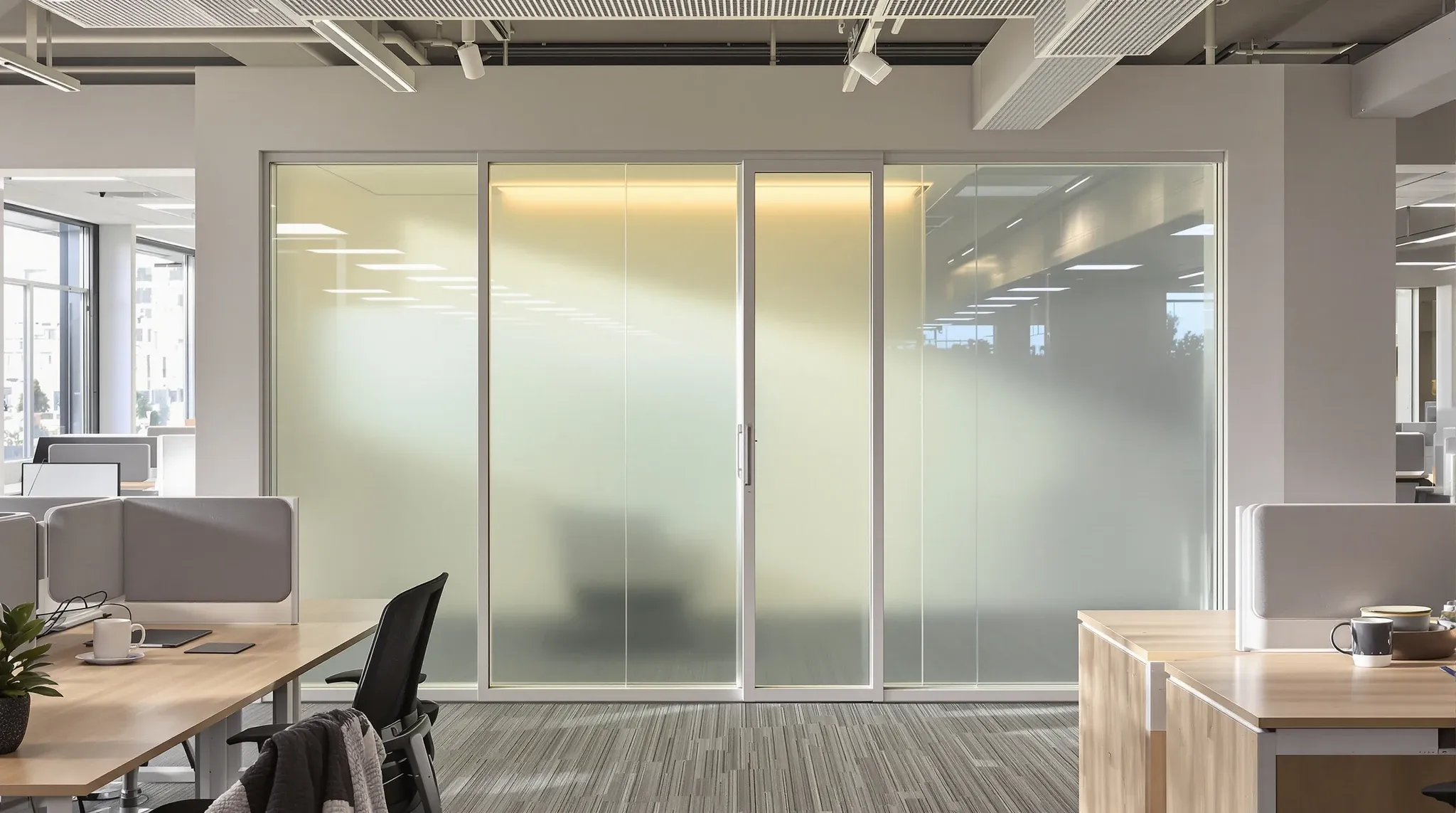
Frosted glass is often treated as a single product in office fit-out conversations, as if “frosted” were a spec line you could tick off on a drawing. In practice it is four different techniques that look broadly similar on install day, cost very different amounts, age at very different rates, and deliver different kinds of privacy. Choosing the right one is less about aesthetics than about matching the treatment to the room it is going into and the way that room gets used.
The useful way to plan frosted glass in a tenancy is to walk zone by zone rather than floor by floor. Some zones need only visual screening, some need privacy that shifts through the day, some need frost that also carries a brand graphic, and some need privacy that frost simply cannot deliver. The sections below work through each of those scenarios, then finish on durability and what the frost choice changes about the glass order before any panels are cut.
The four ways office glass gets “frosted” and why they are not equivalent
The four techniques commonly called “frosted” in commercial offices are acid etching, sandblasting, applied film, and digital print. Acid etch and sandblast both modify the surface of the glass itself, which means the frost is a permanent part of the panel. Film is a separate vinyl layer applied to the glass after install. Digital print is a UV-cured ink pattern, usually applied at the factory.
On install day, all four can look remarkably similar. Five years in, they do not. Acid etch and sandblast still look as they did on day one. Quality applied film is close behind, provided it was installed on a clean surface and sits in a low-contact area. Lower-grade film shows edge lifting, bubbling, or cleaning damage within a year. Digital print sits between the two, with its durability depending on the UV curing and the quality of the base ink.
The cost story runs in roughly the reverse direction. Film is the cheapest upfront option and the easiest to retrofit to existing glass. Acid etch and sandblast are the most expensive because the treatment happens at fabrication, which means the panels have to be specified correctly before they are cut. Digital print is usually the most expensive because of the UV process and the graphic work that typically sits behind it. Getting the choice right depends on how long the fit-out is expected to look new, how often the rooms change hands, and whether the frost is expected to carry any brand content at all.
Zones where you only need visual screening, not acoustic privacy
The most common frosted-glass application in Australian offices is not about sound at all. It is about visual screening: breaking the direct line of sight into a room without making it feel enclosed. Meeting rooms that sit along a busy open-plan floor, HR offices where people stop by during the day, executive offices that need to feel private without being cut off from the floor around them.
For these zones, any of the four frost techniques works. The decision is usually about durability and cost, not about privacy performance, because the acoustic performance of frosted glass is effectively the same as plain glass of the same thickness. Frost does not block sound. It only blocks sight. Tenants who specify frost hoping for acoustic gain are almost always disappointed, and the honest framing at scoping stage is that frost is a visual treatment and nothing else.
Zones where privacy needs to shift through the day
Some rooms need privacy some of the time and openness the rest of the time. A training room used for sessions in the morning and for casual work in the afternoon. A boardroom that runs sensitive meetings once a week and sits empty or open the rest of the time. A flexible meeting room that doubles as an all-hands space.
Static frost does not serve these rooms well, because it commits to one state. The options here are either partial frost (a band at seated head height that gives privacy when people are sitting down but leaves the upper and lower glass clear) or switchable glass, which is a different product category entirely and a noticeably bigger investment. For most offices, the partial-frost band is the answer that lands well. It is cheaper than switchable, it is permanent so it does not carry the maintenance overhead of an electronic system, and it breaks the most useful line of sight without closing the room off.
The band works because the direct line of sight between two people in a meeting room is almost always at roughly the same height regardless of whether they are standing or sitting. A well-placed frosted band at about 900 to 1400mm above floor level interrupts that sight line without killing the daylight transfer above or below. It is one of those small specification choices that delivers more real privacy than tenants expect, and it is the same technique that sits behind most well-designed executive offices with glass fronts, where the occupant needs to feel private without being cut off from the floor.
Zones where you want a brand or graphic element to carry the frost
Reception areas, feature walls, client-facing meeting rooms, and some executive office fronts are where frost starts to double as branding. A cut vinyl logo in frost finish, a custom pattern that sits behind the reception desk, a wayfinding band that runs the length of a corridor. These are cases where the frost is doing two jobs: visual privacy and brand expression.
For these zones, the technique matters more than anywhere else. A digital print can carry full-colour graphics and fine detail. A good applied film can carry simple logos and lines well, and can be updated if the brand changes. Acid etch is permanent and elegant but limited to a single finish and hard to refresh. The durability gap between these treatments plays out most visibly in reception spaces, because the brand element is usually what survives or degrades first on exit photos of the space.
Zones where frost is the wrong answer altogether
There are rooms where frost is not the right tool at all. A finance or legal room where the conversations need acoustic privacy, not visual screening. A medical consulting room where the privacy threshold is high enough that even brief line-of-sight exposure is a problem. A shared quiet room where people actively do not want to be seen at all while they are using it. In each of these cases, a solid wall (or a composite wall with a small high-level glazed panel for daylight transfer) delivers what the room actually needs, and frost is a distraction from the real answer.
The test for whether frost is the right tool is straightforward: is the problem visual, acoustic, or both? If it is visual, frost is a strong answer. If it is acoustic, frost is irrelevant and the question is really about glass thickness, double glazing, seals, and doors. If it is both, frost is a partial contributor at best and the room needs a different system. A glass partition that combines a solid base with frosted upper glass often serves these rooms better than a full frosted wall. In some offices, the needs of professional-services meeting rooms push the specification away from frost altogether and toward solid-base composite systems with dedicated acoustic detailing.
Durability over a long lease: what wears and what does not
On a five-year or longer lease, durability becomes the quiet driver of the frost decision. Acid etch and sandblast are essentially permanent on the glass surface. Short of the glass itself failing, they will still look the same at year ten as at year one. Applied film is the shortest-lived option, particularly in rooms where the glass gets frequent contact (door pulls, chair backs, leaning hands). Cheap film in a high-contact area shows visible wear within the first year, and full replacement on a busy floor is a predictable maintenance item rather than a surprise.
Digital print sits in the middle and is more sensitive to the quality of the curing than tenants realise. A well-cured digital print in a low-contact area can last the full lease. A poorly cured one in a high-contact area starts losing definition noticeably earlier. Cleaning also matters: aggressive cleaning products and abrasive pads take the surface off digital print faster than most commercial cleaning contracts allow for. On a lease where the cleaning routine is not being specified by the tenant, film and digital print both carry more risk than the factory treatments.
How the frost choice affects the glass order in the first place
If the frost treatment is acid etch, sandblast, or factory digital print, the glass has to be ordered with the treatment already specified. The panels arrive with the frost in place, which means any layout change after ordering carries real cost and lead-time implications. Factory treatments also sit on the longer end of the bespoke glass lead times, because the treatment is part of the fabrication run rather than a finishing step on site. Film is the flexible option because it is applied on site after the glass is in, which means the layout can change through install without wasting panels.
On a new fit-out where the layout is settled, the factory treatments are usually the better call because they last longer and carry no edge-lifting or bubbling risk. On a fit-out where the layout might still shift, or where the tenant wants the option to change the frost pattern later, film is the practical answer even with its shorter life. The way we tend to scope frost into a glass partition job is by asking which rooms are fixed in use and layout and which are still flexible, and matching the treatment to the certainty of the brief rather than to a single standard across the floor.
If you are thinking through where frost earns its place in a tenancy, or trying to pick between film, digital print, and a factory treatment for a specific room, we can help you work it through for your own layout and lease length. Call or email us and we will talk through what lasts and what does not for the rooms you actually need.
📞 Call us on 1300 60 93 93