
Every glass office eventually needs some form of visual treatment. Whether it is for privacy in a meeting room, manifestation compliance under the Building Code, branding at reception, or simply to reduce the fishbowl feeling that full-height clear glass can create, the glass surface will be treated. The question is not whether to apply something, but which treatment to choose, because the cost, durability, appearance, and maintenance profile of each option differ significantly, and the wrong choice often becomes apparent only after the treatment has been in place for a year or two.
The three most common treatments for glass office partitions are acid-etched frosting, applied vinyl film, and digitally printed graphics. Each has legitimate applications, each has limitations, and each ages differently over the life of a commercial tenancy. Choosing between them requires understanding not just how they look on installation day, but how they look and perform over the three to ten year lifespan of a typical office fitout.
This article compares the three options across durability, cost, visual quality, maintenance, and end-of-lease implications, and identifies where each one is the right choice and where it is not.
Acid-Etched Frosting: Permanent, Clean, and Expensive
Acid-etched frosting is a permanent surface treatment applied to the glass during or after manufacturing. The acid dissolves a thin layer of the glass surface, creating a uniform matte texture that diffuses light and obscures the view through the glass. The result is a clean, consistent frosted appearance that is integral to the glass itself rather than a surface application.
The primary advantage of acid-etched frosting is its permanence and durability. Because the frosting is in the glass, not on it, it cannot peel, bubble, discolour, or degrade over time. It does not require adhesive, so there is no risk of adhesive failure in hot or humid conditions. And it does not attract fingerprints or show marks in the way that smooth glass does, because the textured surface conceals minor contact marks.
The primary disadvantage is cost and inflexibility. Acid-etched glass costs significantly more than clear glass with applied film, and the frosted pattern is permanent. If the tenant’s branding changes, the room function changes, or the building standards change, the frosted glass cannot be modified without replacing the panel. For tenants on short leases or in spaces where the layout may change, the permanence of acid etching is as much a limitation as it is a benefit.
Acid-etched frosting also has make-good implications. Because the treatment is permanent, the glass cannot be returned to a clear state at lease end. If the landlord’s make-good requirement specifies clear glass, the etched panels may need to be replaced, which adds cost to the exit process.
Vinyl Film: Versatile, Affordable, and Time-Limited
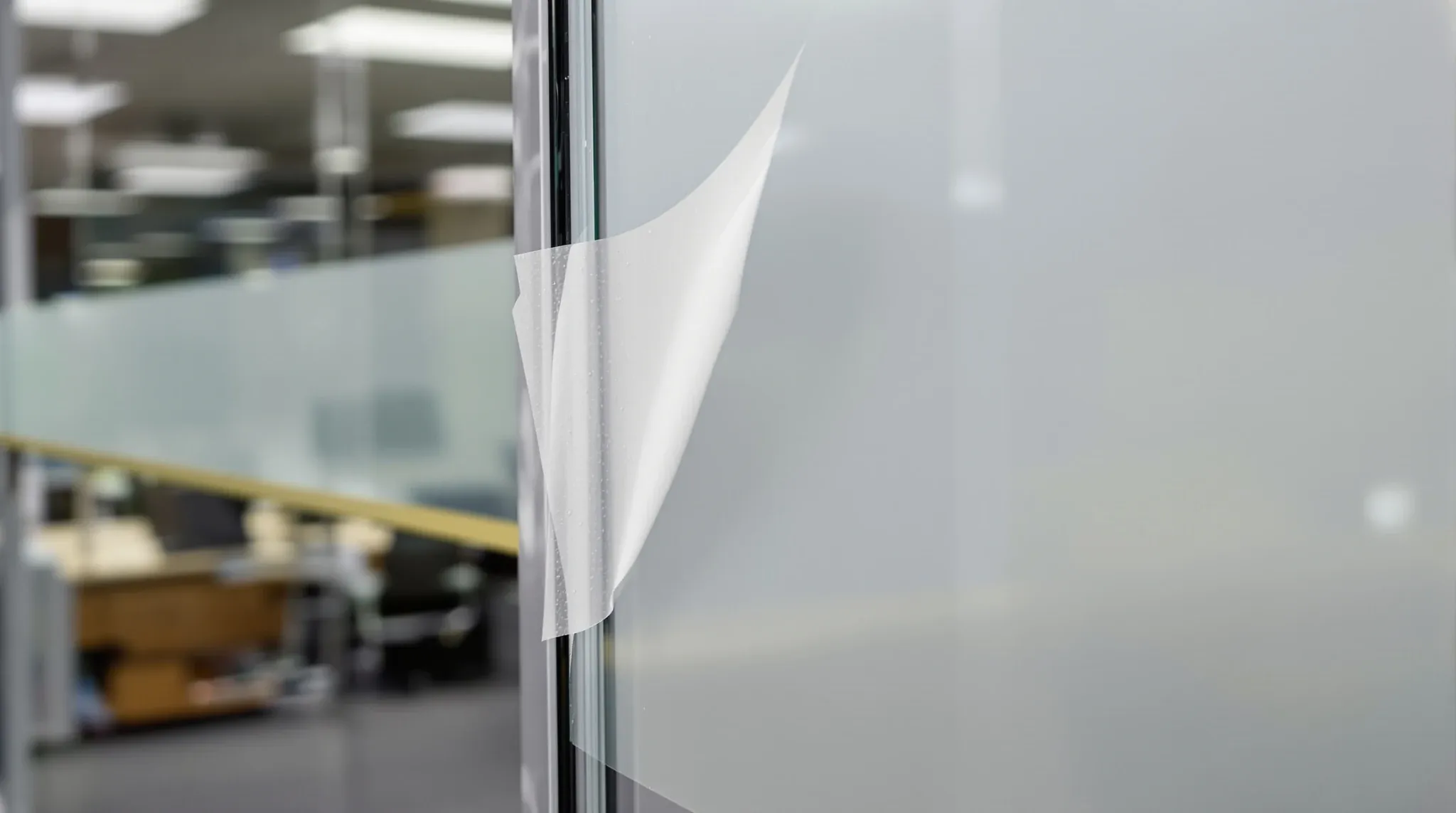
Vinyl film is the most commonly used treatment for glass partitions in commercial offices. It is applied directly to the glass surface using a pressure-sensitive adhesive, and it is available in a wide range of finishes including frosted, etched-effect, coloured, patterned, and branded designs. It is significantly cheaper than acid etching, it can be applied to existing glass without removing the panels, and it can be removed and replaced if the design or function of the room changes.
Frosted vinyl film delivers a visual result that is often indistinguishable from acid etching when viewed from a normal distance. Close up, the difference is visible, particularly in direct light where the film shows the adhesive layer and may exhibit a slight orange-peel texture on the surface. But for most commercial applications, frosted film provides a perfectly acceptable level of visual quality at a fraction of the cost of acid etching.
The limitation of vinyl film is durability. Even high-quality commercial films have a useful life of approximately five to eight years in interior applications. Over time, the adhesive degrades, particularly on glass that receives direct sunlight or is subject to temperature cycling. The degradation manifests as bubbling along the edges, a yellowing or clouding of the adhesive, and increasing difficulty of removal. Film that has been in place for more than seven or eight years can be extremely difficult to remove cleanly, often requiring heat, solvents, and significant labour to strip the adhesive residue from the glass.
For tenants on leases of five years or less, vinyl film is typically the best option because the film will remain in good condition for the lease term and can be removed relatively easily at lease end. For tenants on longer leases, the film may need to be replaced mid-lease, which adds a maintenance cost that should be factored into the original decision.
Digitally Printed Graphics: High Impact, Maintenance Dependent
Digitally printed vinyl allows custom graphics, branding, patterns, and imagery to be applied to glass partitions. The design is printed onto vinyl film and applied in the same way as standard frosted film. The result is a high-impact visual statement that can reinforce brand identity, create wayfinding cues, or add a decorative element to an otherwise plain glass surface.
The visual impact of digital print is its primary advantage. A reception area with branded glass graphics makes a different impression than one with plain frosted film. A boardroom with a custom pattern creates a distinct atmosphere. Conference rooms with printed manifestation markings can meet compliance requirements while also reinforcing the brand.
The disadvantage of digital print is that it ages more visibly than plain frosted film. The printed inks fade over time, particularly when exposed to UV light from external windows. The colours shift, the contrast decreases, and the overall appearance degrades in a way that is more noticeable than the subtle yellowing of plain frosted film. A printed graphic that looked crisp and vibrant on installation can look washed out and dated within three to four years if it is in a sun-exposed location.
Digital print is also more expensive than plain frosted film and less expensive than acid etching. The cost depends on the complexity of the design, the area covered, and the film quality. For branding applications, the design cost must also be factored in, including the preparation of print-ready artwork at the correct scale and resolution.
How Each Option Handles Manifestation Compliance
The Building Code of Australia requires manifestation markings on full-height glass that could be mistaken for an opening. The purpose is to make the glass visible to people walking through the space, and the markings must be within specific height bands and at sufficient contrast to be visible against varying backgrounds.
All three treatment options can meet manifestation requirements, but they do so differently. Acid-etched frosting at the correct height bands provides permanent manifestation that will never degrade or need replacement. Vinyl frosted film at the correct height bands provides manifestation that is reliable for the life of the film but may need replacement if the film degrades. Digitally printed patterns can meet manifestation requirements while also serving a decorative or branding function, but the print must be designed with the compliance requirements in mind, not just the visual intent.
The risk with film-based manifestation is that degraded film may no longer meet the contrast requirement. Film that has yellowed or bubbled may not provide sufficient visual contrast against the background, which technically puts the glass out of compliance even though the film is still physically in place. This is a maintenance issue that building managers should be aware of, because manifestation compliance is a safety requirement that is assessed during building inspections.
Cost Comparison Over a Lease Term
The upfront cost difference between the three options is significant, but the total cost over a lease term narrows the gap. Acid etching has the highest upfront cost but zero maintenance cost because the treatment is permanent and does not degrade. Vinyl film has the lowest upfront cost but may require replacement mid-lease on longer tenancies, and the removal cost at lease end adds to the total. Digital print sits between the two in upfront cost but has the highest potential maintenance cost because faded graphics are more visually unacceptable than faded plain frosting and tend to be replaced sooner.
For a five-year lease, vinyl film is typically the most cost-effective option. The film will last the lease term, the removal cost at lease end is modest, and the total cost including installation and removal is significantly less than acid etching. For a ten-year lease, acid etching becomes competitive because the film alternative would need to be replaced at least once during the lease, and the total cost of two film applications plus two removals approaches the cost of a single acid etch installation.
Digital print is most cost-effective when it serves a dual purpose, such as combining manifestation compliance with branding. In those cases, the cost of the print is offset against what would otherwise be two separate expenditures: one for compliance film and one for branding signage.
Make-Good and End-of-Lease Implications
At lease end, the tenant’s make-good obligation typically requires the removal of all tenant-installed finishes and the reinstatement of the glass to its original condition. For film-based treatments, this means stripping the vinyl and cleaning the adhesive residue from the glass surface. For acid-etched glass, this may mean replacing the etched panels with clear glass if the landlord requires clear glass as the base building condition.
Film removal cost depends on the age and condition of the film. Recently applied, high-quality film can usually be peeled off in large strips and the adhesive wiped clean with solvent. Older film, particularly film that has been exposed to sunlight, often tears during removal and leaves a stubborn adhesive residue that requires scraping, heat treatment, or chemical solvents to remove. The labour cost of removing old, degraded film from a large glass installation can be surprisingly high and should not be underestimated in the make-good budget.
The make-good implications should inform the original treatment choice. If the lease is short and the exit cost matters, vinyl film is the lowest-risk option because it can be removed relatively easily. If the lease is long and the glass will remain in place for the full term, acid etching may be more cost-effective despite the higher upfront cost because it eliminates the removal and replacement cycle entirely.
Choosing the Right Treatment for Each Application
The best approach is rarely to apply the same treatment to every glass surface in the office. Different rooms have different requirements, and the treatment should match the purpose. Meeting rooms that need privacy but may change function over the lease term are well served by vinyl frosted film. Reception areas where brand impact justifies the investment may warrant digitally printed graphics. Boardrooms and executive offices where quality and durability are paramount may justify acid-etched glass.
If you are specifying glass treatments for an office fitout and want to match the right option to each application, we can help. We work with all three treatment types across full fitouts and standalone partition projects, and we specify each treatment based on what will perform best over the full lease term.