
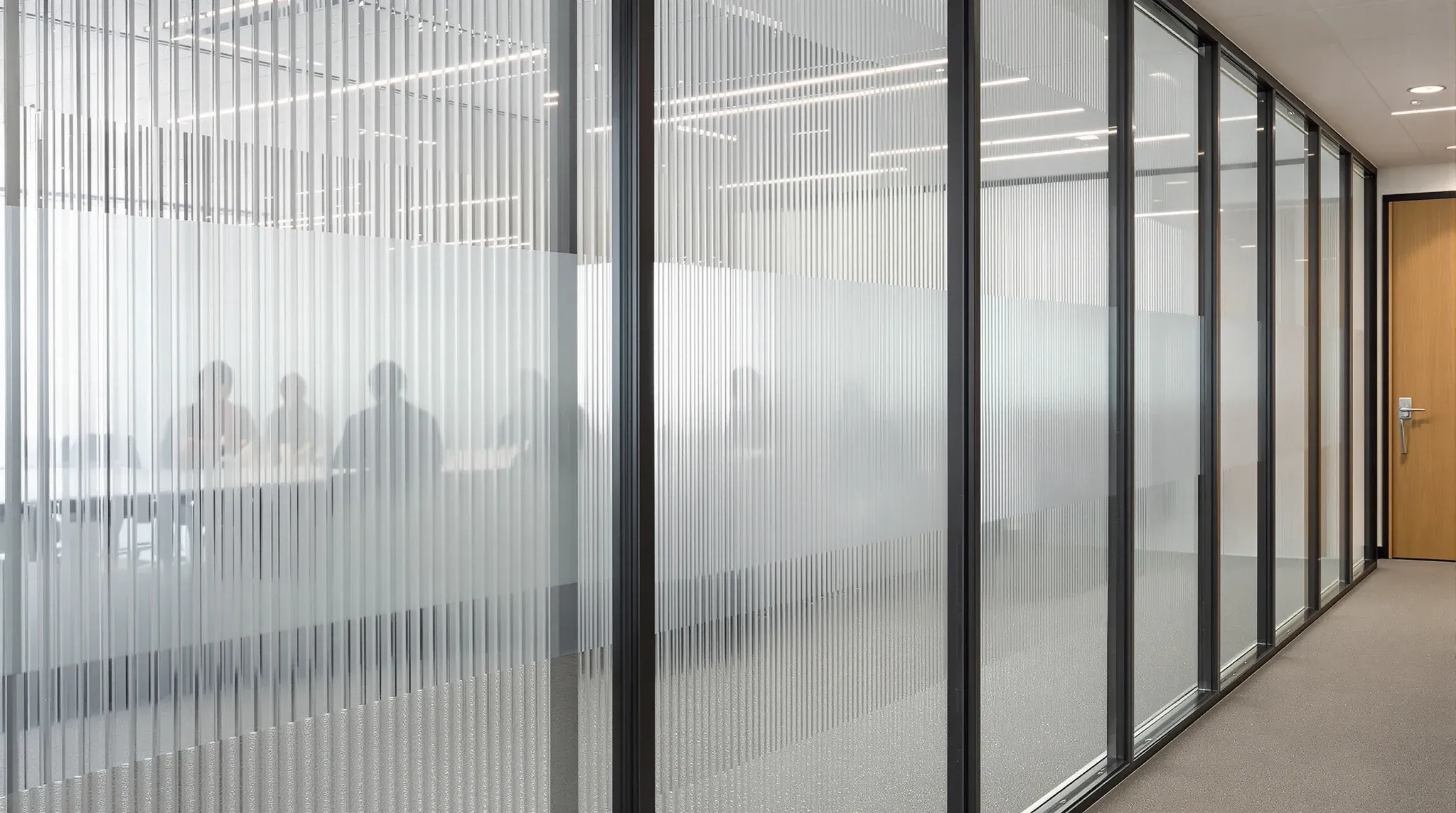
Patterned glass options for office partitions cover the spectrum between full transparency and full opacity, with each pattern type making its own trade-off between privacy, light transmission, acoustic neutrality, durability, and brand expression. The choice usually comes down to the specific room the glass sits in, the privacy demand at that location, how much daylight needs to travel through the panel, and the design intent of the wider fitout. There is no single best pattern. The right answer is the one that matches the room’s brief.
The terminology is also slightly inconsistent across the trade. Frosted, etched, fritted, sandblasted, and filmed are all sometimes used interchangeably, and a tenant comparing quotes can find that two contractors are actually offering different products under similar-sounding names. Knowing what each method does, and where each one earns its place, is what makes the partition specification cleaner.
The main patterned glass methods used in office partitions
Acid-etched glass is produced by treating one face of the glass with hydrofluoric acid or a similar etchant, leaving a uniformly opaque, satin-textured surface. The result is a soft, matt appearance that obscures the view through the panel while still transmitting most of the daylight. Acid etching is permanent and resists wear well, which makes it a good fit for high-traffic areas. The cost sits modestly above plain toughened glass.
Sandblasted glass is similar in visual outcome but produced mechanically by blasting fine abrasive particles against the surface. The result can be uniformly frosted or selectively patterned depending on whether the entire face or just specific zones are blasted. Sandblasted finishes are more vulnerable to surface marking from greasy contact, particularly fingerprints, which leave visible patches that are harder to clean than on smooth glass. The pattern we see most often is sandblasted finishes that look fine on day one and noticeably degraded by month eighteen in high-touch zones.
Ceramic-fritted glass uses a printed pattern, applied as ceramic ink onto the glass face and then fired into the surface during the toughening process. The pattern can be a regular dot or line array, a custom branded graphic, or a gradient between transparent and opaque. The fired finish is durable, resistant to cleaning chemicals, and effectively part of the glass rather than a coating, which makes it the most permanent option for office applications. Cost varies with the pattern complexity but typically sits 30 to 80 percent above plain toughened.
Applied film is a vinyl-based product fitted to the inside face of an installed glass panel. Patterns range from solid frost to custom branded graphics. Film is the cheapest option and the most flexible for late-stage changes, but it has a finite life (often 5 to 10 years before edge lift, scratching, or yellowing become apparent) and is more vulnerable to wear than the integral methods. For tenants on shorter leases or in spaces where the design language may shift mid-tenure, film delivers most of the visual benefit at a fraction of the cost.
Laminated interlayer glass uses a printed or coloured interlayer between two glass plies. The pattern is sealed inside the lamination, which makes it permanent, scratch-proof, and acoustically equivalent to plain laminated glass. This is the most durable patterned option and the highest-cost, typically only specified where the design intent calls for a feature glass element rather than a general-purpose partition.
Privacy performance compared
The four methods deliver different privacy outcomes depending on the lighting conditions and the distance between viewer and panel. Acid etching and sandblasting both deliver a uniformly diffuse surface that obscures detail at conversational distance and prevents direct sightlines. They do not produce full visual blackout. Silhouettes and movement remain perceptible behind the panel.
Ceramic-fritted patterns vary by pattern density. A 50 percent dot pattern reads as semi-transparent at a distance and as patterned at close range. A 70 to 80 percent dense pattern approaches the privacy of acid etching while still letting more daylight through. A custom logo or graphic may obscure specific zones more or less depending on print density across the panel.
Applied film with full frost performs similarly to acid etching for privacy. Patterned films, including bands at eye level over a transparent panel, deliver targeted privacy at the head-and-shoulders zone while leaving the upper and lower panel transparent.
For full visual blackout where the viewer should not perceive movement or shapes, none of these methods deliver. Tenants who need that level of privacy should specify solid panels or switchable privacy glass that goes opaque on demand.
Daylight transmission compared
Daylight transmission is the inverse of privacy density, broadly speaking. Plain glass transmits 80 to 90 percent of visible light depending on thickness and any coating. Acid-etched and sandblasted glass typically deliver 70 to 80 percent transmission, with the diffusion redistributing the light rather than blocking it. Ceramic-fritted glass varies with pattern density: a 50 percent dot pattern transmits roughly 60 to 70 percent of the daylight, a 70 percent dense pattern transmits around 40 to 50 percent.
For office applications where daylight needs to travel through partitions to reach the floor’s interior zones, acid etching or low-density fritting are usually the better choices. They obscure the view without absorbing as much of the light. High-density patterns and full-frost film reduce the daylight contribution and can leave internal zones reliant on artificial lighting even when the perimeter has good daylight access.
The decision is bounded by privacy. A meeting room that needs strong privacy will specify a denser pattern regardless of the daylight cost. A circulation-zone partition that needs only visual definition can afford a lighter pattern that maintains daylight transmission.
Acoustic performance and the patterned-versus-plain question
The patterning method has minimal impact on acoustic performance for most office applications. Acid etching, sandblasting, and ceramic fritting all leave the underlying glass unchanged in mass and stiffness, so the acoustic rating of the panel is the same as the equivalent plain panel. Acoustic performance is determined by the glass thickness, whether the panel is laminated, the perimeter sealing, and any door performance, not by the pattern.
Applied film is similar in this respect; the film adds negligible mass and does not affect the panel’s acoustic properties. A frosted-film 10-millimetre toughened panel performs acoustically the same as a plain 10-millimetre toughened panel.
Laminated interlayer glass is slightly different. The lamination itself improves acoustic performance compared to monolithic glass of the same total thickness, regardless of whether the interlayer is patterned. Tenants needing both visual privacy and acoustic upgrade often specify laminated patterned glass for that reason, with the pattern being a side benefit rather than the primary driver.
Application matching: which pattern for which space
Meeting rooms with privacy demand usually specify acid-etched or ceramic-fritted at moderate density, supported by a clear band at sitting eye-line for occupants to see who is approaching. The transparent band can be inverted (clear panel with a frosted band at eye level) or set as a horizontal stripe in an otherwise patterned panel.
Boardrooms and executive spaces tend toward higher-density patterns or full frost for stronger privacy, often with custom graphics or branded patterns that double as design features. The cost premium is easier to justify in feature rooms.
Workstation-zone partitions and circulation-zone glass usually run lighter patterning or remain plain, prioritising daylight and openness over privacy. A frosted band at chest height for safety marking is common, but full-panel patterning is rarely needed.
Kitchen and breakout zone partitions can use ceramic-fritted patterns as a brand-expression opportunity, with the partition working as both visual divider and design feature. Custom artwork, dot gradients, or branded graphics fit naturally in these spaces.
Bathroom-adjacent or change-room partitions need stronger privacy than office spaces and usually specify high-density frosting, full-frost film, or solid panels. Patterned glass is rarely sufficient for these locations on its own.
Care, longevity, and what tends to fail
Acid-etched and ceramic-fritted finishes are the most durable. They survive routine cleaning with standard glass cleaners, do not show fingerprint marks more than plain glass, and last the panel’s full service life without degradation. Ceramic fritting in particular is essentially indestructible at the pattern level; the ceramic ink is fired into the glass during toughening and cannot be scratched, peeled, or worn off.
Sandblasted finishes are more vulnerable. The blasted surface holds dirt and oil more readily than smooth glass, and aggressive cleaning can dull the finish over time. Sandblasted panels in high-touch zones often look worn within two to three years even with normal cleaning.
Applied film is the least durable. Edge lift, scratching, and discolouration are normal failure modes, and the film usually needs replacement within 5 to 10 years, sometimes sooner in high-traffic environments. The pattern we see most often is film replacement coming up at year five or six on tenancies that originally specified film as a temporary solution and then forgot it was temporary.
Laminated interlayer patterns last as long as the lamination itself, which is typically the panel’s full service life. Failure modes are limited to seal degradation in laminated units that lets moisture in, which is rare in interior partitions and well-managed in commercial-grade products.
Setting the specification on a fitout drawing
A clean specification calls out the patterning method, the visual reference (a specific manufacturer code, a sample, or a drawn pattern), the pattern density where applicable, the glass build-up underneath, and the privacy and daylight performance the design intends. Where a custom pattern is being printed or fritted, the artwork file and the print specification should accompany the drawing.
Where applied film is being used, the specification should note the film type, the application location (which face of the panel), and the warranty position. Where laminated interlayer glass is specified, the lamination should be defined to the manufacturer’s product range.
If you are specifying patterned glass for office partitions and want to talk through which method suits each room in the brief, we run patterned glass installations across the full glass partition scope, from acid etching and ceramic fritting through to applied film and laminated interlayer products.
📞 Call us on 1300 60 93 93