
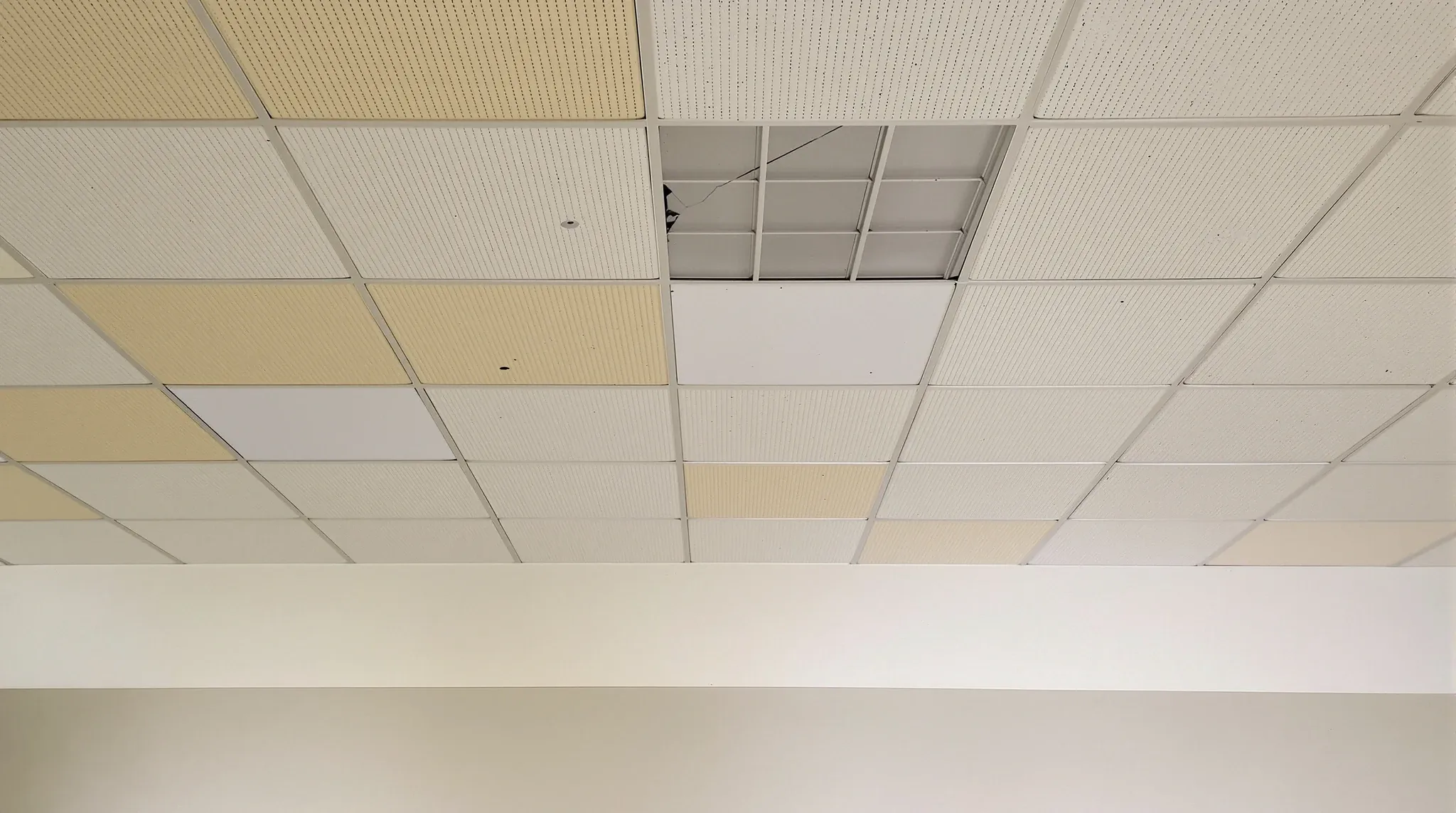
When landlords or their property managers walk through a tenancy at the end of a lease, the ceiling gets more attention than almost any other element. It is not the most expensive component of the fitout, and it is rarely the most modified. But it is the element that most clearly reveals how the fitout was managed, how well it was maintained, and how thorough the make good has been. A ceiling that looks good suggests the rest of the make good was done properly. A ceiling that looks neglected raises questions about everything else.
For tenants preparing for a final inspection, understanding why ceilings draw such disproportionate scrutiny and what landlords actually look for helps them prepare more effectively and avoid the deficiency findings that delay bond release and create disputes.
Why Ceilings Attract More Inspection Attention Than Any Other Element
Ceilings are the largest continuous surface in most commercial offices, and they are one of the few surfaces that is fully visible at all times. Walls are broken by doors, windows, and furniture. Floors are covered by carpet, desks, and chairs. But the ceiling is completely exposed, and every imperfection is visible to anyone who looks up, which is exactly what a landlord’s inspector does.
The ceiling is also a proxy for what happened above it during the tenancy. Every partition that was built connected to the ceiling grid. Every HVAC modification involved working in the ceiling void. Every lighting change required access through the ceiling tiles. Every data cable was routed above the ceiling. The condition of the ceiling at lease end reflects the cumulative impact of every piece of work that happened throughout the tenancy, which makes it a reliable indicator of the overall fitout quality and maintenance standard.
The ceiling grid controls more of the fitout than most tenants realise, and its condition at lease end tells the landlord whether the tenant understood that or not.
What Ceiling Damage Tells the Landlord About the Fitout
Different types of ceiling damage tell different stories, and experienced inspectors can read those stories quickly. Tiles that are cut at irregular angles indicate partitions that were built without proper regard for the ceiling grid alignment. Tiles that are stained in consistent patterns above enclosed rooms suggest HVAC condensation issues that were never addressed. Tiles that are cracked or broken near the edges of the grid indicate rough handling during maintenance access, suggesting that trades worked above the ceiling without adequate care.
Grid components that are bent, sagging, or misaligned indicate that the ceiling was subjected to loads it was not designed for, typically from services that were laid across the grid rather than properly supported from the slab above. These signs collectively paint a picture of how the fitout was managed and, by extension, what condition the rest of the premises is likely to be in.
For the landlord, a ceiling in poor condition means additional restoration work before the space can be relisted. It means potential delays to the incoming tenant’s fitout if the grid needs structural repair. And it means a negotiation with the outgoing tenant about who pays for the work, which is a conversation that landlords prefer to avoid by setting clear expectations from the start.
Tile Condition: The Most Visible and Most Contested Item
Ceiling tile condition is the single most commonly contested item in final inspections. The tenant may argue that the tiles have aged naturally over a five or seven-year lease and that their discolouration represents fair wear and tear. The landlord may argue that the tiles were damaged by the tenant’s fitout activities and need to be replaced at the tenant’s expense. The resolution depends on the condition report from the start of the lease, the nature of the damage, and the reasonableness of both parties’ positions.
Tiles that were cut to accommodate partitions are unambiguously the tenant’s responsibility. They need to be replaced with full tiles that match the building’s standard. Matching ceiling tiles for acoustics and appearance can be challenging if the building’s original tiles have been discontinued, which happens more frequently than tenants expect with fitouts that are more than five years old. In these situations, the landlord may require the tenant to replace an entire zone of tiles to achieve a consistent appearance rather than spot-replacing individual tiles that do not match.
Tiles that are discoloured but not physically damaged fall into the grey area of fair wear and tear. General yellowing from age is typically accepted. Staining from water, condensation, or dust accumulation above the tile is more likely to be attributed to the tenant’s fitout activities, particularly if the staining correlates with the location of HVAC modifications or partition connections.
Grid Alignment and Structural Integrity
The ceiling grid is a structural system that supports the tiles, integrates with the lighting, and provides the interface for partition heads and services access. When the grid is in good condition, it is invisible – the lines are straight, the tiles sit flat, and everything looks uniform. When the grid has been compromised, the imperfections are immediately visible as sagging lines, uneven tile heights, and gaps between tiles and grid members.
Grid damage most commonly occurs during the fitout process itself. Partitions that connect to the ceiling push the grid out of alignment if the connection is not properly detailed. Services contractors who work in the ceiling void and use the grid as a support for cables or tools bend the runners and cross-tees. Access panels that are opened and closed repeatedly for maintenance weaken the clips that hold them in place.
Restoring a damaged grid section is more involved than replacing a tile. The runners and cross-tees need to be straightened or replaced, the suspension wires need to be adjusted to bring the grid back to level, and the surrounding tiles need to be refitted to sit correctly within the repaired framework. This work is not expensive per square metre, but across a large tenancy it can add up to a significant make good line item.
Services in the Ceiling Void: What the Inspection Reveals
A thorough final inspection includes lifting ceiling tiles to inspect the void above. What the inspector finds there reveals whether the tenant’s services installations were done properly and whether the make good addressed the full scope of work, not just the visible surfaces.
Common findings include abandoned data cables draped across the grid, electrical junction boxes that were not decommissioned, HVAC ductwork that was modified but not restored to the original configuration, and fire-stopping at partition penetrations that was never completed or has been damaged during the make good strip-out. Each of these findings represents a deficiency that needs to be addressed before the landlord will accept the make good as complete.
How ceiling design affects lighting performance is also relevant at inspection, because changes to the ceiling configuration during the tenancy may have altered the lighting distribution. If the tenant modified or relocated light fittings, the inspection will assess whether the lighting has been restored to the base building standard or whether the modifications remain in place without approval.
How Ceiling Issues Escalate Make Good Costs
Ceiling-related make good costs escalate quickly because the work is repetitive across a large area. Replacing one ceiling tile costs very little. Replacing 200 tiles across a 500-square-metre tenancy, plus matching the tile specification, arranging delivery, and paying for the installation labour, becomes a significant expense. If the grid also needs repair in multiple locations, the cost increases further.
The escalation is amplified when the ceiling work is discovered late in the make good process. If the tenant’s contractor completes the strip-out and painting but leaves the ceiling for last, the painting may need to be touched up after the ceiling work is finished. If ceiling tile replacement requires access from below that disturbs the newly cleaned floor, the floor may need to be re-cleaned. These are small costs individually, but they reflect a programme that was not sequenced correctly.
Understanding commercial ceiling systems helps tenants appreciate why ceiling restoration is a skilled task rather than a cosmetic one. The work involves matching the grid to the building’s standard, aligning tiles to achieve a uniform appearance, and ensuring that the ceiling performs acoustically and visually to the level the landlord requires.
Preparing Ceilings for Inspection Before the Landlord Arrives
The most effective preparation is to conduct a pre-inspection of the ceiling as part of the make good programme, before the landlord’s formal inspection. This pre-inspection should cover every tile for damage, discolouration, and correct fit within the grid. It should check the grid alignment in every zone, particularly where partitions were connected. It should verify that the ceiling void has been cleared of abandoned cables, materials, and debris. And it should confirm that any HVAC or fire system modifications have been reversed or restored to the base building standard.
Where tile replacement is required, ordering the tiles early is critical. Matching tiles from the building’s original specification can take several weeks if the tiles need to be sourced from the manufacturer, and the delay can push the make good completion past the lease expiry. Identifying the correct ceiling tile type during the scoping phase, rather than after the strip-out is complete, gives the procurement process the lead time it needs.
Addressing ceiling issues proactively also improves the relationship with the landlord during the final inspection. A ceiling that is clearly in good condition signals that the tenant has taken the make good seriously, which sets a positive tone for the rest of the inspection and makes the landlord more inclined to accept minor imperfections elsewhere.
If your make good includes ceiling restoration and you want it done to the standard that passes inspection the first time, we can manage the tile matching, grid repair, and void clearance as part of the full make good programme.
Call us on 1300 60 93 93