
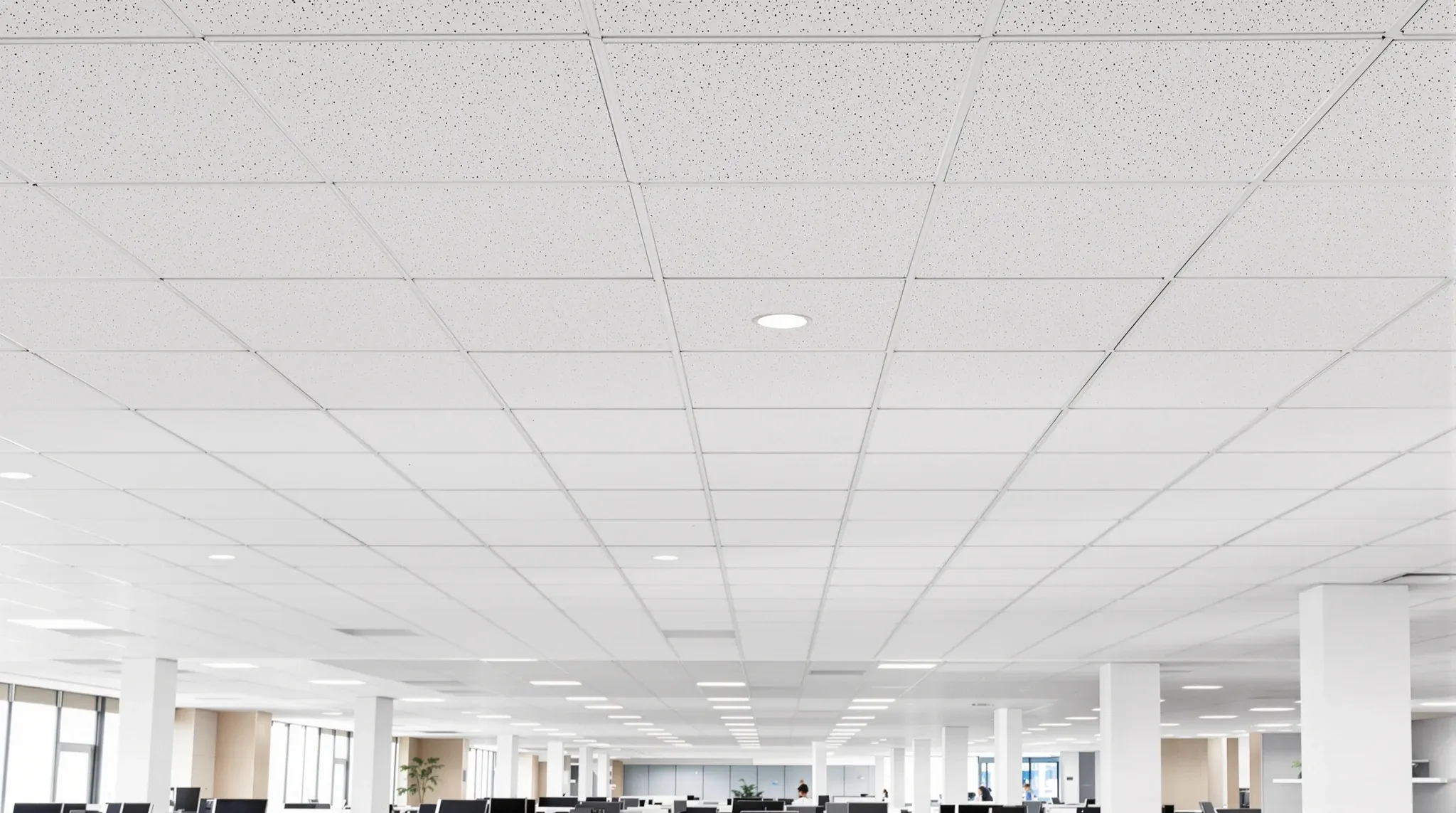
Ceiling tiles are one of the most frequently replaced components in a commercial office, and they are also one of the most frequently mispecified. The selection is often driven by price and availability, with the assumption that one white tile is much like another. In practice, the tile specification affects how the office sounds, how easily services can be maintained, how the ceiling ages over the lease term, and how the space performs when the air conditioning creates moisture or the building moves through temperature cycles. Choosing the right tile means understanding the competing priorities and making a deliberate decision about which qualities matter most for each area of the office.
The three main selection criteria, acoustic performance, services access, and maintenance, each pull in slightly different directions. A tile optimised for acoustics may be heavier and more fragile than one optimised for easy handling. A tile that provides good acoustic isolation may resist access to the void above. A tile that is easy to maintain and replace may not deliver the acoustic performance that a meeting room requires. Navigating these trade-offs is what makes tile selection a more considered decision than it first appears.
Why Tile Selection Matters Beyond Appearance
From below, most ceiling tiles look similar. They are white, flat, and uniform, and the differences between products are not visible to the casual observer. The performance differences are felt rather than seen. A room with high-absorption tiles sounds noticeably different from the same room with basic tiles, because the reverberation is lower, the background noise is controlled, and conversations are clearer. A tile that sags in humid conditions looks presentable on installation day but develops a visible bow within months that makes the ceiling look neglected.
The tile’s interaction with services access affects the ongoing cost and disruption of maintaining the office. In a suspended ceiling, tiles need to be lifted regularly to access cabling, ductwork, valves, and fire systems in the void above. Tiles that are heavy, fragile, or difficult to remove without damage increase the time and cost of every maintenance visit, and they generate replacement costs every time a tile is broken during access. Over a five or ten-year lease, the cumulative cost of replacing damaged tiles can exceed the initial cost difference between a durable tile and a fragile one.
The ceiling system as a whole is only as good as its weakest component, and the tile is the component that degrades most visibly over time. Selecting a tile that balances the acoustic, access, and durability requirements of the specific office delivers better value over the lease term than defaulting to the cheapest available option.
Acoustic Performance as a Selection Criterion
The acoustic performance of a ceiling tile is measured by two properties: absorption (how much sound the tile absorbs rather than reflects) and attenuation (how much sound the tile prevents from passing through to the void above). For most office applications, absorption is the more important property because it directly affects the noise environment experienced by the occupants. Attenuation matters in situations where the ceiling void is shared between adjacent rooms and sound could travel over the partition through the void.
Tiles are rated for absorption using the Noise Reduction Coefficient (NRC), which ranges from 0 (total reflection) to 1 (total absorption). Basic tiles typically rate between 0.50 and 0.60, standard acoustic tiles between 0.65 and 0.75, and high-performance acoustic tiles above 0.80. The practical difference between these ranges is significant. A room with NRC 0.80 tiles sounds noticeably quieter and more comfortable than the same room with NRC 0.55 tiles, because the higher-absorption tiles prevent more reflected sound from building up in the space.
The acoustic specification should be matched to the zone. Open-plan work areas, meeting rooms, and phone-intensive zones benefit from higher-absorption tiles. Corridors, utility areas, and low-occupancy zones can use standard tiles without acoustic compromise. This zoned approach directs the acoustic investment where it has the most impact and avoids over-specifying in areas where the occupants will not notice the difference.
How Tile Type Affects Services Access
Services access through the ceiling is a routine maintenance requirement that happens more often than most tenants expect. Data cabling changes, air conditioning adjustments, sprinkler inspections, and fire services testing all require tiles to be lifted, moved aside, and replaced. The ease with which a tile can be removed and reinstated without damage affects the cost and disruption of every one of these maintenance events.
Standard mineral fibre tiles are relatively fragile. They can break if they are bent, twisted, or dropped during removal, and the broken edges are difficult to repair to a presentable standard. Over time, frequently accessed tiles develop chipped edges and surface damage that make the ceiling look worn even though the rest of the system is in good condition. For areas where access is frequent, such as above IT rooms, plant areas, and zones with regular cabling changes, selecting a more durable tile type or designating specific tiles as access tiles can reduce the replacement rate.
Some tile systems use tegular or concealed-edge profiles that create a cleaner visual appearance than standard lay-in tiles but are harder to remove because the tiles interlock or overlap at the edges. While visually superior, these profiles increase the time needed to access the void and the risk of damaging adjacent tiles during removal. For offices where frequent adjustments after occupation are expected, standard lay-in tiles may be the more practical choice despite the simpler appearance.
Maintenance and Durability Over the Lease Term
Ceiling tiles are subject to ongoing wear from handling, environmental conditions, and the normal use of the office. The most common maintenance issues are staining from water leaks or condensation, sagging from moisture absorption, edge damage from tile removal and replacement, and discolouration from age, UV exposure, or air quality. A tile that resists these effects over the lease term reduces the maintenance burden and keeps the ceiling looking presentable without frequent replacement.
Moisture resistance is one of the most important durability factors for ceiling tiles in Sydney offices. Humidity from the external environment, condensation from air conditioning systems, and occasional water leaks from pipework or sprinkler systems all expose ceiling tiles to moisture. Standard mineral fibre tiles absorb moisture, which causes them to sag, stain, and eventually crumble if the exposure is prolonged. Tiles with moisture-resistant formulations or hydrophobic surface treatments maintain their form and appearance under the same conditions.
The cost difference between standard and moisture-resistant tiles is modest relative to the cost of replacing tiles that have sagged or stained. In Sydney’s climate, where humidity levels are often high enough to affect ceiling tiles even in air-conditioned spaces, specifying moisture-resistant tiles across the floor is a practical precaution that avoids the most common cause of ceiling deterioration over the lease term.
Moisture Resistance and Sag Performance
Sag is the single most common aesthetic problem with ceiling tiles in occupied offices. It occurs when the tile absorbs moisture from the ambient air or from condensation above the tile, causing the mineral fibre to expand and the tile to bow downward. The sag is most visible in the centre of the tile, where the unsupported span is greatest, and it is particularly noticeable under uniform overhead lighting because the shadow cast by the bowed tile contrasts with the flat tiles around it.
The sag resistance of a tile is determined by its formulation and its moisture absorption rate. High-quality tiles use formulations that limit moisture absorption and maintain dimensional stability in humid conditions. Budget tiles use simpler formulations that absorb moisture more readily and are more prone to sagging. The difference in sag performance is not visible at installation but becomes apparent over months and years of exposure to the office environment.
In areas where the ceiling void above the tiles is particularly humid, such as zones near external walls, above kitchens, or beneath roof-level plant rooms, the risk of tile sag is higher and the specification needs to account for it. Using tiles with documented sag resistance ratings, rather than relying on generic product descriptions, ensures the tile will maintain its form under the specific conditions of the building. Reducing fitout risk includes making material selections that anticipate the conditions the materials will face, not just the conditions on installation day.
How to Balance Competing Priorities in Tile Selection
The ideal ceiling tile would provide excellent acoustic absorption, superior durability, easy access, and low cost. In practice, these priorities compete, and the selection involves trade-offs. Higher-absorption tiles tend to be softer and more porous, which makes them less durable and more susceptible to moisture. More durable tiles tend to have denser, harder surfaces that reflect more sound. Tiles with the best access characteristics, lightweight and resilient, may not provide the acoustic mass needed for high-performance applications.
The practical approach is to prioritise the criteria that matter most for each zone and select accordingly. In a meeting room where acoustic performance is critical, a higher-absorption tile is worth the slight increase in fragility because the room is not accessed as frequently as an open-plan zone. In an IT area where tiles are lifted weekly for cabling changes, a more durable, access-friendly tile is worth the modest reduction in acoustic performance because the access frequency is the dominant operational concern.
Getting the right advice on which tiles balance these priorities for a specific office environment is one of the practical benefits of working with a fitout team that installs ceilings regularly. The theoretical performance data from product data sheets does not always translate directly to on-site conditions, and experience with how different tiles perform in real Sydney office environments, across different building types and lease terms, informs better selection decisions than data sheets alone.
Matching the Tile to the Zone
The most effective tile selection strategy uses different tiles in different zones, matched to the acoustic, access, and durability requirements of each area. This is more cost-effective than specifying the highest-performance tile everywhere, because it directs the investment to the areas where the tile’s properties will have the most impact, and it avoids paying for performance that will not be noticed in less demanding zones.
A typical zoned approach might specify high-absorption tiles in open-plan work areas and meeting rooms where acoustic performance is the priority, standard acoustic tiles in corridors and circulation areas where moderate absorption is sufficient, and moisture-resistant tiles in kitchen zones, bathrooms, and areas prone to condensation. Access tiles or metal-faced tiles might be specified in IT zones and above plant rooms where frequent access and durability are the primary concerns.
What experienced fitout teams assess before quoting includes the ceiling condition and the tile specification, because the right tile selection affects the acoustic outcome, the maintenance cost, and the longevity of the ceiling system. Getting the selection right at the design stage is one of the simplest ways to improve the long-term performance of the office without adding significant cost to the fitout.
If you need help selecting ceiling tiles that balance acoustics, access, and durability for your specific office, we can assess your space and recommend a specification that delivers the best result for your budget and lease term.
Call us on 1300 60 93 93