
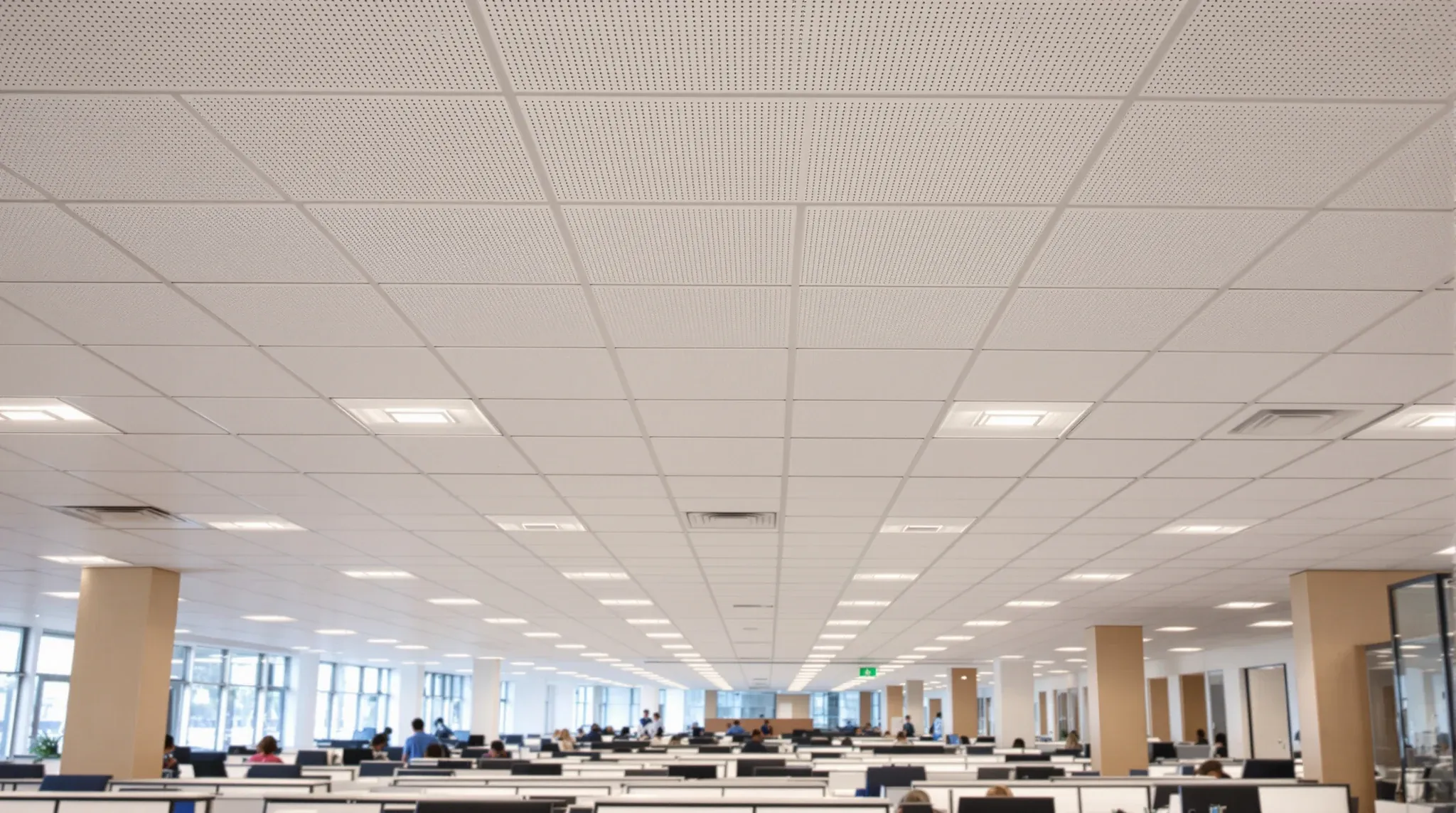
Acoustic ceilings are specified in most commercial office fitouts, but the term itself is used loosely enough that many tenants are not entirely sure what it means or what they are getting. At its simplest, an acoustic ceiling is a suspended ceiling system that uses tiles designed to absorb sound energy rather than reflect it. The effect is a quieter, more comfortable space where conversations are clearer, background noise is lower, and the overall sound environment supports rather than undermines the work happening below.
The reality is more nuanced than that summary suggests, because the performance of an acoustic ceiling depends on the tile specification, the installation quality, the ceiling void conditions, and the relationship between the ceiling and every other surface in the room. Getting a good acoustic outcome from a ceiling system requires understanding what the ceiling actually does to sound, what the ratings mean in practice, and where the ceiling’s performance ends and other factors take over.
What Makes a Ceiling Acoustic
All ceiling tiles interact with sound, but not all of them are designed to manage it. A standard plasterboard ceiling or a basic vinyl-faced tile reflects most of the sound energy that hits it back into the room below, contributing to reverberation and raising the overall noise level. An acoustic ceiling tile is manufactured from a porous or fibrous material, typically mineral fibre, glass wool, or a composite, that allows sound energy to enter the tile surface and be converted into heat through friction within the material’s structure.
The key property that makes a ceiling tile acoustic is its sound absorption coefficient, which measures how much of the incident sound energy the tile absorbs rather than reflects. A tile with a high absorption coefficient absorbs most of the sound that reaches it, reducing the amount of reflected energy in the space below. A tile with a low coefficient reflects most of the sound back, contributing to the noise buildup that makes open-plan offices feel loud even when nobody is being especially noisy.
Acoustic ceiling tiles are available across a wide range of absorption levels, from basic tiles that provide modest improvement over a hard surface to high-performance tiles that absorb the vast majority of incident sound energy. The appropriate level depends on the room type, the background noise level, and the acoustic targets for the space. Not every room needs a high-performance tile, and in some applications a standard acoustic tile provides more than enough absorption for comfortable use.
How Acoustic Ratings Work and What They Mean in Practice
Acoustic ceiling tiles are rated using two main metrics: the Noise Reduction Coefficient (NRC) and the Ceiling Attenuation Class (CAC). These measure different things, and understanding the distinction helps tenants make better decisions about which tiles to specify and where.
NRC measures sound absorption, which is the tile’s ability to absorb sound energy within the room. A tile with an NRC of 0.70 absorbs 70 percent of the sound energy that hits its surface and reflects 30 percent. Higher NRC values mean more absorption, which translates to lower reverberation and a quieter sound environment within the space. NRC is the more important rating for open-plan offices, breakout areas, and any space where controlling in-room noise is the priority.
CAC measures sound attenuation, which is the tile’s ability to block sound from passing through it to the space on the other side, typically the ceiling void. A higher CAC value means less sound passes through the tile, which matters in multi-tenancy buildings or in offices where the ceiling void is shared between adjacent rooms. CAC is less relevant in single-tenancy fitouts with solid partition walls that extend to the slab, because the sound path through the ceiling void is already blocked by the partition.
In practice, most commercial acoustic tiles offer an NRC between 0.55 and 0.90, and a CAC between 30 and 40. These ranges cover the vast majority of office applications. The mistake tenants make is over-specifying CAC in situations where NRC is what they actually need, or vice versa, because the two properties are often conflated under the general label of acoustic performance.
The Difference Between Absorption and Insulation
Absorption and insulation are fundamentally different acoustic properties, and confusing them leads to ceiling specifications that do not deliver the intended result. Absorption reduces the noise within the room by converting reflected sound energy into heat. Insulation reduces the noise that passes from one space to another by blocking the transmission path. An acoustic ceiling tile can provide both properties, but the relative contribution of each depends on the tile construction and the overall ceiling system.
A highly absorptive tile is ideal for reducing reverberation and lowering the background noise level in open-plan areas, corridors, and communal spaces. It makes the room quieter for the people inside it. A tile with good insulation properties is more useful in situations where the ceiling void is a path for sound to travel between rooms, because it reduces the amount of sound that leaks over partition walls through the shared ceiling void.
Most commercial acoustic tiles are optimised for absorption because that is the property that has the most noticeable effect on the everyday acoustic experience of the office. Insulation is typically provided by other elements of the ceiling system, such as acoustic blankets in the void, partition walls that extend above the ceiling line, or dedicated sound barriers above the tiles. Relying solely on the tile for inter-room insulation is rarely effective, because the tile is only one element in a more complex acoustic path.
Why Tile Selection Matters More Than Most Tenants Expect
Tenants often treat ceiling tiles as a commodity, selecting them based on price and availability rather than acoustic performance. This is understandable when the ceiling is not the focus of the fitout, but it can lead to a sound environment that undermines the investment in partitions, lighting, and furniture. The ceiling is the single largest absorptive surface in most offices, and the tile specification has more effect on how the space sounds than almost any other single decision in the fitout.
The difference between a budget tile with an NRC of 0.55 and a higher-specification tile with an NRC of 0.85 is substantial in a real office environment. The higher-rated tile absorbs roughly 50 percent more of the sound energy that reaches it, which translates to noticeably lower reverberation, reduced background noise buildup, and better speech clarity at normal conversation distances. In a busy open-plan office, this difference affects how many people can work comfortably without raising their voices.
Where budget is a concern, zoning the tile specification can deliver good acoustic outcomes without the cost of a high-performance tile across the entire floor. Higher-rated tiles in open-plan work areas, meeting rooms, and zones adjacent to phone-intensive teams, with standard tiles in corridors, utility areas, and low-occupancy zones, targets the investment where it has the most impact on the occupants who need it most.
How Installation Quality Affects Acoustic Outcomes
Even the best acoustic tile will underperform if the installation is poor. The most common installation issues that degrade acoustic performance are gaps between tiles, tiles that do not sit flat in the grid, and tiles that have been cut or damaged to accommodate services penetrations. Each of these creates a path for sound to bypass the tile surface, reducing the effective absorption of the ceiling system.
Gaps between tiles and the grid, even small ones, allow sound to pass directly into the ceiling void rather than being absorbed by the tile face. In rooms where the ceiling is providing part of the acoustic separation between adjacent spaces, these gaps reduce the effective insulation of the ceiling and increase the noise that transfers through the void. Ensuring that tiles sit properly in the grid and that perimeter cuts are tight against the wall or bulkhead maintains the acoustic integrity of the ceiling plane.
Services penetrations are the other common source of acoustic compromise. When a sprinkler head, diffuser, or data point passes through a ceiling tile, the penetration must be sealed to maintain the acoustic performance of the tile. An unsealed penetration, even a small one, provides a direct acoustic path through the ceiling that can degrade the performance of the surrounding tiles. In practice, many penetrations are left unsealed because the installer is focused on the service itself rather than the acoustic seal, and this kind of detail is one of the things that ages poorly in a fitout as seals degrade and gaps widen over time.
When Standard Tiles Are Enough and When They Are Not
For many office applications, a standard commercial acoustic tile with an NRC in the range of 0.55 to 0.65 provides adequate acoustic absorption. This level of performance is typically sufficient for general open-plan areas where the primary goal is to manage reverberation and keep the background noise at a comfortable level. When combined with carpet flooring, soft furnishings, and a reasonable amount of absorptive material on the walls, a standard acoustic tile contributes to a sound environment that most occupants will find acceptable.
Higher-specification tiles become worth considering in spaces where the acoustic demands are greater. Call centres, open-plan areas with high occupancy density, and collaborative workspaces where multiple conversations happen simultaneously all benefit from tiles with NRC values of 0.80 or above. In these environments, the standard tile does not absorb enough energy to keep the noise floor from climbing to uncomfortable levels as the number of active sound sources increases.
Meeting rooms and private offices present a different set of requirements. In these spaces, the ceiling needs to provide both good absorption within the room and reasonable attenuation to the spaces outside. A tile with good NRC but poor CAC will make the room comfortable to be in but will not prevent conversations from being heard in adjacent areas through the ceiling void. Where privacy matters, the tile specification needs to address both properties, and the ceiling void treatment above the room also needs to be considered as part of the overall acoustic solution.
Acoustic Ceiling Performance Beyond the Tile
The tile gets most of the attention in acoustic ceiling conversations, but the overall performance of the ceiling system depends on several factors that sit outside the tile specification. The ceiling void depth, the presence of acoustic blankets or barriers above the tiles, the quality of the grid installation, and the treatment of junctions between the ceiling and partitions all contribute to how the ceiling performs acoustically.
A deeper ceiling void tends to produce better low-frequency absorption because the tile is further from the reflective soffit above. In shallow voids, the soffit reflects low-frequency energy back through the tile, reducing the effective absorption at those frequencies. This is one of the reasons that identical tiles can perform differently in different buildings, and why acoustic specifications based on tile data sheets do not always translate directly to on-site performance.
Acoustic blankets laid on top of the ceiling tiles, typically glass wool or polyester batts, improve both the absorption and the insulation of the ceiling system. They are particularly useful in areas where the ceiling void connects adjacent rooms and sound transfer through the void is a concern. For offices where fitout changes may trigger new compliance requirements, including acoustic compliance, the ceiling system as a whole needs to be considered, not just the tile face that is visible from below.
If you are planning a fitout and want to understand what acoustic ceiling specification will deliver the right result for your office, we can assess your space and recommend a system that matches the way your teams actually work.
Call us on 1300 60 93 93