
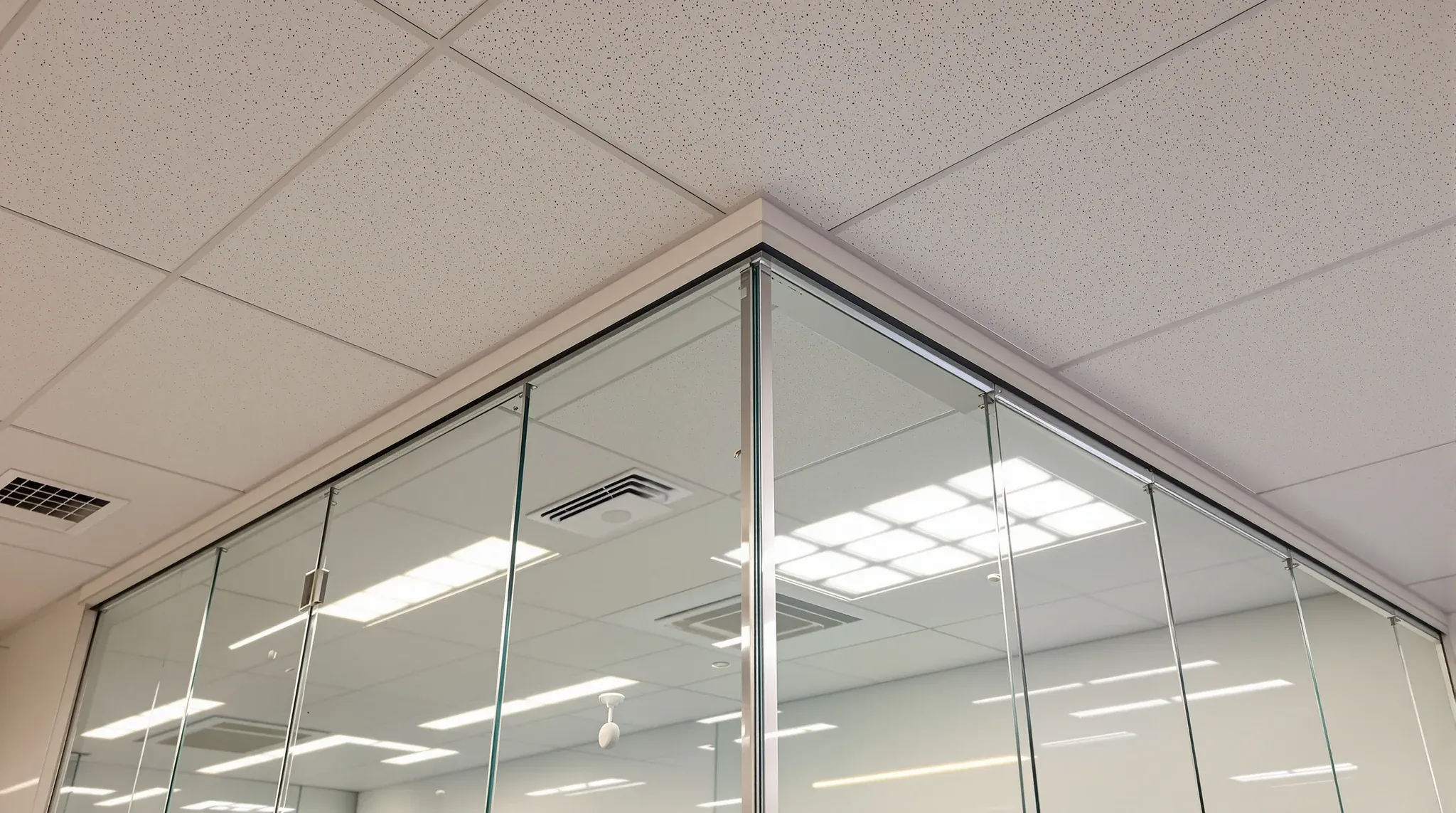
Most tenants spend more time choosing paint colours than they do thinking about the ceiling grid, which is understandable because the grid is not the part of the ceiling that anyone looks at. But the grid is the part that controls how the ceiling works. It determines where partitions can land, where lights sit, where air conditioning diffusers go, and how easily services can be accessed after the fitout is complete. When the grid is right, none of this is visible. When it is wrong, the consequences show up in awkward partition junctions, misaligned lighting, limited services access, and compromised ceiling performance that persists for the life of the tenancy.
The ceiling grid is the metal framework, typically aluminium or steel tee-sections, that is suspended from the structural soffit and holds the ceiling tiles in place. It looks simple, and in concept it is. But the grid module, the grid alignment, and the way the grid coordinates with every other element of the fitout are decisions that affect cost, programme, and function more than most tenants realise until those decisions have already been locked in.
Why Nobody Thinks About the Grid Until Something Goes Wrong
The ceiling grid is invisible in the finished office. Once the tiles are in place, the grid becomes a thin line between tiles that most people stop noticing within a week of occupation. Because it is visually neutral, it receives almost no attention during the design brief or tenant review process. The conversation focuses on tile colour, tile acoustic rating, lighting type, and ceiling height, all of which are important but all of which depend on the grid to function properly.
Problems with the grid tend to surface during construction rather than during design. A partition wall that was drawn on the layout does not align with the grid module, so the ceiling needs to be cut and patched to accommodate it. A lighting layout that looked clean on the reflected ceiling plan does not fit the actual grid spacing, so fixtures end up shifted or resized. A diffuser location that worked in the mechanical design does not land on a tile centre, so the air distribution is compromised. Each of these issues adds cost and time to the programme, and each could have been avoided by starting with the grid.
The reason the grid gets overlooked is that it sits between the architectural design and the services coordination, which means it falls between the responsibilities of different consultants. The architect draws the layout, the mechanical engineer designs the air conditioning, the electrical engineer specifies the lighting, and the ceiling grid is expected to accommodate all of them. When nobody takes ownership of the grid as a coordination tool, the clashes only become apparent when the trades arrive on site.
How Grid Module Affects Partition Placement
The grid module, which is typically 600mm by 600mm or 1200mm by 600mm in Australian commercial offices, determines the points at which partition walls can meet the ceiling without requiring cutting, patching, or custom framing. When a partition head aligns with a grid line, the junction is clean, the acoustic seal is straightforward, and the ceiling tiles on either side of the partition remain intact. When the partition falls mid-tile, the tile needs to be cut, the grid may need a supplementary cross tee, and the acoustic seal at the head of the partition is harder to achieve.
This becomes significant in offices with multiple enclosed rooms, because every room boundary intersects the ceiling. If the room layout was designed without reference to the grid module, the number of cut tiles and modified grid sections can be substantial. Each modification adds labour cost, creates a potential acoustic weak point, and produces a less clean visual result than a partition that lands on a grid line.
The practical solution is to design the room layout on the grid module from the start. This does not mean every wall must fall exactly on a grid line, but it does mean the designer should have the grid drawn on the floorplan before finalising partition positions. Where a partition cannot align with the grid, the modification should be planned rather than discovered on site, because partition design mistakes at the ceiling junction are among the more common causes of fitout delays and compliance issues.
The Relationship Between Grid and Lighting Layout
Lighting in a suspended ceiling is either recessed into the tile module or surface-mounted below the tile plane, and in either case the grid determines where the light fittings can go. Standard LED panel lights are designed to fit into the tile module, typically replacing a ceiling tile entirely. The most common sizes are 600mm by 600mm panels that replace a single tile, or 1200mm by 300mm linear panels that sit within a standard tile space. If the grid module does not match the lighting specification, the fittings will not drop in cleanly and the installation becomes more complex.
The grid alignment also affects the uniformity of the lighting layout. A reflected ceiling plan may show an evenly spaced array of light panels, but if the grid is not aligned to the room boundaries or is offset from the partition layout, the lights can end up closer to one wall than another, creating uneven illumination. In open-plan areas this may not be noticeable, but in enclosed rooms with glass fronts the asymmetry is visible and can look poorly finished.
Coordinating the lighting layout with the grid module is one of the things that should happen early in the fitout but often does not. The lighting designer works from the room layout, the ceiling installer works from the grid plan, and if the two are not reconciled before construction starts, the discrepancies emerge during installation. At that point, the options are to modify the grid, modify the lighting, or accept the mismatch, none of which is ideal.
How Grid Quality Affects Long-Term Performance
The quality of the grid system itself, the material, the profile, the connection method, and the hanger spacing, affects how the ceiling performs over the life of the tenancy. A well-installed grid with adequate hanger density will remain level, support tile weight without sagging, and maintain clean, straight lines between tiles for years. A poorly installed grid with insufficient hangers, uneven levelling, or loose connections will develop visible waviness, sagging tiles, and gaps at tile junctions that degrade both the appearance and the acoustic performance of the ceiling.
Grid sag is the most common long-term performance issue. It occurs when the hanger spacing is too wide relative to the weight of the tiles and any services mounted through the ceiling, such as heavy light fittings, speakers, or security cameras. Over time, the grid deflects between hangers, and the tiles follow the grid downward, creating a visible wave pattern across the ceiling. This is most apparent under certain lighting conditions and is more noticeable in corridors and open areas where the eye can follow the ceiling line over a long distance.
The prevention is straightforward but often skipped under budget pressure: specify the hanger spacing to suit the tile weight and any additional loads, use grid profiles that are rated for the span, and ensure the installation is levelled using a laser rather than a string line. These are not expensive measures relative to the total ceiling cost, but they are the ones most likely to be value-engineered out of a tight programme, and the consequences only become apparent months or years later.
Service Penetrations and the Grid’s Coordination Role
Every service that passes through the ceiling plane, air conditioning diffusers, sprinkler heads, smoke detectors, speakers, data points, and access panels, must be positioned relative to the grid. Diffusers and sprinkler heads typically sit at tile centres, which means their positions are determined by the grid layout. If the grid is not aligned to the room layout, these services can end up in visually awkward positions or in locations that do not serve the room effectively.
Air conditioning diffusers are particularly sensitive to grid alignment because their position affects airflow distribution, comfort, and noise. A diffuser that sits at the centre of a room serves the space more evenly than one offset to one side, and the difference in occupant comfort can be noticeable. When the grid is planned as a coordination framework rather than an afterthought, diffuser positions can be optimised for the room layout rather than defaulting to wherever the grid happens to place them.
Electrical and data services also interact with the grid, because cable routes run through the ceiling void and penetrate the ceiling plane at designated points. When these points align with the grid, the penetration can be made through a standard tile or through a dedicated service tile. When they do not align, the penetration cuts across tiles, which weakens the tile, compromises the acoustic seal, and produces a less tidy result.
What Happens When the Grid Does Not Match the Design
When the existing ceiling grid does not match the proposed fitout design, the tenant faces a choice between modifying the design to suit the grid, modifying the grid to suit the design, or accepting compromises in the areas where they do not align. Each option has cost and programme implications, and the choice depends on how far apart the grid and the design are, and which elements are most important to get right.
In many cases, the most practical approach is to adjust the room layout slightly to align with the existing grid. Moving a partition 50mm to land on a grid line rather than mid-tile is usually invisible in the finished space but eliminates a complex ceiling detail and an acoustic weak point. Experienced fitout teams build this kind of grid-based adjustment into the design process as a matter of course, which is one of the reasons seemingly small changes made late in the process can have disproportionate effects on cost and programme.
Where the grid cannot be reconciled with the design, partial grid reconfiguration is an option. This involves removing and reinstalling sections of the grid to realign with the new layout. It is more expensive than adjusting the design, and it requires careful coordination with the services in the ceiling void, but it delivers a cleaner result than forcing the design onto an incompatible grid.
Getting the Grid Right From the Start
The most effective way to avoid grid-related problems is to include the grid layout as a coordination drawing from the earliest stage of the fitout design. The grid module and alignment should be drawn on the floorplan before partition positions are finalised, before the lighting layout is designed, and before the mechanical engineer places diffusers. This gives every discipline the same reference framework and ensures that the finished ceiling supports the design rather than fighting it.
For fitouts in existing spaces where the ceiling grid is already in place, a survey of the existing grid should be one of the first site activities. The survey should confirm the module size, the grid alignment relative to the building grid and the perimeter walls, the condition of the grid, and the hanger spacing. This information feeds into the design process and allows the fitout team to identify potential clashes early, when they are cheapest and easiest to resolve.
The ceiling system is not the glamorous part of an office fitout, and the grid is not the glamorous part of the ceiling. But the grid is the coordination framework that holds the ceiling, the lighting, the services, and the partition junctions together. Giving it the attention it warrants at the design stage is one of the simplest ways to avoid problems that are difficult and expensive to fix once construction is underway.
If you are planning a fitout and want to make sure the ceiling grid supports your layout rather than constraining it, we can coordinate the grid with your partition and services design from the outset.
Call us on 1300 60 93 93