
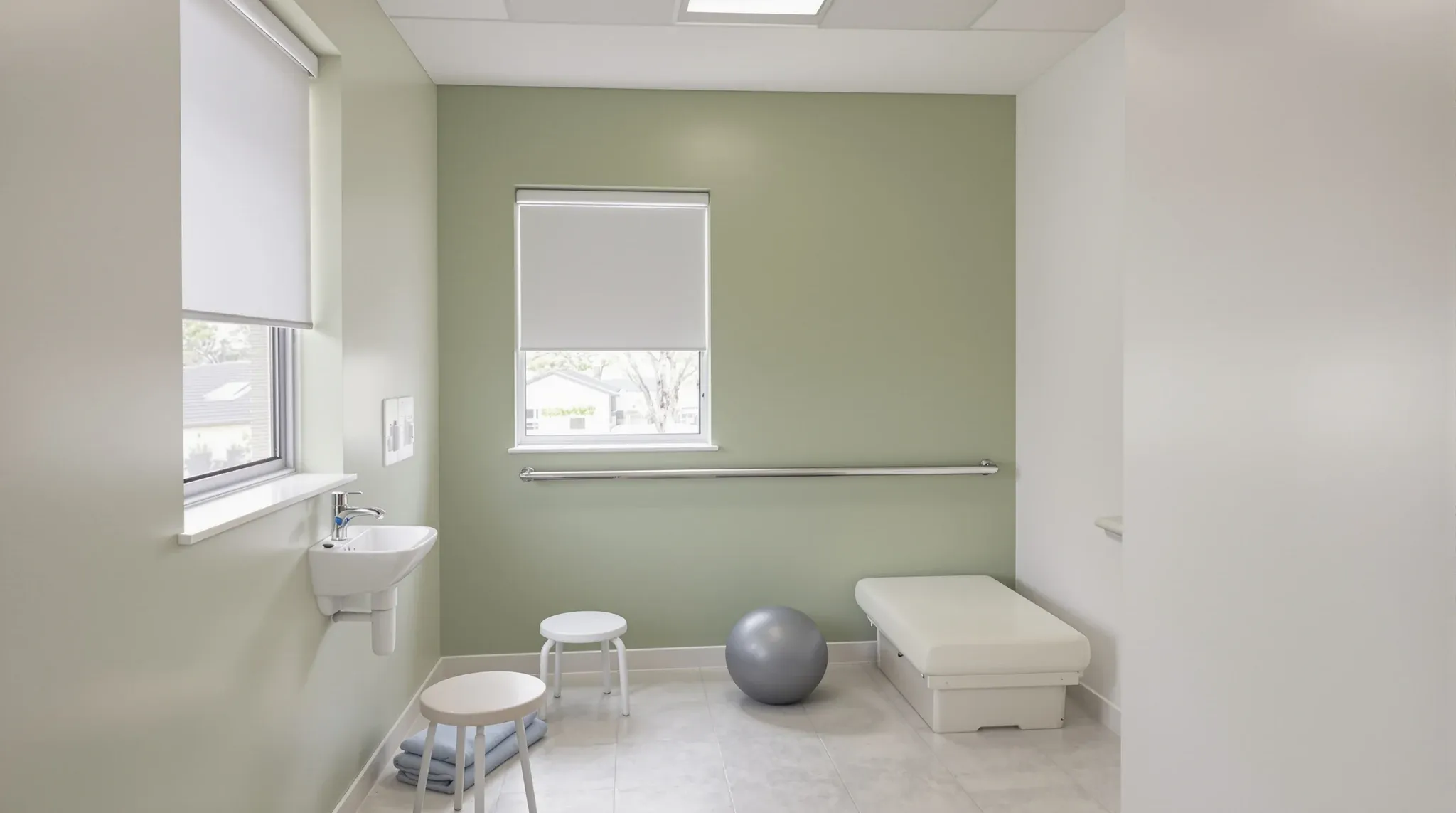
Plasterboard partitions do most of the heavy lifting in medical and allied health fitouts. Consulting rooms, treatment areas, procedure rooms, and administrative spaces all rely on plasterboard walls to deliver the acoustic privacy, structural capacity, and infection control properties that clinical environments demand. Glass may feature in reception areas and circulation zones, but the rooms where care is delivered are almost always enclosed by plasterboard because nothing else meets the full range of clinical requirements as reliably.
Specifying plasterboard for a medical practice involves different considerations from a standard commercial office. The walls need to accommodate plumbing penetrations, clinical equipment mounting, higher cleaning regimes, and acoustic standards that reflect the sensitivity of conversations between practitioners and patients. Getting these details right during design avoids the costly remediation that comes from discovering problems after patients are already being seen.
Why Plasterboard Is the Primary Partition System in Clinical Settings
Medical and allied health practices need partitions that provide genuine acoustic privacy, support wall-mounted equipment, resist impact damage from trolleys and clinical furniture, and present a surface that can be cleaned and maintained to clinical standards. Plasterboard delivers all of these within a single wall system, which is why it forms the backbone of virtually every medical fitout regardless of the practice type.
Solid walls outperform glass in healthcare fitouts across most of the criteria that matter clinically. A patient discussing symptoms, test results, or treatment options with a practitioner expects that conversation to remain confidential. A plasterboard partition with acoustic insulation provides that confidentiality far more reliably than glass, and it does so without requiring the additional specification costs that high-performance glass demands.
Plasterboard also provides the structural base for equipment mounting that many clinical rooms require. Wall-mounted examination lights, monitor arms, shelving for supplies, and hand basin supports all need a solid substrate behind the lining. Standard plasterboard can be reinforced at specific points with noggings or plywood backing to carry these loads, which is straightforward to plan during the framing stage but difficult and disruptive to add after the wall is finished.
Acoustic Privacy Between Consulting Rooms
Acoustic privacy in a medical practice is not a comfort feature. It is a fundamental requirement of patient care. Patients share personal, medical, and sometimes distressing information during consultations, and they have a reasonable expectation that the conversation will not be audible from the adjacent room, the corridor, or the waiting area.
The standard single-stud plasterboard partition used in most commercial offices provides only moderate sound reduction. For consulting rooms in a medical practice, that standard is often inadequate. What actually makes a plasterboard wall soundproof depends on the stud configuration, the insulation, the number of lining layers, and the quality of the sealing at every junction. Upgrading to a double-stud configuration with acoustic batts and additional lining layers produces a meaningful improvement in privacy between adjacent consulting rooms.
The ceiling void above consulting room partitions is a common weak point. If the partition stops at the suspended ceiling grid without extending to the structural slab above, sound travels freely over the top of the wall through the ceiling void. In a medical practice where multiple consulting rooms share a common ceiling void, this flanking path can undermine the privacy of every room simultaneously. Extending the partition to slab or installing a ceiling barrier above each partition line closes this path and delivers the acoustic performance the wall system was designed to achieve.
Plumbing and Service Penetrations in Clinical Walls
Medical fitouts involve more plumbing penetrations through plasterboard walls than standard commercial projects. Hand-washing basins in consulting rooms, sinks in treatment areas, and plumbed sterilisation areas all require water supply and waste drainage to pass through or be mounted on partition walls. Each penetration is a potential point of acoustic leakage, moisture ingress, and structural weakness if not detailed correctly.
The basin location needs to be coordinated with the partition contractor, the plumber, and the ceiling contractor to ensure that the wall framing accommodates the basin support, the plumbing rough-in is completed before the linings are closed, and the acoustic performance of the wall is maintained through proper sealing around the penetrations. Moisture-resistant plasterboard should be used in all areas where basins are wall-mounted or where splash zones exist, because standard plasterboard will degrade over time when exposed to repeated moisture contact.
Modifying plasterboard partitions after services are in place is significantly more disruptive and expensive than getting the coordination right during construction. In a medical fitout, where the plumbing scope is larger than in a standard office, the coordination between trades needs to be managed proactively to avoid late-stage rework that delays the practice’s opening.
Impact Resistance and Durability in Clinical Environments
Medical and allied health practices subject their walls to more physical stress than typical office environments. Treatment tables, wheelchairs, trolleys, and mobile equipment regularly contact walls at lower heights. Corridors between consulting rooms experience concentrated foot traffic and trolley movement that standard office corridors do not see.
Impact-resistant plasterboard is worth specifying in high-traffic areas and corridors within a medical practice. Impact-rated boards are denser and more resistant to denting and cracking than standard lining boards, which reduces the frequency of repairs and maintains the clean, professional appearance that patients expect. The cost difference between standard and impact-rated boards is modest when measured against the ongoing maintenance costs of repeated patching and repainting.
Corner protection is another detail that pays for itself over the life of the tenancy. Aluminium or stainless-steel corner guards at external wall corners in corridors and treatment areas prevent the damage that trolley impacts cause to unprotected plasterboard edges. These guards are inexpensive to install during the fitout but costly to retrofit once the walls are painted and the practice is operational.
Wall Finishes for Clinical Cleaning Standards
The wall finish specification in a medical practice needs to support the cleaning regime that clinical standards require. Standard commercial paint finishes are adequate for most consulting rooms and office areas, but treatment rooms, procedure rooms, and areas where splash or spill risk exists may need a more durable and washable surface.
Semi-gloss or gloss paint finishes are easier to clean than flat or matt finishes, though they show surface imperfections more readily. In rooms where frequent cleaning with disinfectant solutions is expected, a washable paint system rated for chemical exposure will maintain its appearance longer than a standard commercial paint. The junction between the wall and the floor should be detailed with a coved skirting or vinyl cove strip that eliminates the right-angle junction where dust and contaminants can accumulate.
Where clinical requirements are more demanding, such as in minor procedure rooms or sterilisation areas, vinyl wall sheeting provides a seamless, fully washable surface that can be cleaned to hospital-grade standards. The cost premium over painted plasterboard is significant, so the specification should be targeted at the rooms that genuinely need it rather than applied across the entire practice.
Fire and Compliance Considerations
Medical practices in commercial buildings are subject to the same fire compartmentation requirements as other tenancies, with the additional consideration that some clinical areas may have specific fire separation requirements depending on the services provided. The boundary between the tenancy and the common area typically requires a fire-rated partition, and in some configurations the walls around plant rooms, risers, and certain clinical areas may also need fire-rated construction.
Plasterboard partition systems are the standard method for achieving fire ratings in commercial fitouts because the fire rating can be integrated into the same wall assembly that provides acoustic and structural performance. The fire-rated specification must be followed exactly as tested, because substituting components can invalidate the rating. In a medical practice, where patient safety is the primary consideration, fire compliance is not an area where shortcuts are acceptable.
Disability access requirements also affect the partition specification in medical fitouts. Door widths need to accommodate wheelchair users, and some rooms may need specific clearances that affect the wall layout. Accessible bathrooms require specific dimensions and fitting positions that are defined by the Building Code and the relevant access standards. These requirements should be integrated into the partition layout during the design phase rather than discovered during the building approval process.
Getting the Specification Right for Healthcare Environments
The partition specification in a medical fitout is more nuanced than in a standard commercial project, and the consequences of getting it wrong are felt immediately through poor acoustic privacy, difficult cleaning, and premature wear. A well-prepared partition schedule for a medical practice identifies each room type, its acoustic requirement, its fire rating requirement, its equipment mounting needs, and its finish specification, and assigns a partition construction detail that addresses all of them.
Many medical fitouts use glass only in circulation areas and rely on plasterboard for every clinical space, which is a sensible approach that maximises acoustic privacy and clinical functionality where it matters most while allowing glass to contribute light and openness in the zones where patient privacy is not at stake. The discipline of matching each wall to its clinical purpose, rather than applying a uniform specification, is what separates a medical fitout that works well from one that creates daily compromises for both practitioners and patients.
If your medical or allied health practice needs plasterboard partitions that meet clinical standards for acoustic privacy, durability, and compliance, we can help with the specification, coordination, and installation.
Call us on 1300 60 93 93