
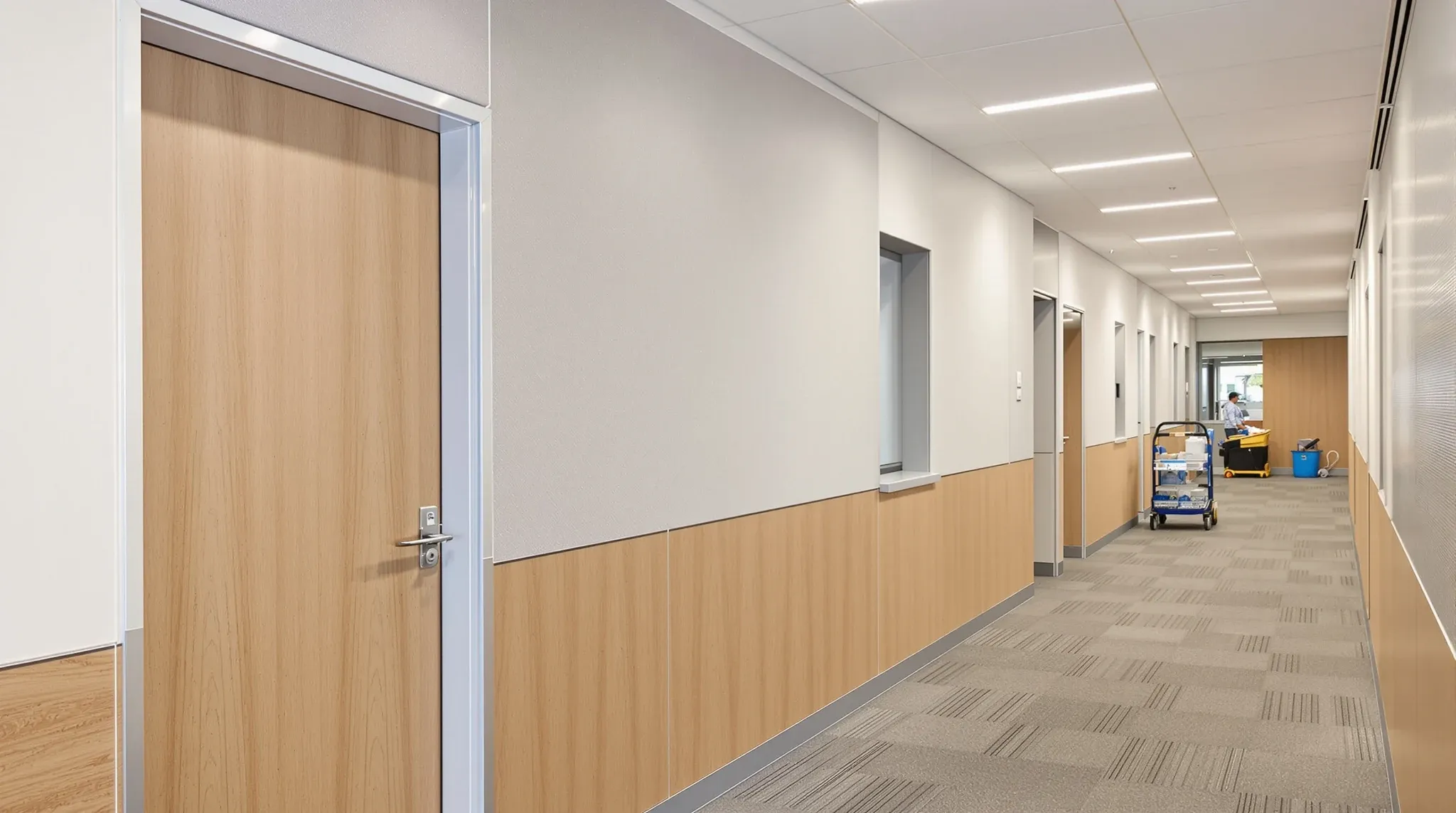
For most office partition walls, paint over set plasterboard is the right finish, because any painter can repair it at short notice. Laminate earns its extra cost on the short runs of wall that get hit or wiped down all day, and vinyl wallcovering sits between the two where a large surface has to stay presentable without a regular repaint.
The install price barely separates the three. What separates them is how each one gets repaired when it is damaged, and what state the wall is in when the tenancy ends. Those two questions decide the finish schedule on most floors we price.
What Each Finish Means on a Partition Wall
A painted partition is plasterboard fixed to studs, with the joints taped, set, sanded, sealed and coated. Paint follows the surface under it, so the finish you see belongs to the plasterer as much as the painter. The plasterboard finish level specified for the sheets sets how flat that face reads once the lights are on.
Laminate on a partition usually arrives one of two ways. It can be a factory-faced panel fixed into a framed or demountable partition system, which gives the wall a visible module and joint pattern. It can also be a decorative laminate sheet bonded to a backing on site as a wall lining, with its edges and corners detailed by the installer.
Vinyl covers a wider range than most tenants expect. At the lighter end is commercial vinyl wallcovering hung over primed plasterboard, sold in weight grades up to heavier Type II commercial products. At the other end is rigid PVC wall cladding with heat-welded joints, which manufacturers position for healthcare, commercial kitchens and wet areas. The first is mostly a decorative choice, the second a protective one, and they behave very differently over a lease.
Where Paint Is the Right Default
Paint is the only one of the three that almost anyone on site can repair. A scuffed painted wall gets filled and touched up by a painter without ordering anything with a lead time. Paint can also be tinted to match a colour on the schedule, while laminate and vinyl come in ranges, and an exact brand colour may or may not be in them.
Paint for busy areas has improved too. Anti-scuff, washable low sheen paints are made for entrances, hallways and stairwells, where everyday marks need to wipe off without a touch-up. We raise one detail with any darker colour scheme, because the paint manufacturer notes that darker colours show marking more readily than light ones.
The weak point is the maintenance cycle. A painted corridor or client-facing wall wears in the same places year after year, and keeping it presentable becomes a touch-up and repaint cycle that has to run around a working office. On a floor that is otherwise quiet, that cycle is easy to live with. On a floor with heavy circulation it comes around faster than the budget expects.
Where Laminate Earns Its Place
Laminate makes sense where a wall is going to be hit. Trolley corridors, print and store rooms, lift lobbies and the wall behind a bank of desks where chairs reverse into it all day are the usual candidates. In those places a painted surface does not fail at once, it simply looks worse each month until the repaint arrives early.
Scuffs and dents need separating before the face is chosen. Laminate stops the surface marking, but a wall that takes real knocks can still dent behind the finish, and impact resistance in plasterboard walls is decided by the board and framing, not the coating. On the hardest-hit runs we price the two together.
Cleaning is the other reason tenants ask for laminate. Laminate resists staining from most household chemicals and wipes down with an all-purpose cleaner, which suits walls that are cleaned daily. The manufacturer's care guidance still rules out strongly acidic or alkaline cleaners and bleach for routine cleaning, so we check the tenant's cleaning routine against the product before the order goes in.
What laminate will not do is take a patch. A damaged laminate panel is replaced, so the availability of that exact colour and finish becomes the maintenance plan, and ranges change over the life of a lease. Where we install laminate-faced panels, we order a few spare panels from the same run to be stored on site, because that is the difference between a quick swap and a wall that never quite matches again. Dark and high gloss laminates also show scratches more readily, which counts on any wall people brush past.
Where Vinyl Sits Between Them
Vinyl wallcovering gives a wall the continuous look of paint with a thicker, wipeable face. A textured or patterned product also hides light scuffing that a flat painted wall would show, which is why it turns up on long corridor runs and large feature surfaces.
It repairs better than laminate and worse than paint. A damaged length can be cut out and replaced with a matching piece from a spare roll kept from the original order, and on a textured product that repair can almost disappear. On a plain, light vinyl the join will be visible, much like a touch-up on a flat white wall.
A common assumption is that a wallcovering lets the plasterboard behind it drop to a lower grade of finish, and it does not. Gyprock describes Level 4 as the level typically specified where wallcoverings will be applied, and reserves Level 3 for concealed areas such as above ceilings and service shafts. The board still needs a proper wallcovering primer before hanging, which is what protects the sheet if the vinyl ever has to come off.
What Each Finish Costs over a Lease
On install price the ranking rarely moves: paint is usually the lowest, vinyl sits above it and laminate above that. The gaps are narrower than the conversation tends to suggest, because the studs, board and setting are common to all three. What you are comparing is a coating against a bonded surface, not one whole wall against another.
Ownership reorders some of that. A painted floor carries a recurring cost in touch-ups and repaints, spread across the lease. Laminate carries very little recurring cost and one uncomfortable risk, which is a damaged panel in a colour that is no longer made. Vinyl sits in between, and plain light colours will show hand marks around door handles and switches regardless of the product.
Lease length is the cleanest way to cut the decision. On a short lease, most of the maintenance never lands on you and install price should lead. On a long lease, the maintenance profile of each wall run matters more than the difference in install price.
What Each Finish Leaves You at Handback
A painted partition is the simplest wall to hand back. The work is patching and repainting, priced by area, and the main question is the choice between spot patching and a full repaint across the floor.
A laminate-faced demountable system can be a useful asset at the end of a tenancy, because the panels come down cleanly and can go into the next space. Whether they come out or stay is set by the make good scope for the floor, so we confirm that before we plan the removal rather than at the last inspection.
Vinyl is the one that can surprise a tenant. Removal guidance from wallcovering installers warns that where primer was missed or thin, stripping vinyl can pull sections of paint and plasterboard facing off with it. That turns a covering removal into sheet repair across the affected walls. Where the damage runs across whole walls, re-skinning the partitions can give a cleaner result than trying to patch back to bare board.
How We Split Finishes Across One Floor
Very few offices should be finished in one material, and the layouts we price rarely are. Treating the finish as a single floor-wide selection is what makes a durable finish look expensive, because it gets applied to every wall when only a handful of runs needed it.
The pattern that works on most floors is paint as the default across offices, meeting rooms and any wall that is mainly decorative. Laminate goes on the specific runs that take contact or daily cleaning. Vinyl goes where a large, continuous surface has to look good for years without a repaint, and reception usually gets its own answer because that wall is doing a different job again.
A few decisions have to be made before the board goes up. A writable wall surface can change the wall build behind it, and any wall that will carry a screen or wall-mounted equipment needs its noggins in place before sheeting. Adding either to a finished room means opening the wall again.
When we price plasterboard partitions, the finish schedule is often the part of the specification with the most room left in it. Moving a few wall runs between paint, vinyl and laminate can shift the final number noticeably, and it costs nothing to do while the drawings are still open.
We price paint, vinyl and laminate against each wall run on the drawings, so the durable finish only goes on the walls that take the wear.
📞 Call us on 1300 60 93 93