
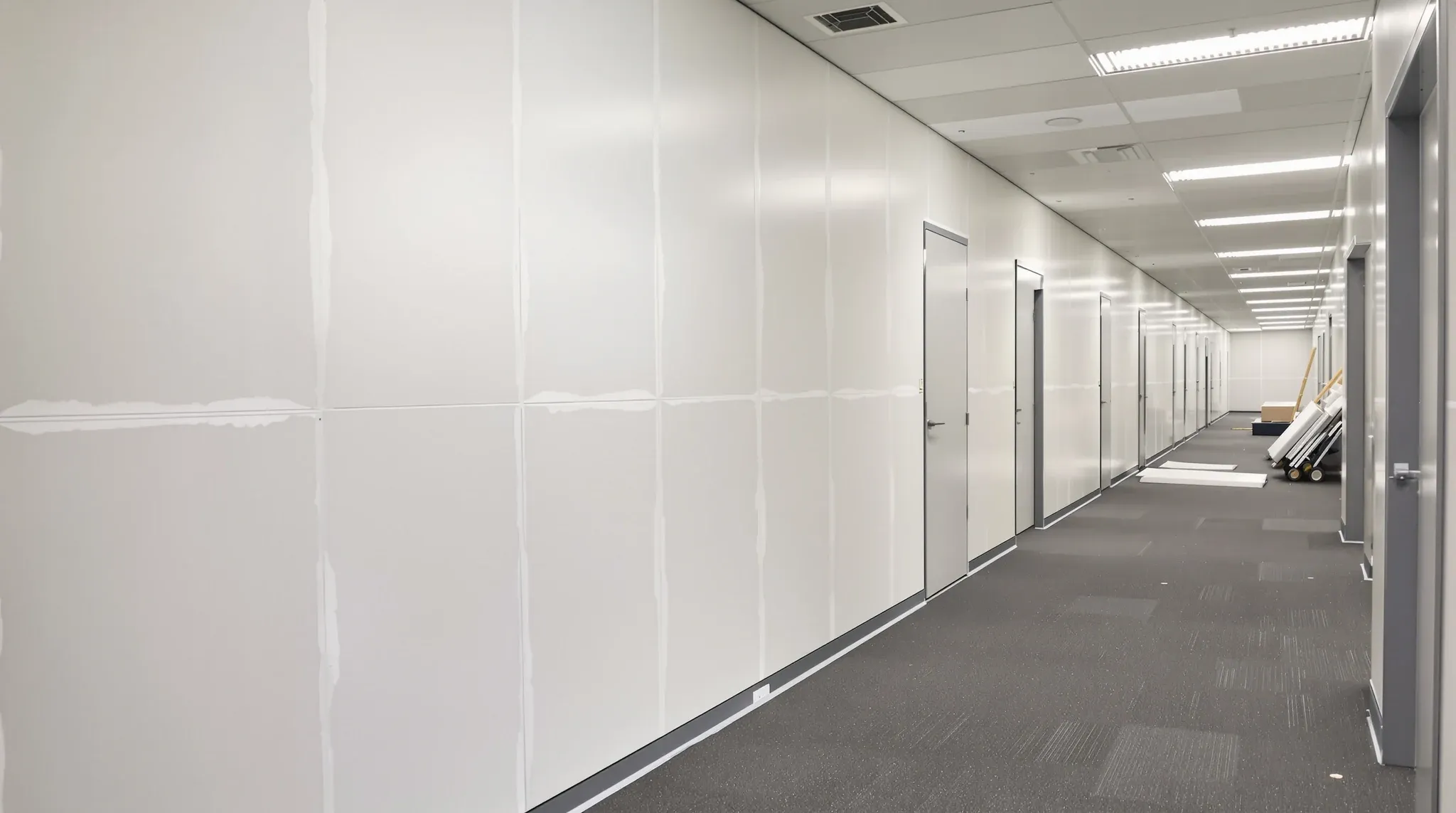
Between tenants, the plasterboard partitions that divide a Sydney commercial office are often in better shape than they look. The studs are straight, the top and bottom tracks are still sound, the services behind the wall have not shifted, and the only real problem is that the wall surface carries five or seven years of scuffing, patched-up signage mounts, small cracks at the head and poorly matched touch-ups that collectively read as tired. A full rebuild replaces everything to solve a problem that only lives on the skin. Re-skinning the existing partition is often the right answer; the trick is knowing which version of re-skinning.
There are three practical options, each suited to a different degree of cosmetic damage and a different landlord expectation. Choosing between them is mostly about what is happening behind the sheet, what the next tenant needs the wall to do, and how much programme is available for the change-over.
Defining Skim Refresh Overboard Re-Skin And Full Re-Sheet
A skim refresh leaves the existing sheet in place. The surface is scraped where paint has built up, minor cracks and dents are filled, the whole wall is coated with a thin plaster skim, and the painter takes it back to a clean finish. This is the lightest option. It fixes cosmetic damage, removes the painted-over fixing scars, and leaves the wall looking new from 500 mm away. What it cannot fix is a wall that has developed a wave, a stud that has started to bow, or a sheet that has soft spots where an old repair did not hold.
An overboard re-skin adds a fresh sheet of plasterboard over the existing one. The new sheet is typically 10 mm or 13 mm depending on what is already there, it is screw-fixed back through the old sheet into the existing studs, the joints are set, stopped and painted, and the finish is indistinguishable from a new wall. This fixes cosmetic damage fully, hides any old repair, and adds a small acoustic and thermal benefit from the second layer. The trade-off is that the wall becomes thicker, which matters where the partition meets skirting, door frames, glazing channels, or any existing hardware the new sheet now needs to accommodate.
A full re-sheet strips the existing plasterboard back to the frame and applies a new sheet on the original studs. This is more invasive than an overboard re-skin because it reopens every services penetration and every fixing detail in the wall. The finish is as clean as a new wall; the programme is longer; the services disruption is real; and the cost moves noticeably closer to a rebuild. The reason to choose a re-sheet over an overboard is usually that the existing sheet has integrity problems – soft patches, repeated failed repairs, or a history of water damage – that the overboard cannot mask reliably.
A rebuild, for completeness, is the full removal of the partition to slab and floor and the construction of a new wall. That belongs on the table only when the frame itself is the problem, or where the new layout demands a different position for the wall.
Conditions For Retaining Existing Stud And Track
The case for any re-skin option rests on the frame. A steel-stud partition installed cleanly on a level floor holds its geometry for decades, which is why most office walls more than a few years old still have perfectly useful framing inside a tired finish. Three things decide whether the existing frame can stay.
First, frame alignment. Press a straight edge against the existing wall at chest height, head height and low. A wave of more than 5 mm across a 2.4 metre span means the frame has probably been bumped at some point, and the overboard sheet will telegraph the wave. Straighten the frame or re-sheet properly, rather than burying the defect under a new skin.
Second, fixing integrity. Knock the existing sheet across its full area. Hollow sound is fine; soft spongy feedback where a screw spins freely is not. A handful of failed fixings can be re-screwed; widespread fixing failure is a signal that something has moved and the whole wall needs more than cosmetic work.
Third, head and base conditions. A deflection head that has cracked at the top joint does not fix itself under a new sheet. Crack patterns at the head or the floor line usually indicate that the head detail is allowing the slab above to drop onto the sheet, or that the base track has shifted. An overboard re-skin over a cracking head produces a new crack in the new sheet inside twelve months.
Where all three checks pass, the frame stays and the wall is a re-skin candidate. Where one or two fail, the honest answer is a full re-sheet with the defect resolved, or a targeted rebuild of the failing section while the rest remains.
Acoustic Impact Of Overboard Layering
An overboard re-skin adds a second layer of plasterboard to a wall that already has at least one layer each side. Intuitively this should improve the acoustic rating, and it does, but by less than the brochures imply. A single-layer 13 mm plasterboard partition on 92 mm steel studs with no insulation typically rates somewhere around Rw 38 to 40. Adding a second 13 mm layer to one side lifts it roughly 2 to 3 Rw, which is audible in a quiet room but small compared with the gains from acoustic infill inside the wall cavity or a genuinely acoustic build-up.
The practical implication is that an overboard is not an acoustic upgrade. If the partition is failing acoustically for the new tenant’s use – meeting rooms with poor privacy, executive offices where conversations carry – overboarding one side does not fix that problem. The honest options there are a full re-sheet with an acoustic product, or the addition of insulation and a second layer as a coordinated upgrade, or a genuine acoustic rebuild. Dressing a poor acoustic wall with a cosmetic overboard is a false economy the new tenant will notice within the first quarter.
Where the wall is acoustically adequate for the new use, the overboard is fine as a cosmetic move and the 2 to 3 Rw uplift is a small incidental bonus.
Pre-Installation Checks For Concealed Services
Every office partition that has been lived in carries services inside it. Data cables, power runs, AV backing plates, wall-mounted equipment brackets, audio-visual cabling, thermostats and door-access wiring all end up behind plasterboard at some point in a tenancy. An overboard re-skin assumes that the new sheet can be screw-fixed into the existing studs without hitting any of this, and that assumption is only safe when the existing services layout is known.
Before any re-skin, the wall should be scanned with a cable detector at the fixing pattern that will be used. Every penetration in the existing sheet – GPOs, data, switches, mounting brackets – should be marked, measured, photographed and mapped before the new sheet goes on, because the new cut-outs have to land on the same penetrations with millimetre precision if the services are to continue working. Any penetrations that the new tenant does not need can be blanked off before the overboard, which produces a clean wall; missing a penetration that is still in service is a reopening-the-wall afterthought nobody wants.
Where services are being changed as well – new GPOs, new data locations, new AV provisions – a full re-sheet almost always wins on practicality. The existing sheet is coming off anyway to relocate services, and trying to add a new layer on top of a services-disruption works against every step of the programme.
Programming Re-Skins During Tenancy Changeover
The commercial appeal of re-skinning is the programme. An overboard re-skin on a 30-metre partition run with no services disruption is a two to three day job for a small plasterboard crew. A full re-sheet on the same run is closer to five to seven days once the services are reopened and closed. A full rebuild is ten to fourteen days, sometimes more if the floor finish has to be lifted and relaid.
In a tenant change-over where the outgoing lease ends on a Friday and the incoming lease starts two weeks later, the overboard re-skin leaves nearly all of the window for flooring, paint and services. The full re-sheet consumes half the window. The rebuild takes most of it, and if anything slips, the new tenant moves into a half-finished floor.
The sequencing also matters. Re-skinning runs best after the strip-out is complete and before the new floor finish is laid, so that plasterboard dust does not contaminate a freshly installed carpet. If a wall overboard is happening over an existing carpet that will remain, the carpet needs protection during the work and a final commercial clean at the end, which is an extra line on the bill.
Comparative Cost Analysis Against Full Rebuilds
Across a reasonable sample of Sydney commercial offices, the cost pattern for refreshing a plasterboard partition wall at change-over stacks up roughly as follows:
Skim refresh: the lightest option, usually a quarter to a third of a rebuild cost. Fits walls that are cosmetically tired but structurally and acoustically fine.
Overboard re-skin: generally a third to half of a rebuild cost, depending on wall length and how many services penetrations it carries. Fits walls where the cosmetic damage runs deeper than a skim can reliably repair.
Full re-sheet: typically 55 to 70 per cent of a rebuild cost. Fits walls where the sheet has integrity problems the overboard would conceal rather than fix.
Full rebuild: the reference point for the other three. Fits walls where the frame itself has moved, where the new layout needs a different wall position, or where the acoustic build-up has to be genuinely upgraded.
These are proportions, not quotes, and the actual numbers shift with wall length, access, services density, finish level and the level of programme pressure around the change-over. What matters is that the four options sit in a roughly consistent order, and that choosing the right one by match-to-condition is usually more productive than defaulting to a rebuild simply because the walls look tired.
Our Specialized Partition Management
Between tenants, most Sydney commercial plasterboard partitions do not need a rebuild; they need the right scope of refresh for their actual condition. We can help a landlord or an incoming tenant assess the walls honestly, pick between a skim, an overboard, a re-sheet or a genuine rebuild, and sequence the work against the change-over window so the new tenant walks into a fresh floor without paying for a ground-up partition rebuild that never had to happen.
📞 Call us on 1300 60 93 93