
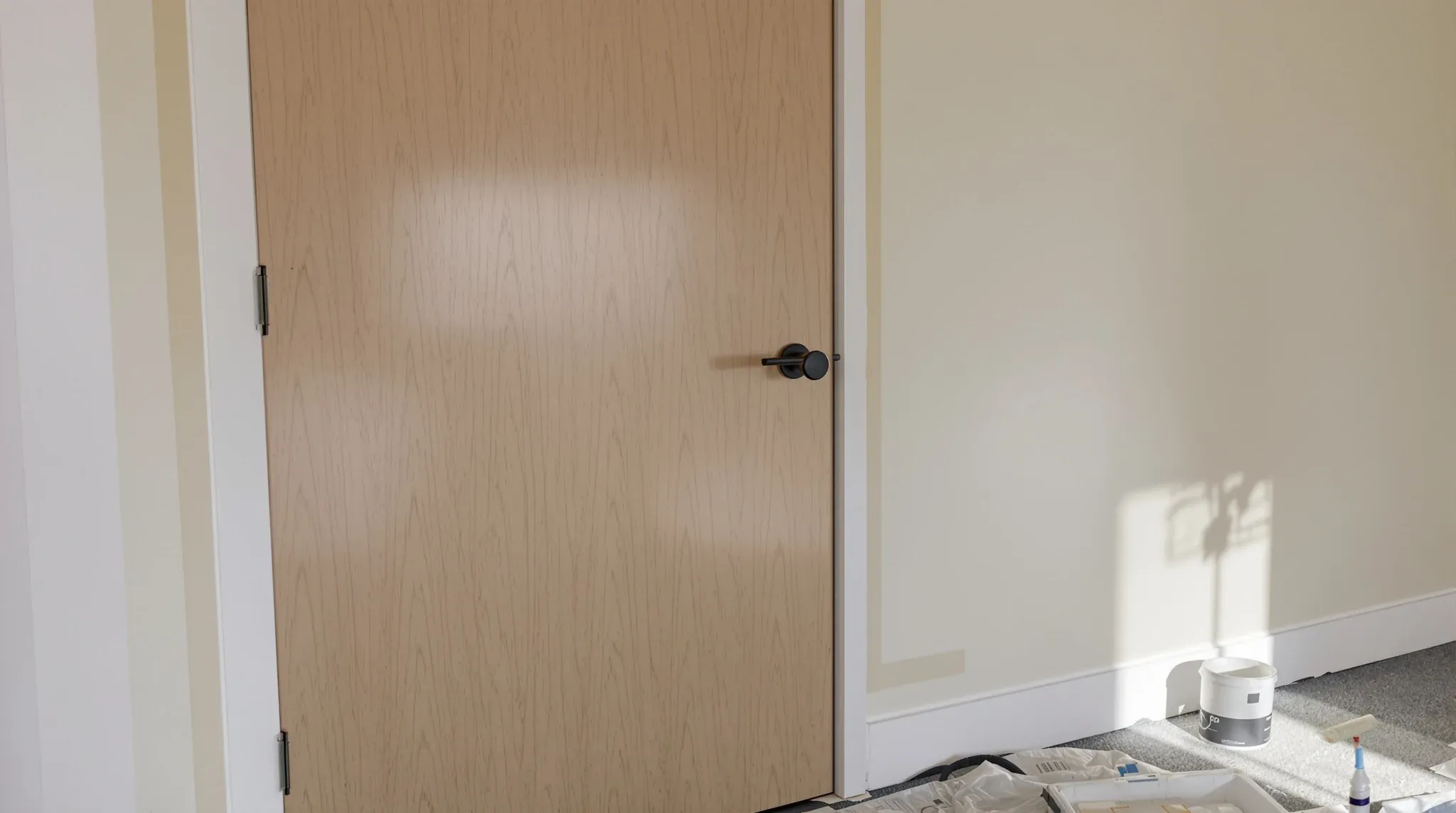
Between one tenant leaving and the next one signing, a commercial office partition system usually has eight to twelve weeks of vacant tenure. That window is the cheapest and least disruptive time the landlord or the incoming tenant will ever get to refresh the doors, the paint, and the hardware on an otherwise functional partition system. The work takes a fraction of the time of a full partition rebuild, costs a fraction of the budget, and returns a partition layout that reads as newly installed rather than inherited.
The between-leases window is genuinely different from mid-lease partition maintenance and from a full refitout. It is the one moment when the space is vacant, the services are off, the contractor has clear access, and no operating business is working around the works. A refresh scope that would take six weeks in a live office, with night work and protective barriers, can complete in two weeks end-to-end in a vacant tenancy. That is where the commercial case lives.
Defining The Scope Of A Partition Refresh
Partition refresh between leases typically covers four categories of work: doors and hardware, paint and finish, glazing and vision panels, and partition-integrated services. It does not cover layout changes, partition removal or reconfiguration, or ceiling and floor works (which are usually separate scopes in their own right).
The distinction matters commercially because refresh work does not trigger the approvals, make good, and coordination overhead that structural partition change does. The landlord or incoming tenant is updating what is already there rather than altering the fitout, and the scope stays inside a fast, contained programme.
Typical inclusions:
Door replacement or refurbishment: swing doors, meeting room doors, and office doors are the most visibly tired elements in an inherited partition system. Replacing the door leaf while keeping the frame, or by refurbishing the leaf with a new veneer or paint finish, transforms how the partition system reads for a small fraction of the cost of a full replacement.
Hardware updates: handles, locks, hinges, vision-panel gaskets, and door seals carry heavy use across a lease life and often look worn even when the door itself is sound. Refreshing the ironmongery to a current specification (particularly levers, closers, and privacy locks) updates the whole system with disproportionate impact.
Paint and finish: plasterboard partitions, framed glass partitions, and painted joinery usually need a full repaint or touch-up between tenants. This is the single highest-impact item relative to cost, and the vacant-tenancy window is when it is cheapest to deliver.
Glazing and vision panels: scratched glass, damaged frosting, tired branded films, or glass that has accumulated adhesive residue from previous tenant signage all affect how the partition system looks. Replacing damaged glass and stripping old films is a fast, contained job in a vacant space.
Partition-integrated services: switch plates, data outlets, intercom panels, card readers, and light fittings built into partitions often show more wear than the partition itself. Replacing these to a current standard completes the refresh without touching the partition build.
Strategic Timing For Between Lease Updates
Three factors make the vacancy window commercially and operationally favourable for partition refresh.
The first is access. A vacant tenancy has no desks, no staff, no cables, no equipment, and no operational constraint. Trades can move freely, dust and paint do not need elaborate containment, and the programme runs day-rate rather than night-rate. The same scope costs meaningfully less because the contractor is not working around an occupied floor.
The second is sequencing simplicity. Refresh work in a vacant tenancy can run all trades simultaneously rather than staged behind protective barriers. Painters, door installers, electricians and glaziers overlap their scopes within the same week, compressing the programme in a way that a live-office refresh cannot match.
The third is commercial leverage. Landlords refreshing between leases usually do so specifically to present better for the next letting, which means the spend has a direct commercial case: a well-presented fitted tenancy lets faster and usually at a better rent than a tired one. Incoming tenants paying for refresh do so to take possession of a cleaner baseline, which is a cost they are often prepared to commit to if the savings on a full refitout are clear.
Comparative Costs Of Refreshing Vs Rebuilding
Refresh is almost always cheaper than partition rebuild when the underlying partition system is structurally sound, the layout is acceptable to the incoming tenant, and the issues are cosmetic or hardware-level rather than structural.
The test is whether the partitions themselves, under the paint and behind the doors, are still fit for purpose. A plasterboard partition that has accumulated paint wear, patched repairs, and dated door hardware is usually a refresh candidate. The partition itself is sound, and the refresh restores its finish. The same partition with water damage, structural movement, or failed acoustic seals between rooms is usually not a refresh candidate. The refresh would hide rather than fix the underlying problem.
Glass partition refresh follows the same logic. Framed glass partitions with minor scratches and tired film are refresh candidates. Framed glass partitions with damaged gaskets, failed acoustic seals at the head or base, or bent framing are rebuild candidates. The visual refresh would mask problems that would return under the next tenancy.
The arithmetic generally favours refresh heavily. A partition refresh on a mid-sized tenancy often lands at fifteen to twenty-five per cent of the cost of a partition rebuild, with a fraction of the programme length. For landlords or incoming tenants working to a letting deadline, that cost and time differential is usually decisive.
Identifying Elements To Retain During Refresh
The temptation in a vacant tenancy is to extend the scope beyond refresh into reconfiguration, because access is easy and the trades are already on site. That temptation is a commercial trap.
Moving a partition wall mid-scope converts a refresh into a reconfiguration, which triggers approvals, services rework, and a materially longer programme. The cost climbs sharply, and the benefit (a layout marginally better than the inherited one) is usually worth less than the added cost unless the incoming tenant has specifically requested it.
Adding new rooms to an existing layout has the same problem in a different form. A new meeting room inside a refresh scope needs new walls, new ceiling work, new services, and new floor treatment, and it rarely finishes within the refresh programme. Better to scope the addition as a separate small works package after the refresh completes, or to defer it to the new tenant’s first brief.
Ceiling work, lighting replacement, and flooring replacement are all individually bigger scopes than partition refresh. Combining them in a single between-leases programme can make sense, but it is no longer a refresh: it is a partial refitout, and the commercial case, the programme, and the contractor selection all change accordingly. Keeping the scopes separate, if the time permits, usually produces cleaner delivery.
Effective Methods For Scoping A Refresh Project
A good refresh scope starts with a walk-through of the tenancy in its current state, with a realistic eye for what will read as acceptable to the next tenant versus what will read as inherited wear.
Paint is typically full-coverage rather than touch-up, because touch-up paint tends to read as patching even when the colour matches. Full-coverage repaint on all visible partition surfaces, door frames and partition-integrated joinery sits inside a week for a mid-sized tenancy.
Doors are assessed individually. Doors in good condition with dated hardware get new handles, closers, and locks. Doors with visible damage get leaf replacement while the frame stays. Doors with frame damage or significant wear get full replacement (leaf and frame), which is a larger line item but cheaper than it would be in a live office because the removal and refit has free access.
Hardware updates usually run to a coordinated specification across the tenancy, so that all meeting rooms have the same privacy-lock pattern, all office doors use the same lever style, and all ironmongery feels like one system rather than a patchwork of previous tenant choices.
Glass and film work is specified room by room. Damaged glass is replaced. Old films are stripped back to clear glass, with replacement film specified if privacy is needed. Branded films from the previous tenant are always removed, even if the new tenant has not yet been signed.
Partition-integrated electrical and data points are usually replaced to current specification rather than refurbished. Switch plates, outlet covers, and face-plates are small-cost items that make a disproportionate difference to how a partition system reads.
Managing Programs Within The Vacancy Window
A typical between-leases programme in a Sydney commercial office sits somewhere between two and four weeks depending on tenancy size. Smaller tenancies (under 400 square metres) complete in two weeks. Mid-sized tenancies (400 to 1,000 square metres) typically take three weeks. Larger tenancies may run four weeks or more, particularly if the refresh is extensive or if ceiling and flooring work is combined.
The programme runs in a sensible order. Strip-out of films, signage and wayfinding comes first. Paint follows: painters need clear walls, and other trades need the paint dry before they can return. Hardware and door work runs next because painters are no longer needed and the door installers can work without dust. Glass and film replacement typically closes the programme, because it benefits from all other finishes being complete. Services replacement (switch plates, outlets, light fittings) threads through the programme at whichever week suits access.
Cleaning and snagging sit at the end of the programme, in the final two or three days, and produce the handover-ready state. A tenancy that has been through a clean refresh reads as newly fitted even though the underlying build is the same, which is the commercial point of the exercise.
Funding Responsibilities For Tenancy Refreshes
The commercial structure varies by lease, by landlord, and by the deal the incoming tenant has negotiated.
Where the outgoing tenant is performing make good to base-building condition, the partition system is usually removed entirely and refresh does not apply. This is the full-strip-out path, and the tenancy is re-let bare or as a new fitted suite.
Where the outgoing tenant has negotiated a fitted handover (through temporary make good or a retained fitout arrangement), the partition refresh usually falls to the landlord or the incoming tenant. The commercial split depends on who gets the benefit. A landlord running the refresh to improve marketability absorbs the cost against lettability. An incoming tenant paying for refresh usually negotiates a contribution from the landlord in the form of rent-free or fitout contribution against the deal.
Where the outgoing tenant’s make good scope is contested or mid-negotiation, a refresh arrangement sometimes becomes part of the commercial settlement: the outgoing tenant contributes a cash amount toward the refresh rather than performing a more extensive reinstatement, and the landlord delivers the refresh for the incoming tenant. This is particularly common where the incoming tenant has been identified early and the timeline does not allow for full strip-out and rebuild.
Refreshing As A Viable Alternative To Full Fitouts
For incoming tenants looking at an available fitted tenancy, the between-leases refresh often shifts the commercial case. A partition system that looks tired in its current condition can read as near-new after a refresh programme, and the cost of the refresh is usually a fraction of commissioning a new partition system from scratch.
That changes the conversation from “do we take this fitted tenancy or build our own” to “can this fitted tenancy be refreshed to the standard we want, and at what cost”. Tenants who can see past the inherited wear often find that a refreshed partition system in a well-located tenancy serves them better than a new fitout in a less preferred space.
The honest check is whether the underlying layout suits the incoming tenant’s brief. A partition system that can be refreshed into an acceptable starting point is only useful if the layout itself works. If the layout is wrong, the refresh refreshes the wrong space, and the tenant is better off with either a different tenancy or a partition reconfiguration as part of the commissioning.
We handle commercial office partition refresh and between-leases presentation works across Sydney, and when you have a vacancy window between one tenant and the next we can help you scope the refresh that will present the tenancy at its best without drifting into reconfiguration cost. If the underlying partitions have problems the refresh would only mask, we can tell you that too, and work with you on a targeted rebuild instead.
📞 Call us on 1300 60 93 93