
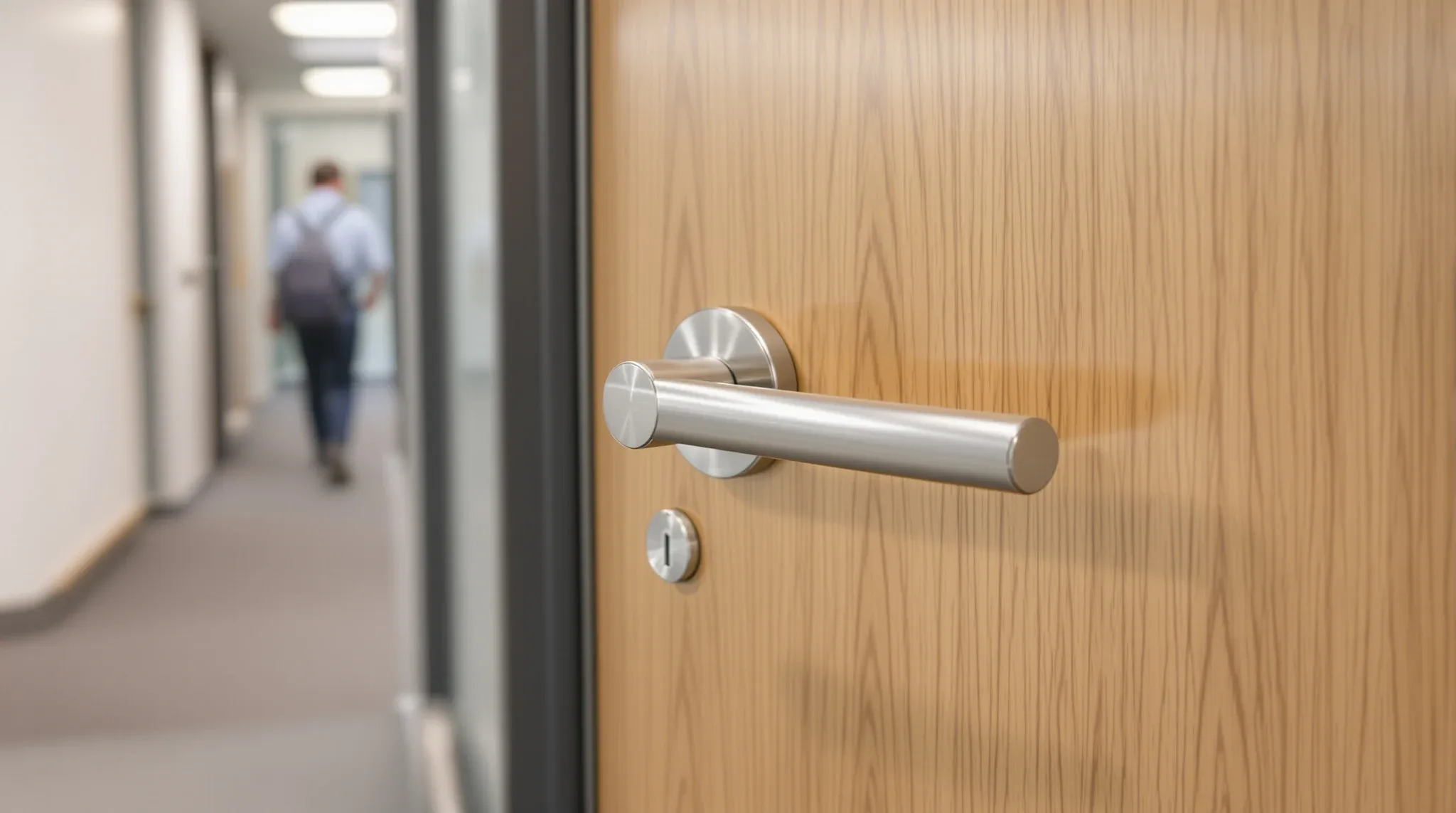
Doors and hardware rarely lead the design conversation, and almost always lead the complaint list a year into the lease. A door that binds on its frame is remembered every time someone opens it. A lock that does not latch cleanly is a daily friction. A closer that slams is a steady source of irritation across an open plan. None of that is visible in the spec sheet, and all of it is decided by choices made during the fit-out.
The useful way into this decision is not to start from product catalogues. It is to start from how the door will be used, how often, under what acoustic and privacy load, and where in the floor plate it sits. The hardware follows the use case. Tenants who reverse that order, picking a hardware brand first and then matching it to the room, usually end up with a door that looks right and feels wrong.
Question 1: how much traffic does the door really see
Traffic is the first filter. A boardroom door that opens six times a day does not need the same hardware as an open-plan meeting room door that opens a hundred times a day. A kitchen door that carries coffee and deliveries needs different hinges again. Traffic decides the durability grade of every component: hinge cycles, lock cycles, closer cycles, handle finish wear.
The grading system used in the hardware industry describes these cycles explicitly, and the spec needs to match reality rather than wishful thinking. Under-spec a high-traffic door by one grade and it fails within the lease. Over-spec a low-traffic door and the tenant has paid for cycle life they will never use. The practical answer is almost always a mid-range hardware set for most doors and a step up for the two or three that take constant use.
Traffic is also a privacy question in disguise. A room beside the main walkway that gets bumped against every time someone walks past needs a frame and hinge combination tough enough to absorb the knocks without losing alignment. A room tucked into a quieter corner does not. Tenants who choose hardware based on how the door looks tend to under-spec the high-bump doors and over-spec the quiet ones, which is the opposite of what the floor needs in practice.
Question 2: what acoustic load does the door need to carry
A door is the weakest acoustic link in almost any wall. The wall can be built to an excellent acoustic standard and the door can undo it in seconds if the specification is wrong. A meeting room that was meant to hold a confidential conversation fails because the door leaks speech around the edge, over the top, under the bottom, and through the handle penetration.
The components that carry the acoustic load are the door leaf itself, the frame seal, the threshold seal (either a drop seal or a fixed threshold), and the handle hardware that cuts through the leaf. A door rated to the acoustic standard the room needs, installed with all four of those components working together, holds the wall’s performance. A door that has only one of those components working holds a fraction of it. For serious privacy requirements, what counts as a realistic privacy level in a glazed meeting room usually comes down to the door seal and the ceiling return path, not the glass. Solid-walled rooms face the same weak-point problem: the wall is easy, the door is where the acoustic performance lives or dies.
Question 3: what privacy level does the visible hardware signal
Privacy is not only about acoustics. It is also about whether the door signals openness or closure to the rest of the office. A heavy timber door with a solid handle reads as closed even when it is unlocked. A glazed door with a discreet pull reads as open even when the room behind it is private. The fit-out has to decide which signal the room needs to send, because hardware is one of the few elements the occupants read without thinking about it.
For open-plan collaboration zones, lightweight glass doors with recessed pulls work well because they reinforce the open character of the zone. For executive offices, a substantial timber door with a designer lever usually reads better because the room itself is supposed to feel separate from the open plan. The mismatch, a light glass door on a serious executive office or a heavy timber door on a casual collaboration room, reads as a category error every time someone walks past.
There is also a handedness question that bites on fit-outs where the layout changes late. A door hinged on the wrong side, a closer that stops short of its expected sweep, or a lock that faces the wrong way are all trivial on drawing and expensive to fix after install. A short pre-install walk-through of every door, with the hanging direction confirmed in person, avoids most of these.
Question 4: what maintenance regime does the tenant actually run
Hardware choice is also a maintenance decision. Some hardware tolerates neglect for years. Some needs regular adjustment. A closer that is cheap on the invoice usually needs re-tensioning every few months, and an office with no cleaning contract that covers it will have closers out of alignment within a year. A premium closer holds its setting for the life of the lease but costs three or four times more per door.
The practical call is whether the tenant has a facilities function that will notice a door that is starting to drift. Tenants with good facilities capacity can usually run mid-range hardware and adjust as needed. Tenants without can usually run premium hardware and forget it. The worst outcome is cheap hardware in an office with no one to maintain it, because the doors are the first thing occupants lose patience with. Fit-out maintenance and upgrades reduce to a short list of predictable trouble spots, and door hardware is at the top of almost every one.
Question 5: where does the door sit in the fit-out sequence
Doors are installed near the end of a fit-out, which means they inherit the compounded tolerances of every trade that came before them. If the wall was built slightly out of plumb, the door frame is slightly out of plumb, and the door hangs slightly off its latch line. If the floor finish is slightly thicker than expected, the threshold detail binds. If the ceiling head is a few millimetres low, the top of the door clips on opening.
The fit-outs that deliver clean door installations are the ones where the partitions, the floor, and the ceiling are all brought into tolerance before the doors arrive on site. The fit-outs that deliver binding doors are the ones where the door is expected to accommodate whatever tolerance error everyone else accumulated. This is the same failure mode that leads to partition design mistakes delaying occupation certificates: the compounded tolerance error only becomes visible on the last trade in. Poor plasterboard installation causes cracks, noise and rework, and the rework often lands on the door as the visible symptom, even though the cause is the wall behind it. The symptom is the one the tenant reports and the one the maintenance team chases first, and the real root cause is frequently found only when the frame is pulled out.
How the hardware spec sits in the overall programme
Hardware usually has lead times that are longer than the rest of the door set. A custom lock, an unusual finish, or a specialty closer can push a door installation back by weeks if the hardware is ordered late. The hardware decision should usually be locked several weeks before the doors themselves are needed, even when the rest of the fit-out is still moving.
Under a complete fit-out scope, the hardware spec sits inside the overall procurement schedule, which is the cleanest way to avoid last-minute substitutions. Where the scope is narrower and the doors are being replaced as part of a standalone partition job, the lead time still matters, and a partition scope should always check hardware availability before committing to the install date. The operator-grade detail is that the hardware spec is also where a fit-out quietly saves or quietly overspends. A smart mid-range hardware set applied consistently across the floor, with step-ups only where use demands it, usually reads better and lasts longer than a premium set specified without reference to use. Consistency matters as much as grade.
If you are scoping a fit-out and the door and hardware decisions feel like a detail you will handle later, we can walk through the use cases on your floor and recommend where the spec deserves to be higher and where it can sit mid-range without losing quality. That conversation usually prevents the door-related complaints a year later. Call us on the number below and we will set up a time.
📞 Call us on 1300 60 93 93