
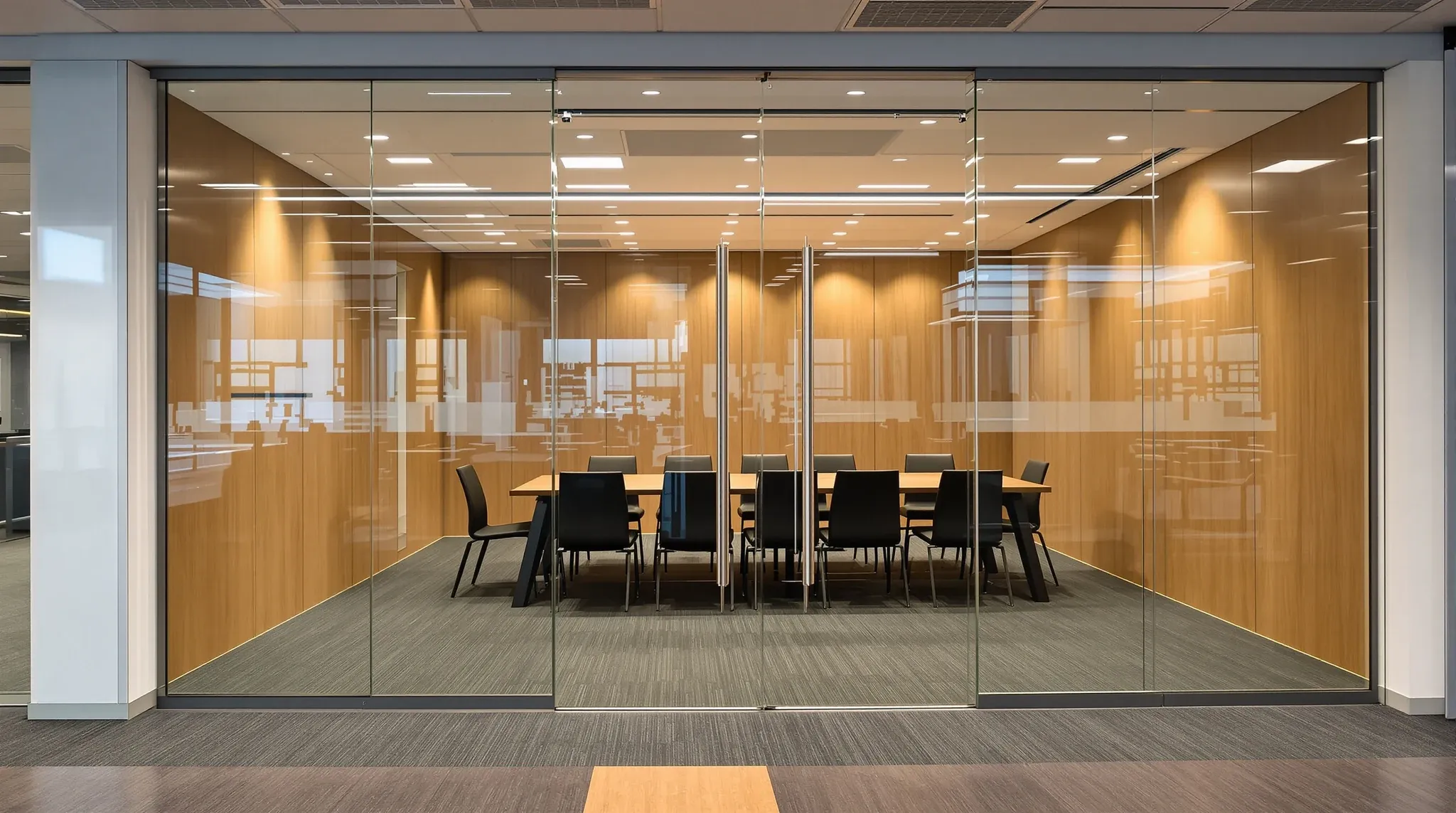
The first thing that fails on a new glass office fitout is almost never the glass. It is the door hardware. A hinge rated for residential cycles, a pull mounted through a panel without the right cut-out, a closer that never got adjusted properly at handover; these are the components that show up in the building manager’s defect log at six months and again at eighteen. The glass itself has decades of life in it if no one hits it. The hardware running that glass is what decides whether the room still works the way it did on day one.
For a tenant writing a specification, or comparing two quotes that look identical on the cover page, door hardware is where the difference between a premium outcome and a budget one actually lives. A well-specified hinge, closer and lock on a frameless glass door costs more than the minimum acceptable option, but the extra is small relative to the price of the glass, and it is the single line item with the highest ratio of long-term impact to short-term cost.
How to Read the Cycle Rating on a Hinge or Closer
Every piece of door hardware sold into commercial work carries some version of a daily-cycle rating, usually expressed as a total cycle count the manufacturer stands behind before measurable wear. A meeting room door in a busy Sydney commercial office is typically opened and closed between forty and one hundred and twenty times a day, depending on room size, booking pattern and whether the adjacent open plan uses the room for informal catch-ups as well as booked sessions.
A hinge rated for two hundred thousand cycles sounds generous until the arithmetic runs. At a hundred openings a day over a five-year lease, the door clears one hundred and eighty thousand cycles without a weekend break. A lower-rated hinge is already beyond its design life before the lease is halfway through, and it will start to express that wear as sag, alignment drift, and occasional refusal to close fully. The same cycle maths applies to floor springs, top pivots, magnetic latches and door closers, each of which publishes its own rating.
Boardroom doors, executive office doors and glass doors into privacy rooms sit at the quieter end of the range and tolerate a lower-rated product. Collaboration rooms, focus rooms that double as video-call booths, and any glass door near a kitchen or circulation spine do not. Specifying one hardware suite across the whole tenancy is tidy, but specifying two or three tiers matched to expected traffic is honest.
Pull Handles: Where the Premium Look Actually Earns It
The handle is the component the occupant touches most, and it is where finish quality reads loudest. Sydney tenants typically compare back-to-back pulls against single-sided pulls, and the decision often gets made on price without examining where each one sits in the glass panel.
A back-to-back pull passes through the glass via a pair of through-holes and clamps across the face. The advantage is visual symmetry and mechanical strength; the risk is poor tolerance control at the drill stage, which shows as uneven clamping pressure and eventually as loose handles. A single-sided pull attaches to one face and is easier to install cleanly, but reads as lighter and can work loose faster if the anchor is not specified for the glass thickness.
Finish matters more than any marketing sheet will admit. Satin stainless holds fingerprints and cleans up well. Brushed brass is on trend in 2026, but it oxidises faster than the installer’s sample tile suggests and needs a protective clear-coat to look its best at year three. Polished chrome is striking on day one and shows every touch by day ten. Black and bronze finishes are unforgiving on cheap substrates; the coating thins at contact points and the base metal shows through within a year in any high-use door.
The failure mode tenants miss most often is not the pull itself but the glass cut-out. A cut-out drilled to the wrong tolerance is not repairable without replacing the glass panel, which is why reputable installers mock up the pull position on a template before the panel is cut. A supplier who cannot show where the through-hole will sit before the glass is ordered is carrying risk onto the tenant’s drawings.
When a Floor-Spring Closer Is Worth the Premium Over Surface-Mounted
A floor-spring closer sits in a cassette cast into the slab, connects through a pivot at the bottom of the door, and is invisible from above. A surface-mounted closer bolts to the door and the head track, and is visible from the room. The price difference between the two is significant; the experience difference is also significant.
Floor springs deliver cleaner aesthetics and a more consistent closing action across a longer life, because their larger hydraulic body handles heat, dust and misuse better than a compact surface unit. They also tolerate heavy glass leaves better; any door over about 80 kilograms in a busy room is a better candidate for a floor spring than a surface-mounted closer. The trade-off is installation complexity. Retrofitting a floor spring into a finished slab usually means cutting the floor finish, and in a raised access floor or heritage building the question may be academic because the detail simply cannot be built.
Surface-mounted closers are lower cost and perfectly suitable on lighter glass doors in lower-cycle rooms. The common mistake is specifying a closer at the minimum leaf-weight rating for the glass; installers will argue that it meets the spec, but at the upper end of its rating the closer works harder every cycle and wears faster. Specifying a closer one size up from the minimum is the quiet difference between a door that still closes smoothly at year four and one that needs replacing by year three.
Latching and Locking on Glass: Magnetic, Mortice or Privacy Latch
Latching decisions on glass doors are driven by what the room is used for and how often it has to lock. A magnetic latch holds the door closed with no moving pin and works well on frameless systems where a traditional mortice would require a patch fitting in the glass. The downside is that magnetic latches lose grip with misalignment and make a small but audible clack on every close, which reads as cheap in a quiet boardroom.
A mortice latch in a patch fitting gives a positive mechanical close and accepts conventional locking cylinders. It suits doors that need to lock for confidentiality, such as partner offices, HR rooms, meeting rooms that double as private discussion spaces, and any room with a cash handling or client confidentiality dimension. The specification sits slightly heavier and the patch fittings at the glass edge need more careful coordination.
A privacy latch is a specific product that offers indicator-showing engagement, typically red for occupied and green for vacant, and suits wellness rooms, parent rooms, or any space where brief single-occupant privacy is the core function. These are different products from standard mortice locks and live in the same family as toilet-partition indicator bolts; the price premium is modest and the user experience improvement is out of proportion to the cost. Wellness rooms, parent rooms and private consultation rooms are the cleanest case for privacy latch hardware, and it is worth asking for a specific product schedule rather than a generic latch line item when that brief is in play. For rooms where the privacy requirement is stronger than an indicator latch can carry, the realistic level of privacy a glass partition can offer is a conversation that should happen before the door hardware is fixed.
Hinge Selection for Framed, Frameless and Composite Systems
Hinges on office glass doors are not interchangeable across system types, even when they look close on paper. A framed glass door uses conventional architectural hinges screwed to the aluminium stile and the frame; the hinge family is the same kind used on timber and steel commercial doors, and spare parts are easy to source.
A frameless glass door uses patch fittings clamped to the glass edge, and the hinge mechanism usually lives inside a top and bottom pivot assembly. Specification of the pivot matters more than specification of the hinge itself, because the pivot has to accept the tolerance of the concrete floor below the cassette. Any deviation above about two millimetres in the slab level across the door width will either bind the pivot or let the door hang visibly off-square.
This is where a pre-install floor level check pays for itself. On projects where the builder commits the glass order before the partition trade has finalised floor levelling, the hardware sits off its ideal tolerance on day one and closes worse every month after that. The fix is not really a fix; it is a re-shim that creates its own wear pattern. Building the floor check into the pre-order process removes the problem before the glass is cut.
Composite systems, typically a half-height solid panel with a glass upper or a framed base with a frameless leaf, use a mix of conventional and proprietary hinges. The watch item is the specification of spare parts in ten years, because composite-system hinges are often bespoke to a single manufacturer and will be discontinued before the lease ends.
Specification Discipline at Tender: The One-Page Schedule That Removes the Rework Risk
The common thread across every decision above is that installer default is not the same as informed specification. A door hardware schedule is a one-page document that lists, for every glass door in the tenancy, the hinge or pivot type and cycle rating, the closer type and rating, the pull dimension and finish, the latching hardware, the locking hardware, and any special requirement such as accessibility compliance or security system integration.
Issuing this schedule at tender stage, rather than accepting the contractor’s standard hardware line, is how tenants stop the specification being made for them at the cheapest acceptable level. It also gives the landlord and certifier what they need for sign-off, which is a set of products with traceable ratings rather than a generic hardware call-out. On projects where this schedule is missing, the first sign of trouble is usually a request at shop-drawing stage for hardware substitutions that have already been ordered and cannot easily be changed. The schedule shortcuts that conversation.
For tenants who are running their first fitout, a useful sanity check is asking the installer to confirm which products on the schedule are in stock, which are on two to four week lead times, and which are special order. Any entry that is special order with a lead time longer than the partition programme needs to be either substituted before the order is placed or accepted as a programme risk. The schedule stops that check from being a late-stage discovery.
What a Good Glass Door Feels Like at Year Three
The simplest test of a well-specified glass door suite is how it feels three years after handover, not on the day the tenant moves in. A well-specified door still closes cleanly without a slam, latches with the same pressure as it did on day one, and shows wear on the finish in the places occupants touch rather than in places where the hardware has failed. A poorly specified door announces its problems by the end of year one, often in the form of a closer that needs adjusting every few months, a hinge that squeaks and then sags, or a pull handle that starts to turn in its mount.
Getting there is not about spending the most. It is about deciding, in the tender pack, which components will carry the load of real traffic and which can sit at the lower end of the product range. A $150 price difference on a hinge pair across twelve meeting rooms is less than two thousand dollars on the whole tenancy and buys several years of extra service life. The same calculation applies across closers, pulls and latches. The line items are small individually and decisive collectively.
If you are scoping glass partitions for a Sydney commercial office and want to know whether your hardware schedule will still be performing in year four, or whether the quote in front of you is specifying the minimum acceptable product rather than the right one, we can help you work through the schedule door by door before the glass order is committed.
📞 Call us on 1300 60 93 93