
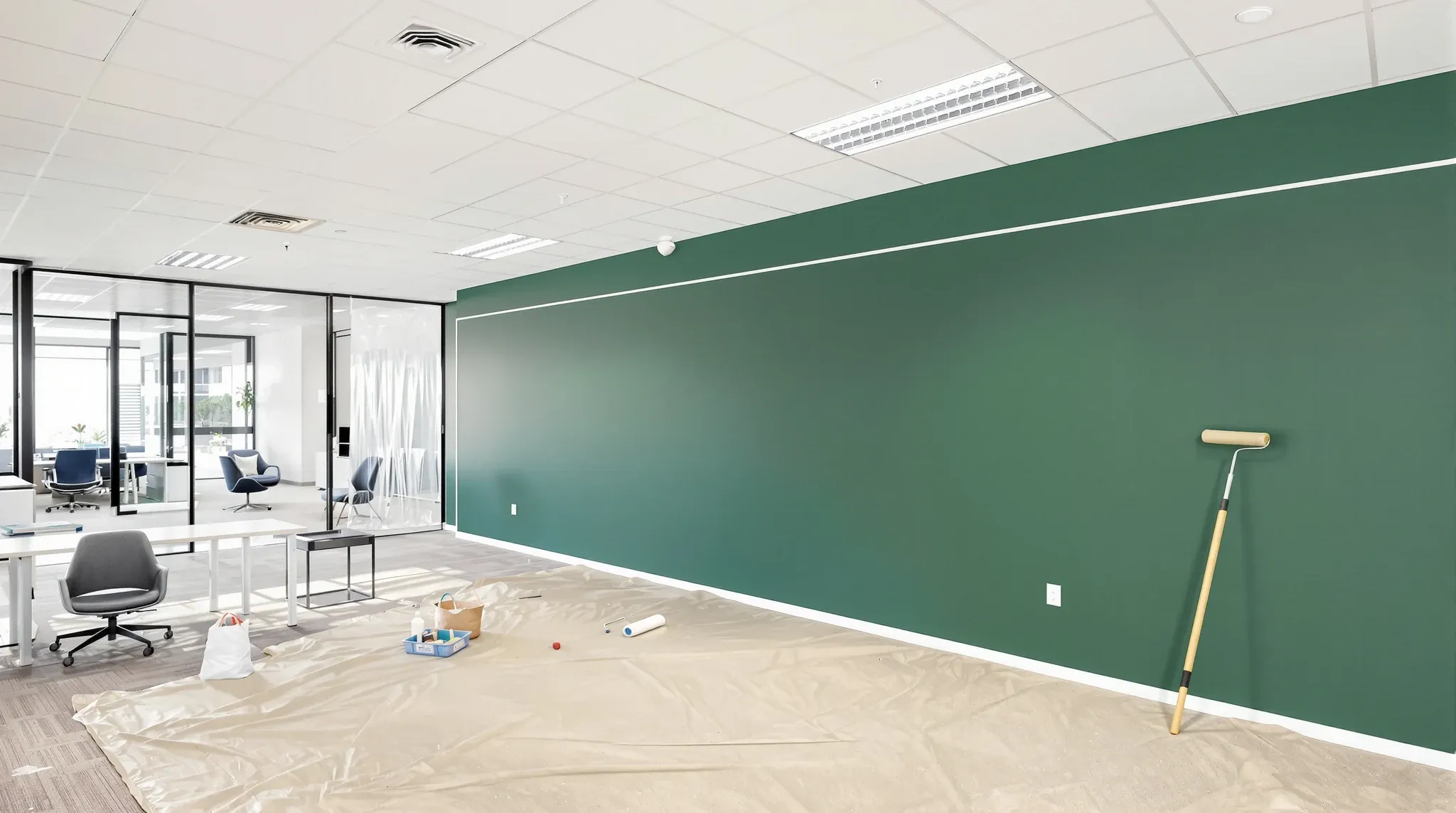
Commercial painting is one of those fitout trades that seems straightforward until it goes wrong. A coat of paint on a plasterboard wall appears to be one of the simpler tasks in a fitout programme, but the quality of the paint finish is one of the most visible indicators of overall fitout quality. Visitors, staff, and landlords all register the condition of painted surfaces, and walls that show roller marks, uneven sheen, paint runs, or colour inconsistency undermine the impression of professionalism that the fitout is supposed to create.
In the Sydney market, commercial painting sits at the intersection of quality, programme, and cost pressures that affect every fitout. The painting trade comes near the end of the construction sequence, which means it inherits whatever time and budget pressure has accumulated from earlier trades. When the programme slips, it is often the painter who is asked to compress their scope to meet the handover date. The result is rushed application, insufficient drying time between coats, and a finish that looks acceptable on the day but deteriorates quickly under the demands of an occupied office.
What Commercial Painting Involves in an Office Fitout
The painting scope in a commercial office fitout typically includes all new plasterboard walls and ceilings, any existing surfaces that are being refurbished or recoloured, door frames and timber elements, and feature walls or accent areas that use different colours or finishes. The scope may also include preparation work on existing surfaces that have been damaged, patched, or previously painted to a standard that does not match the new fitout.
Preparation is the most important and most frequently under-resourced part of the painting process. New plasterboard requires a sealer coat to equalise the porosity between the set joints and the board face, followed by two topcoats to achieve a consistent colour and sheen. Existing surfaces may need sanding, filling, and priming before the topcoat is applied, depending on their condition. The quality of the preparation directly determines the quality of the finished surface, and skipping or rushing the preparation stage is the most common cause of visible defects in commercial painting.
The paint specification matters more than most tenants realise. Commercial-grade paints are formulated for durability, washability, and consistency in large-area applications, and they perform significantly better over the life of the tenancy than residential-grade alternatives. The choice between flat, low sheen, and semi-gloss finishes also affects how the surface looks under different lighting conditions. Higher sheen levels are more durable and easier to clean, but they show surface imperfections more readily than flat finishes, which is why the paint sheen needs to match the quality of the underlying surface preparation.
How Painting Fits Into the Fitout Programme
Painting is a late-stage trade in the fitout construction sequence. It happens after the plasterboard is set and sanded, after the ceiling is installed, after the joinery is fixed, and ideally after the main services installation is complete. This positioning means the painter needs a clean, finished substrate to work on, and any trades that work after the painter needs to protect the painted surfaces from damage.
The programme impact of painting is often underestimated. Each coat of paint requires drying time before the next coat can be applied, and the drying time depends on the temperature, humidity, and ventilation in the space. In a well-ventilated office during Sydney’s warmer months, drying time between coats is typically two to four hours. In cooler conditions or poorly ventilated spaces, the drying time can extend to eight hours or more, which means two coats may take a full day rather than a few hours.
When the programme is compressed, the temptation is to reduce drying time by applying the second coat before the first is fully cured. This creates adhesion problems that may not be visible at handover but will show up as peeling, blistering, or poor washability over the following months. The correct build order allocates adequate time for painting, including preparation, priming, and topcoating, and the programme should not treat this time as optional.
Colour Selection and Its Effect on the Workspace
Colour selection for commercial offices has evolved significantly from the days when every office was painted in the same neutral white or cream. Contemporary fitouts use colour strategically, with different tones in different zones to support the function and character of each area. Reception areas may use a feature wall in the company’s brand colour. Meeting rooms may use warm neutrals that feel comfortable and focused. Open-plan areas typically use light, reflective colours that maximise the effect of artificial and natural lighting.
The practical considerations around colour selection go beyond aesthetics. Dark colours absorb more light, which means rooms painted in darker tones need more artificial lighting to achieve the same desk-level illumination as rooms painted in lighter tones. This affects the lighting design, the energy consumption, and the perception of the space. Very dark feature walls can make a room feel smaller and more enclosed, which may be the desired effect in a boardroom but is counterproductive in an open-plan area that is supposed to feel spacious.
Colour consistency is another practical concern. Large areas of the same colour need to be painted from a single batch of paint to avoid visible colour variation between sections. If the paint runs out mid-wall and a new batch is opened, even paint from the same colour code can show a visible difference in tone or sheen where the batches meet. Commercial painting contractors manage this by calculating the paint volume accurately before starting and using paint from a single batch for each continuous surface.
Sydney-Specific Considerations for Commercial Painting
Sydney’s climate affects commercial painting in ways that tenants and programme managers need to account for. The city’s high humidity during summer extends drying times and can cause problems with water-based paints that do not cure properly in humid conditions. The temperature range between seasons affects paint viscosity and application characteristics, and the UV exposure through north and west-facing windows accelerates the fading and chalking of painted surfaces over the life of the tenancy.
For offices in Sydney CBD buildings, the logistical constraints of painting in a high-rise environment add complexity. Paint, equipment, and waste need to be transported through the building’s loading dock and lifts, which may have restricted access hours. Fumes and odours from paint application need to be managed, particularly in buildings where adjacent tenancies are occupied and sensitive to smells. Low-odour paint formulations are standard in most commercial applications, but they are essential in occupied buildings where the painting work happens during business hours or in spaces adjacent to occupied tenancies.
After-hours painting is common in Sydney commercial fitouts, particularly for touch-up and remedial work in occupied or nearly completed spaces. After-hours access incurs additional costs for security, building access, and the painter’s out-of-hours rates, and these costs should be factored into the fitout budget rather than discovered as extras during the programme.
The Relationship Between Painting and Other Finishes
Painting interacts with every other surface finish in the fitout. The colour and sheen of the painted walls affect how the floor looks, how the joinery reads, and how the lighting performs in the space. A warm-toned wall paint can make a cool-toned carpet look grey, while a cool-toned paint can make the same carpet look balanced. Colour matching between paint, joinery laminates, carpet, and soft furnishings needs to happen under the actual lighting conditions of the office, not under showroom lights, because different light sources render colours differently.
The junction between painted surfaces and other finishes also requires careful detailing. The line where a painted wall meets a glass partition, a joinery unit, or a ceiling bulkhead needs to be clean, straight, and consistent. Masking and cutting-in at these junctions is skilled work, and the quality of the line is one of the details that distinguishes a well-finished fitout from a rough one. Experienced commercial painters invest significant time in preparation and masking at these junctions, because a wavy or inconsistent line between finishes draws the eye and degrades the overall quality perception.
For fitouts that include feature walls, branded graphics, or multi-colour schemes, the painting scope becomes more complex and the skill requirement increases. Feature walls with contrasting colours need clean, straight edges between the colours. Branded colour matches need to be verified against the brand guidelines under the actual lighting, because paint colour can shift significantly between different light sources. These details add time and cost to the painting scope, but they are the details that make the finished space feel professional and intentional.
What Defines Quality in Commercial Painting
Quality in commercial painting is defined by consistency, coverage, durability, and detail. Consistency means the colour and sheen are uniform across the entire painted surface, with no visible joins between sections, no roller marks, and no variation between coats. Coverage means the underlying surface is not visible through the topcoat, the colour is solid and opaque, and the paint has been applied at the recommended spreading rate. Durability means the paint will withstand the normal wear of an occupied office, including cleaning, occasional impact, and the UV exposure from windows, without prematurely fading, cracking, or peeling.
Detail means the edges are clean, the junctions with other finishes are precise, and there are no runs, drips, or spatters on adjacent surfaces. These details are the difference between a paint job that looks professional and one that looks rushed, and they are almost entirely determined by the skill and care of the painter rather than by the paint specification.
For tenants, the practical takeaway is that the painting scope should be specified and inspected with the same attention as any other visible finish in the fitout. The painter’s work is the first thing people see when they look at a wall, and the quality of that work shapes the overall perception of the office. Accepting a substandard paint finish to save time or money on the programme is a false economy, because the cost of repainting after occupation is substantially higher than the cost of getting it right during the fitout.
Why Painting Should Be Managed as Part of the Fitout, Not Separately
The most effective approach to commercial painting in an office fitout is to manage it as an integrated part of the fitout programme rather than as a separate trade that comes in at the end. When the painting is coordinated with the plasterboard, joinery, and floor finishing trades, the preparation, application, and protection stages can be sequenced to produce the best result in the least time. When it is treated as a standalone scope, the painter inherits whatever conditions the previous trades have left, and the quality of the finish depends on factors that the painter cannot control.
In a complete office fitout, the painting specification, colour selection, and programme allocation are determined during the design phase and carried through the construction sequence as an integrated element. The plasterboard setter knows what finish level the painter needs. The joiner knows where the paint line meets the cabinet face. The floor installer knows when the painting will be complete so they can schedule their work without risk of damage. This integration produces a higher-quality result and a smoother programme than treating painting as an afterthought.
If you are fitting out an office in Sydney and want the painted finishes to match the quality of the rest of the fitout, we can manage the painting scope as part of the overall project to ensure the colour, finish, and programme are coordinated from start to handover.
Call us on 1300 60 93 93