
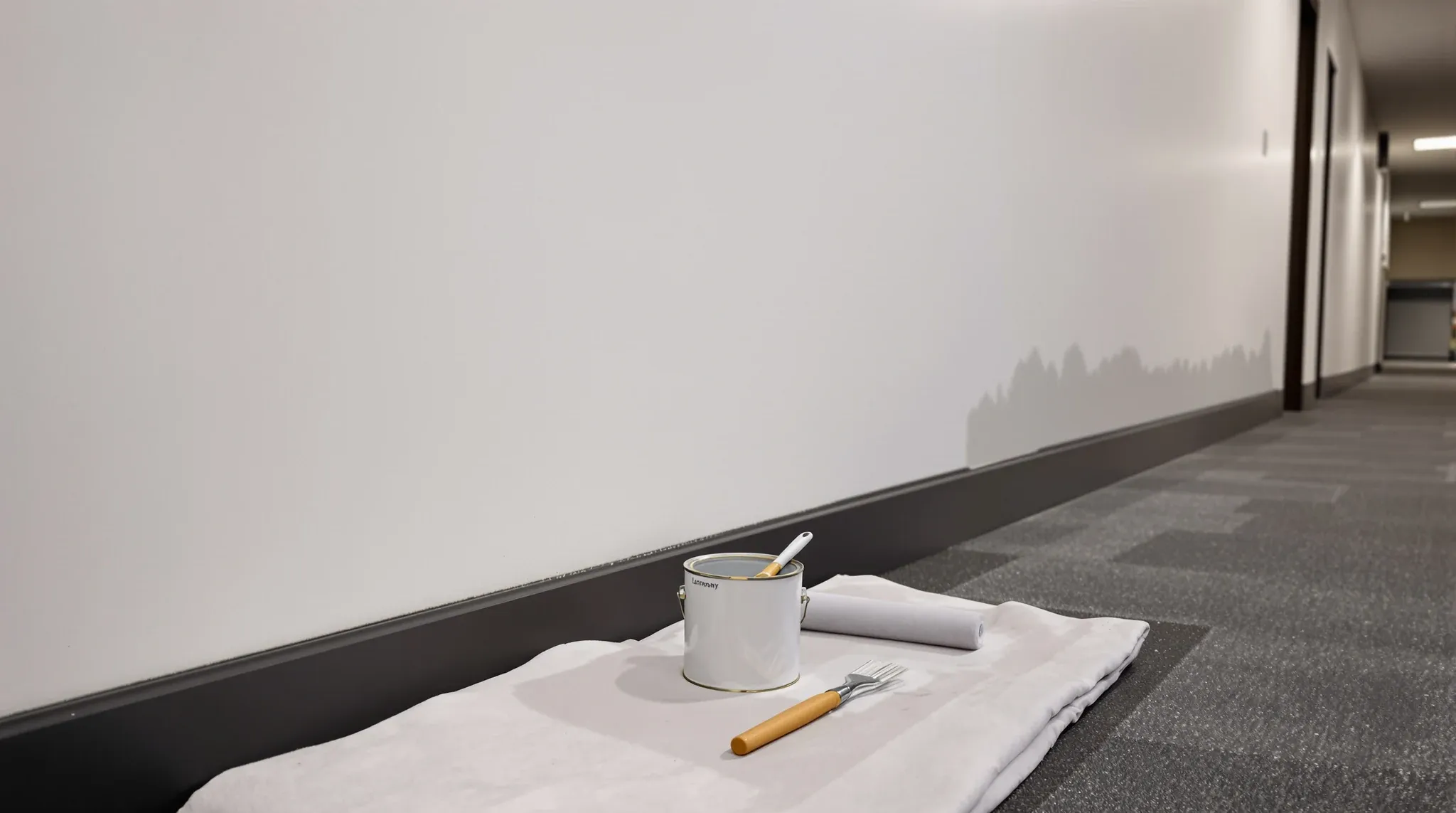
Office walls age faster than most tenants expect. The paint that looked clean at fitout handover starts to show chair-rail abrasion along the meeting rooms in the second year, pin holes accumulate around team boards, and the corners near print hubs and kitchens lose their sharpness in the same places where foot traffic and trolley-based movement is concentrated. None of this is damage in the insurance sense, and none of it justifies a full refurbishment. It is the baseline wear of a working office, and the way a tenant handles it between fitout and lease end shapes both the day-to-day feel of the space and the size of the paint line at make good.
Handled well, touch-up and repaint during the lease is a low-cost maintenance task that keeps the office presentable and reduces the eventual exit bill. Handled poorly, it turns into a patchwork of mismatched paint finishes that tenants still have to fix at lease end, often at a cost higher than if the whole wall had been repainted cleanly in the first place.
How the Walls Actually Wear in a Working Office
The wear pattern in a commercial office is not random. It concentrates in a handful of specific zones that follow how the space is used. The same logic applies across the rest of the fit: the elements that wear first are predictable once you know which parts of a fitout age poorly in Sydney commercial tenancies. Chair rails around meeting rooms and collaboration zones pick up abrasion from the backs of chairs scraping against the wall. Corners along main circulation routes take knocks from trolleys, deliveries, and shoulder-height equipment. Walls adjacent to print hubs collect toner smudges and the occasional chair-height impact from people leaning while waiting for jobs.
Pin holes and adhesive marks accumulate anywhere posters, team boards, or temporary signs go up. A single department that uses one wall for its quarterly planning boards leaves behind a grid of small holes that is invisible from across the room and obvious from a metre away. Skirting boards scuff from vacuum cleaners and heavy foot traffic, particularly in corridors. Wet-zone walls near kitchens and end-of-trip facilities pick up water marks and the occasional stain from cleaning products.
The pattern is predictable enough that a practical office can plan for it. A walk-through every six months, with photographs of the affected areas, builds a record of where wear is accumulating and shows whether a touch-up is enough or whether the zone needs a full repaint. Without that record, decisions get made at the end of the lease under time pressure, which is exactly when the costs are highest.
Where Touch-Up Works and Where it Fails
A touch-up is effective when three conditions are met. The original paint specification is known, including the manufacturer, colour reference, sheen level, and ideally the batch number. The damage is small enough that a spot repair will blend rather than stand out. And the wall surface in the surrounding area has not drifted so far from its original state that the repaired patch reads as newer than everything around it.
All three conditions fail quickly in practice. Paint records from the original fitout are often lost within eighteen months because the tenant has changed facilities coordinators or the fitout contractor has archived the details. Sheen levels shift after a year of cleaning, which means a fresh patch in the same product can look glossier than the surrounding wall even if the colour matches exactly. Colour itself drifts through exposure to light, and a two-year-old wall in a perimeter office is already noticeably different in colour from the fresh paint in the tin that was saved at fitout.
The result is that touch-up works cleanly for small, recent damage on walls that are still close to their handover condition, and less cleanly as the wall ages. For walls more than two or three years into a lease, a spot touch-up often produces a visible halo around the repair, which is worse than the original damage. In those cases, repainting a full wall or a full room is usually the right move, even though it is a larger scope than the damage seems to call for.
When to Shift from Patching to a Room-Level Repaint
The trigger for a room-level repaint is when the accumulated wear has crossed the threshold at which individual patches can no longer blend. Practically, this happens when any one of three conditions is true. The room has accumulated more than a handful of visible patches that did not blend. The paint colour or sheen has drifted noticeably across the wall. Or the wear is distributed rather than concentrated, such that patching would leave a wall speckled with repairs.
Room-level repainting is cheaper per unit area than repeated touch-ups once a room has crossed that threshold, and the finished result is better. The cost is higher upfront but lower over the remaining years of the lease, because the wall will not need to be revisited again until the next major threshold is crossed.
A full-floor repaint is a larger decision. It typically comes up at lease renewal, at the end of a major occupancy change, or when the tenant has decided the fitout needs a visible refresh to match changes in the business. It is usually cheaper per square metre than partial repaints because the contractor can work through the whole floor systematically, and it resets the wall clock across the tenancy so that the next repaint is a clear point in the future rather than a creeping series of partial jobs.
How to Keep Touch-Up Work from Looking Worse than the Damage
The practical rules for good touch-up are straightforward but are rarely followed under time pressure. Keep a record of every paint product used in the fitout, including the manufacturer, product code, colour code, sheen, and batch number, and store it in a location that survives staff changes. Keep a small volume of the original paint on site in sealed containers, stored out of sunlight, so that small repairs can be made with product from the original batch.
Feather the edges of every patch. A touch-up that ends at a hard edge will always read as a patch. A feathered edge, where the new paint is worked outward with a dry roller until the transition becomes invisible, blends into the surrounding wall and disappears. This is slow work and requires a painter who is willing to take the time; a quick touch-up with a loaded brush produces a patch that stands out for the rest of the wall’s life.
Where the original paint is no longer available, accept that the patch will not blend at close range and plan for a wider repaint. Trying to match a paint that is no longer in production typically produces a slightly wrong colour that reads as a repair even to people who would not notice a perfect match. In those cases, repainting a full wall corner-to-corner usually looks better than attempting to patch.
How this Affects the Make Good Bill at Lease End
Most commercial leases require the tenant to hand back the premises in a condition consistent with the original condition report, with fair wear and tear excepted. Paint is one of the most commonly contested line items at make good, because the boundary between fair wear and tenant damage is rarely precise. Walls with accumulated marks, patches that did not blend, or partial repaints in mismatched colours tend to be assessed as needing a full repaint at exit, which shifts the cost back to the tenant rather than into the landlord’s acceptance of fair wear.
Walls that have been maintained across the lease, with clean touch-ups that blend and full repaints done before the patch count became obvious, present better at final inspection and more often attract the fair wear judgement. The cost difference at lease end can run to thousands of dollars per floor, which is usually more than the cost of the maintenance painting through the lease that avoided the problem. The same principle applies to the broader set of decisions covered in general make good work explained for commercial tenants, where proactive mid-lease maintenance consistently reduces the exit bill.
The other interaction with make good is the photographic record. A tenant who has documented the walls through the lease, with dated images of each repair and repaint, has an evidence base that supports a fair wear position. Without that record, the lease-end inspection becomes the first time anyone is comparing the current state to the original, and the comparison tends to be less favourable than it would be with ongoing documentation.
Running the Maintenance Painting Through a Live Tenancy
Painting in a working office is not the same as painting in a vacant one. Dust, fumes, drying time, and furniture moves all affect whether the painting can happen during business hours or has to run after-hours. Low-VOC paints have made daytime painting practical for small repairs, but larger scopes still usually move to evenings and weekends to avoid disrupting occupants and to let the paint cure before the space is reoccupied.
The coordination that makes this work is scheduling. A maintenance painting programme that aligns with natural quiet periods, school holidays, internal team offsites, or holiday shutdowns lands cleanly and does not interfere with business operations. A programme that tries to paint around peak activity tends to produce compromises on surface preparation, feathering, and curing, which shows up in the finish quality.
The broader principle is that the painting work scales with the wall condition, not with a fixed calendar. A floor that is well looked after might go three to five years between room-level repaints, while a higher-wear floor might need the same work every two. Matching the programme to the actual condition keeps the cost proportional to the need and keeps the walls presentable across the lease.
If you are planning mid-lease painting or partition maintenance across a Sydney commercial tenancy, and want the work sequenced so the finish holds and the walls present well at lease end, we can help you plan it. We handle plasterboard partition work across full fitouts and standalone partition projects, so maintenance painting and touch-up sits inside the wider partition and fitout scope rather than as a separate trade line.
📞 Call us on 1300 60 93 93