
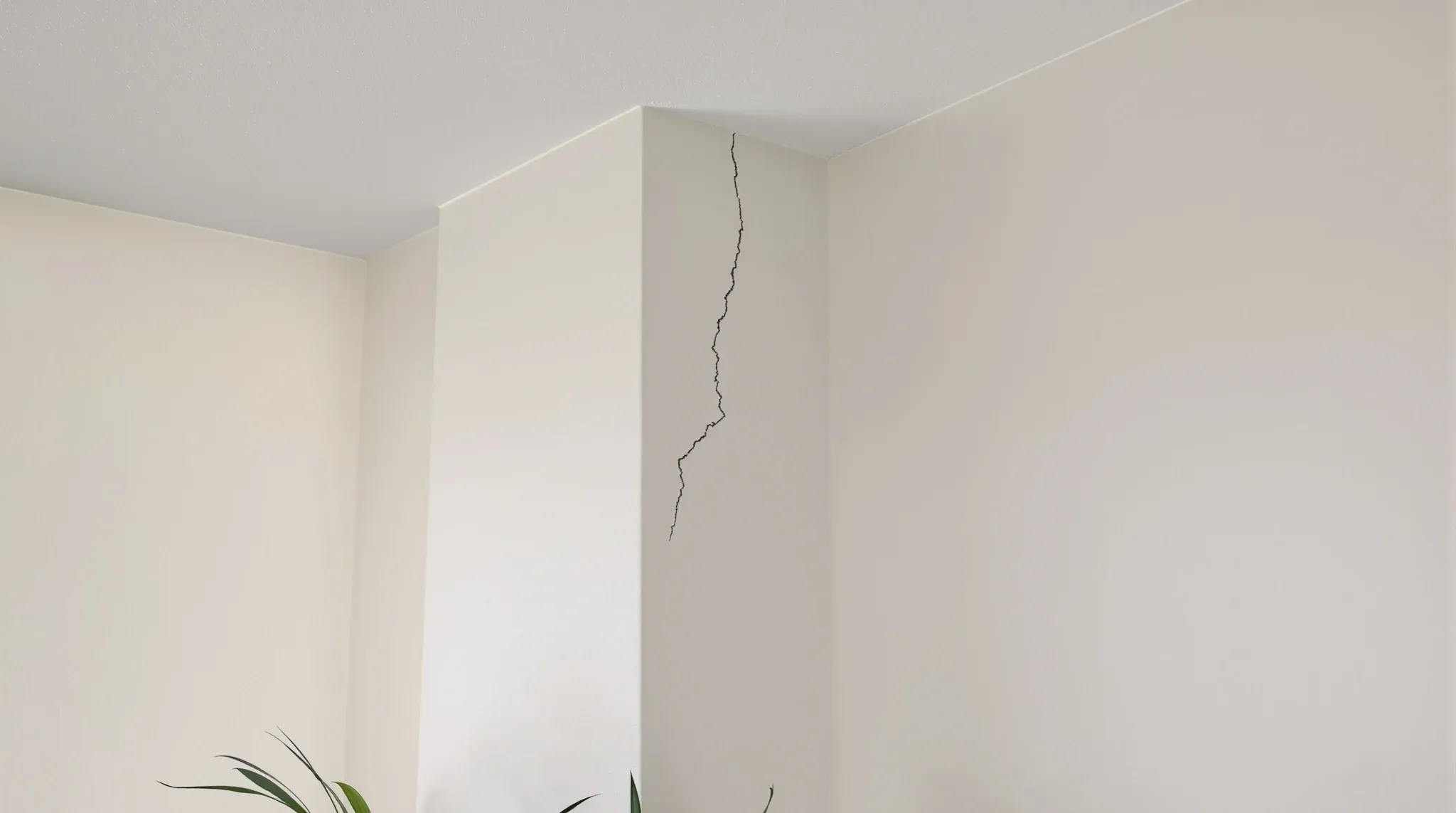
A crack in a commercial office wall is usually a surface problem, sometimes a structural one, and occasionally a sign that the whole section of sheet has to come off and be replaced. The right decision depends on what caused the crack, whether the cause is still active, and what state the sheet is in behind the visible damage. Patching a crack that is still being pulled open by an underlying movement is wasted effort; the same crack reopens within months. Replacing a sheet because of a single hairline that will never grow again is over-scoping. The decision that keeps walls looking right through the lease is narrower than either extreme and depends on reading the crack accurately before choosing the repair.
For most small hairline cracks on a wall that has stopped moving, a properly feathered patch with fresh compound and matching paint is durable for the rest of the lease. For cracks along the head of a wall that sits under a deflecting slab, no amount of filler will hold unless the head detail is addressed first. Between those two extremes sits the majority of commercial office wall cracking, and knowing which category a crack falls into is the difference between one repair that works and a cycle of repairs that never quite lands.
Why commercial office walls crack in predictable places
Cracks follow stress concentrations, and in a plasterboard partition the stress concentrations are in known locations. The head of the wall, where the sheet meets the ceiling line or the slab, is the most common because it is where slab deflection and temperature movement pull hardest on a fixed wall. Corners of door and window openings are the second most common because the framing around an opening transfers load in a way that can open the joints above and beside the frame.
The third common zone is where control joints were needed but not installed. A long run of plasterboard without a control joint behaves as one continuous sheet, and even small movements at either end produce visible cracks along the path of least resistance. The fourth is at the perimeter where the wall meets a column, a facade, or a core element. The plasterboard and the hard base material behind it respond differently to temperature and load, and the joint between them opens predictably.
Impact damage is a separate category. A chair back that hit the wall hard, a trolley that ran into a corner, a pin that was driven and removed several times in the same spot can all produce localised cracking or surface damage that is straightforward to identify by pattern. These cracks are about the event rather than about ongoing movement, and they respond well to patch repair once the underlying surface is stable.
When a patch will hold for the rest of the lease
A patch is the right answer when three conditions are met. The crack is hairline to narrow, typically under about two millimetres wide. The underlying cause is either a one-off event, such as impact damage, or a movement source that has settled, such as completed slab creep. The surrounding wall surface is in a condition that allows the patch to blend after feathering and painting.
The repair itself is routine. The crack is raked back slightly to remove loose material and give the filler something to bond to, filled with a fresh compound appropriate to the wall, taped with paper or mesh if the crack length justifies it, set with two or three coats of compound feathered outward, sanded smooth, spot-primed, and painted. For small repairs this takes an hour or two per location, with return visits to allow each coat to cure.
A well-executed patch is effectively invisible once the paint has fully cured and the surface has had a few weeks to equalise with the surrounding wall. The test is whether the patch is visible at grazing light from six months after the repair. If it still reads, the match was wrong at some point in the process, and the right fix is usually to repaint the whole wall rather than re-patch the patch.
When patching fails and the sheet has to come off
A patch fails to hold when the underlying cause is still active. The most common version of this is a crack along the head of a wall that has a rigid top detail and a slab that continues to deflect. The crack reopens every few months regardless of how well the filler was applied, because the movement that opened it the first time is still happening. In that case, the right repair is not another patch but a correction to the head detail, often in combination with a reboarded top course of sheet.
The same principle applies where a crack has opened because the plasterboard behind it has failed. A sheet that has been wet, impact-damaged through to the core, or delaminated at the paper face cannot be repaired from the surface. Filler over a compromised sheet will hold for weeks to months but will eventually reveal the damage beneath either through visible shadowing, sheen irregularity, or a new crack along the compromised zone. In those cases, the affected section of sheet needs to be cut out, replaced, joint-taped, set, and refinished.
A third failure mode is cosmetic. A crack that has been patched several times with different compounds, in different batches, by different people, produces a zone on the wall that is technically sound but visually busy, with variations in sheen and texture that never equalise. The right move on those walls is usually to replace the full face of sheet, or at least to repaint the full wall after patching, rather than continuing to rebuild the existing patchwork.
How to read a crack before choosing the repair
Three observations do most of the diagnostic work. The first is direction. Horizontal cracks near the top of the wall point to head movement. Vertical cracks at openings point to frame-related stress. Diagonal cracks from the corner of an opening point to the same source but at a later stage of movement. Cracks that follow the joint lines between sheets point to joint compound failure rather than sheet failure.
The second is behaviour over time. A crack that is the same width today as it was six months ago is stable. A crack that has visibly widened, or that reopens repeatedly after patching, is being actively driven by something beneath. Tenants who take a dated photograph of each crack at first notice, and compare it against the same crack six months later, have a straightforward diagnostic record. Without it, the diagnosis is being reconstructed from memory at the point of repair.
The third is what the wall feels like at the crack. A stable crack typically has paper that is intact on both sides of the gap. A crack over an active failure often has paper that is lifting, tearing, or pulling away from the compound, and the sheet behind may deflect slightly under pressure. When the wall fails these touch tests, the repair decision shifts from patch to reboard regardless of how small the crack looks on the surface.
What the reboard actually involves
Replacing a section of sheet is a larger job than a patch but is not a full wall rebuild. The damaged section is cut out along the nearest studs on each side, the exposed framing is checked for any damage or issue that contributed to the original problem, and a new piece of sheet is cut to match and fixed to the framing with screws at the correct centres. The joints between old and new sheet are taped and set with at least three coats of compound, feathered beyond the join into the surrounding wall so the transition is invisible once painted.
Board thickness and type matter. A repair patch of 10mm sheet into a 13mm wall will read as a shadow across the join regardless of how well the compound is applied, because the surface sits slightly low. A repair using a different board grade, such as standard board into a fire-rated wall, may be visually identical but compromises the rating of the whole wall section. The specification has to match the original, which is one of the reasons the fitout record becomes useful years into a lease.
The finishing coats are where most reboard repairs succeed or fail. A repair that is set to the same finish level as the surrounding wall, typically Level 4 across a broad feathered area, blends cleanly under standard office lighting. A repair set to a lower level, or feathered across too narrow a band, shows as a patch under raking light even after painting. The finishing quality is a labour cost, and compressing it produces a visible compromise that usually ends up being redone anyway.
How crack repair fits into the wider partition maintenance picture
A practical approach treats crack repair as one part of the wider partition maintenance programme rather than as a separate reactive task. Mid-lease maintenance painting blends small patches into a broader wall refresh, which reduces the cumulative cost of individual repairs and keeps the walls looking consistent. Documenting cracks as they appear creates a record that supports both the repair decisions across the lease and the fair wear position at make good.
Where cracks keep appearing in the same location despite repairs, the correct response is to treat the location as evidence of a detail problem rather than of a maintenance problem. A recurring crack at the head is a head-detail issue, as covered in the behaviour of poor plasterboard installation producing cracks and rework. A recurring crack at a doorway is a framing or control-joint issue. Fixing the cause is the only durable answer, and it is usually cheaper over the lease than continuing to patch the symptom.
At lease end, unrepaired cracks and visibly patched zones become make good exposure. Walls that were maintained cleanly through the lease, with patches that blend and full repaints handled in good time, present well at final inspection. Walls that accumulated patches without ongoing paint refresh tend to be assessed as needing a full repaint at exit, which adds to the final cost. The allocation of that cost depends on the lease, and the starting point for the commercial tenant in NSW sits inside the wider question of who actually pays for make good at the end of a commercial lease. Keeping the maintenance ahead of the deterioration through the lease is usually cheaper overall than catching up at the end.
If you are dealing with recurring cracks in a Sydney commercial office, or planning mid-lease partition works where the distinction between patch and reboard matters, we can help you diagnose what is driving each crack and sequence the repair so the wall stays presentable for the rest of the lease. We handle plasterboard partition work across full fitouts and standalone partition projects, so crack diagnosis and repair sits inside the same scope as the broader partition build.
📞 Call us on 1300 60 93 93