
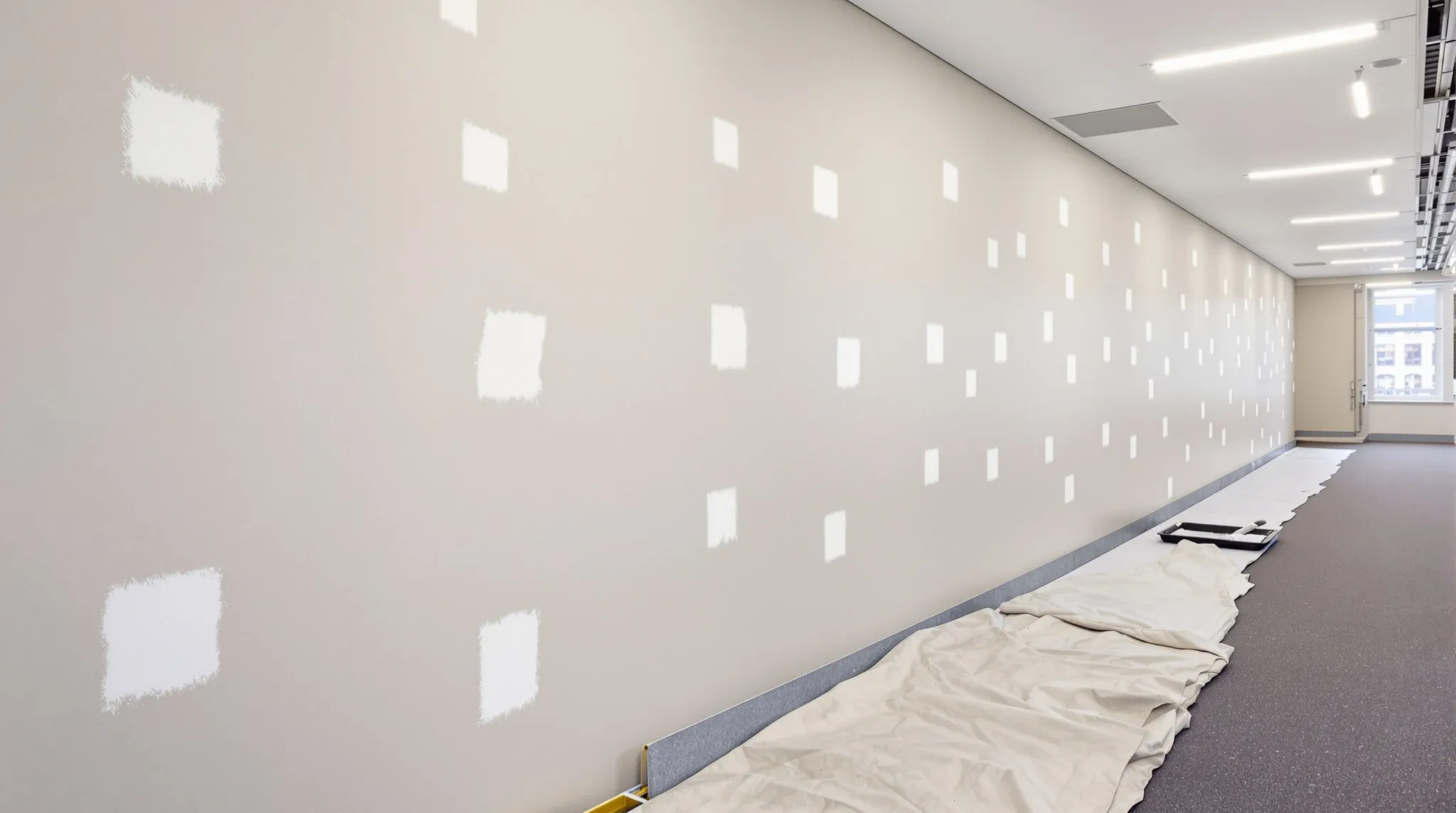
Full repaint or spot patch is one of the larger single decisions inside a commercial office make good, and the answer is rarely in the lease. A lease that asks for the premises to be returned in good condition could be discharged either way depending on the state of the walls, the landlord’s plans for the floor, and what the incoming tenant is expected to accept. Tenants who start from that premise typically end up with a smaller painting bill than tenants who assume “return to original” means a uniform repaint of the entire tenancy.
The short version: if the walls carry clear damage or heavy tenant-specific modification, expect full repaint in those zones. If the walls are generally intact with localised marks, spot patching is a defensible position. The useful detail is where the boundary sits, and how to read the landlord’s side of the conversation before accepting a scope.
Typical Make Good Painting Scope
Painting inside a make good is not just walls. The scope usually covers walls, ceilings where damaged, doors and door frames, skirtings, architraves, reveals, and any built-in joinery that was painted during the occupancy. It can also pick up service-riser doors, comms cupboards, and meter-box doors if those were touched. On floors with exposed concrete or stained ceilings, the scope narrows to vertical surfaces and joinery; on floors with plastered and painted soffits, ceiling paint re-enters the discussion.
The method matters as much as the surface list. Two coats of paint over a primed patch behaves differently from a whole-wall skim and repaint, and both look different again three months later in side-light. A scope that simply reads “repaint walls” without describing preparation, patching depth, or finish level tends to produce surprises at final inspection.
When Full Repainting Is Unavoidable
There are a handful of conditions under which full repaint, usually measured wall by wall rather than room by room, is the sensible assumption. The first is heavy or widespread surface damage: deep scuffs at furniture-rub height, chair-rail impact across multiple rooms, dropped fixings that have pulled back paint, or fitout removal that has left irregular patching that cannot be blended on a spot basis.
The second is colour change. Walls painted in a tenant-specific colour, whether a brand tone or a feature-wall accent, almost always need to come back to a neutral base at end of lease. Spot patching a navy feature wall with off-white primer produces a visually uneven surface no landlord will accept; full repaint of the affected wall, and often the adjoining ones, is the realistic path.
The third is age and cumulative wear. On a tenancy that has run more than about seven years, the original paintwork has typically gone through enough cleaning cycles, sun exposure, and general wear that the entire space reads as tired. Spot patching simply moves the problem around the floor; full repaint delivers a consistent surface the landlord can re-let without apology.
The fourth is a structural reconfiguration. Where partitions have been removed during strip out, the wall line where they joined existing surfaces rarely patches cleanly. The adjoining wall needs a full-face repaint to hide the line where the partition used to be, and the opposing wall often needs the same treatment for consistency.
Realistic Outcomes for Spot Patching
The opposite case is equally common. A tenancy with a short to medium lease term, neutral colour scheme, light occupancy, and no major fitout changes can usually be handed back with spot patching rather than full repaint. The walls carry the usual knocks around door swings, workstation edges, and service cupboards. Each of those is localised, each is repairable, and each blends acceptably into the surrounding finish when the original paint colour has been kept.
Spot patching also tends to be the right call when the landlord’s intended next use of the space is confirmed refurbishment. There is no point repainting walls that are about to be removed as part of a new tenant’s fitout. In that case the landlord often proposes a “paint to match, patches only” scope, and a tenant accepting that is delivering exactly what the floor needs.
The realistic condition for a spot-patch outcome is that the tenant has kept a record of the original paint specification, ideally with a brand name and code. Without that, patches rarely blend on the first attempt, the landlord’s consultant finds visible witness marks on the final walk, and the scope quietly expands to full-wall repaint. Keeping a note of the paint specification on file from day one is a small piece of administration that keeps the exit simpler.
Managing Scope Creep on Trims and Doors
The wall surface gets most of the attention in a paint scope, but the overruns tend to live elsewhere. Door faces absorb years of traffic and handle contact, and a door that has been cleaned with the wrong product often shows a halo around the lock plate. Skirtings pick up shoe scuffs and trolley marks that sit at a height most office cleaning misses. Architraves around frequently-used doors carry compressed paintwork where fingers have pushed them open.
In a make good schedule, these items are usually itemised separately from walls and can account for a quarter or more of the paint budget on larger floors. A tenant who treats paint scope as “just the walls” at quoting stage and only sees the trim items at handover tends to be surprised by the total. Treating the fittings as part of the scope from the beginning produces a tighter final number.
The same applies to any painted joinery the tenant installed. Printer nooks, kitchen backs, built-in storage, and branded reception desks are all scope items if they were painted during the occupancy and are being reinstated to a neutral base. Joinery removal tends to leave the surrounding walls needing attention too, which is why joinery items are rarely cleanly isolated in the paint scope.
Addressing Feature Walls And Brand Accents
Feature walls are the single most predictable driver of paint scope expansion. A reception wall painted in a brand accent, a boardroom with a dark timber-look finish, a collaboration zone with a specialty texture, or a corridor run in a signature tone all land in the same place at lease end: neutralised back to a base colour, usually with the landlord’s approval on the exact shade.
What tenants often miss is the adjoining surface. A feature reception wall is rarely isolated on one plane; it usually wraps into a soffit, meets a joinery element, or sits adjacent to another wall that has been painted to complement it. Returning only the obvious feature wall to neutral usually leaves the adjoining surfaces visually detached and the landlord rightly pushes back. Scoping the feature wall and its immediate visual context together is the practical way to avoid a second visit.
Digital printing, vinyl graphics, and brand murals sit in the same category but add a removal step before paint. Adhesive residue, ghosting from aged vinyl, and surface damage from removal all tend to need remediation before the painters touch the wall. That work is usually outside the painting scope in a make good quote and needs to be included explicitly or it creates a gap at handover.
How Landlord Reletting Plans Impact Scope
The underlying commercial fact inside most paint decisions is what the landlord intends to do with the floor after handover. A floor being held for refurbishment has almost no value in a high-specification paint scope. A floor being re-let as-is, to an incoming tenant who expects neutral walls and move-in-ready presentation, values paint scope highly and will push for more of it.
Tenants rarely ask the landlord’s agent directly about the re-letting plan, but a straightforward conversation with the property manager is usually informative. If the answer is “we’ll be refurbishing the floor before the next tenancy,” the case for a minimal paint scope is strong. If the answer is “we have someone looking at it already and they want move-in ready,” the scope is realistic to expect on the higher side.
This is not a matter of overreach or generosity on the landlord’s part. It is a commercial reality of what the floor needs next, and understanding that reality is often the difference between a proposed scope that feels punitive and one that reflects what is genuinely required for the re-let. It is the same underlying logic that drives the broader conversation about what is actually required and what is negotiable in a make good more generally.
Practical Strategies To Control Painting Costs
Several straightforward habits during the tenancy reduce the paint scope at exit. Keeping a documented record of the original paint colour and specification, in an accessible file, avoids the “we don’t know what this wall was” problem at lease end. Touching up knocks and scuffs every twelve to eighteen months during the occupancy, rather than letting them accumulate, keeps the wall surfaces in a state where spot patching at exit is viable rather than notional.
Keeping feature walls to a minimum, and where they are used, documenting their full extent including adjoining surfaces, makes the exit scope predictable. Removing vinyl graphics and applied films yearly rather than only at lease end reduces adhesive damage and the risk of surface defects that push paint into a larger scope. Any partition choices made with lease end in mind will also reduce the paint scope by reducing the patch work at wall junctions after strip out.
None of this avoids paint work entirely. It keeps the paint scope inside a realistic band rather than pushing it into full-floor repaint territory. Tenants who approach make good planning early usually find the paint scope sits at the lower end of what the lease allows; tenants who only engage in the final six weeks often discover the scope has already settled at the higher end by default.
If you are reviewing a make good scope and the paint items look heavier than the condition of the space actually warrants, we can walk through the walls with you, separate the items that genuinely need a full repaint from the items that would patch acceptably, and deliver the make good painting to a scope that reflects what the tenancy actually requires.
📞 Call us on 1300 60 93 93