
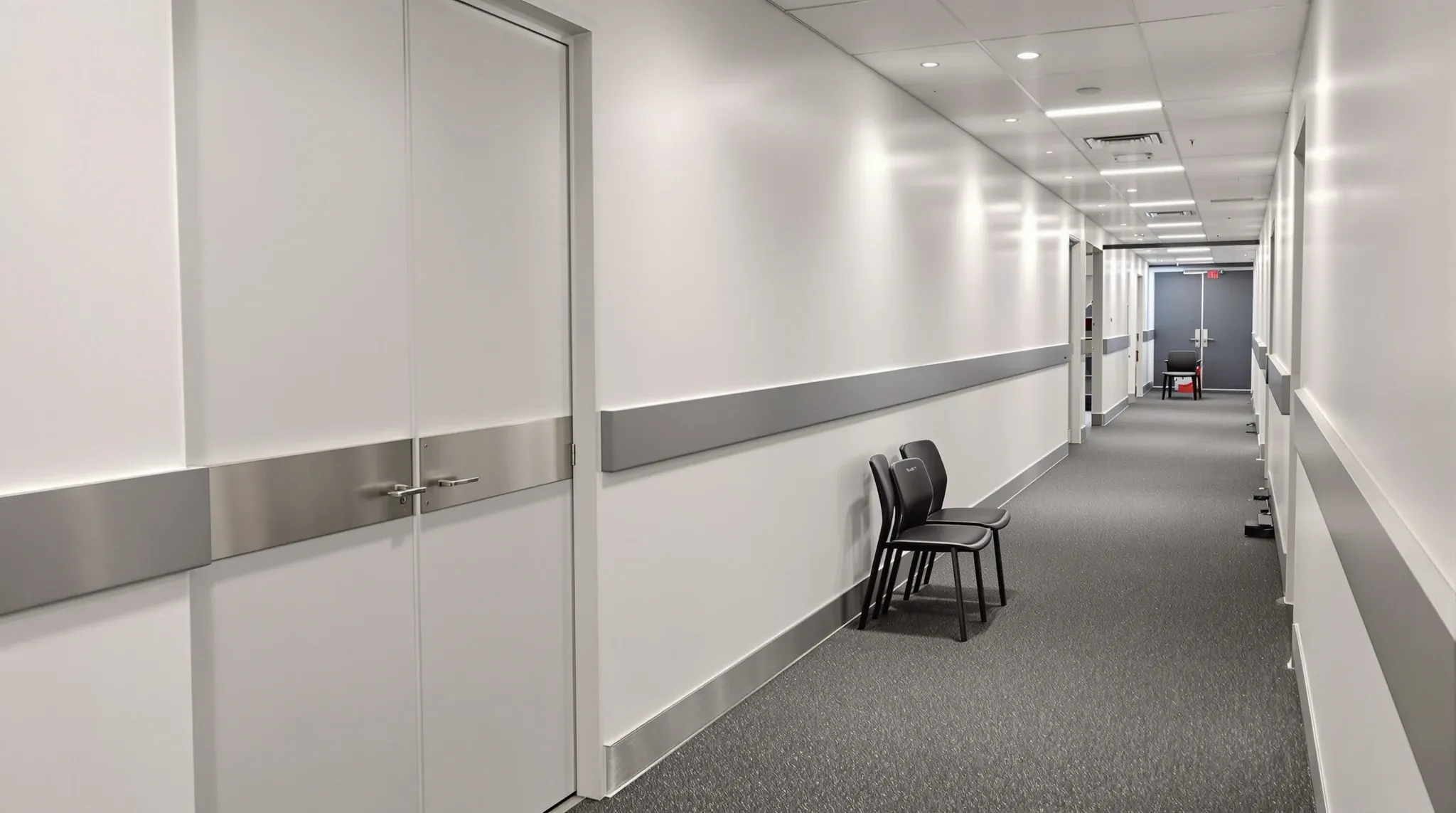
Plasterboard partitions in high-traffic offices face physical demands that standard office partitions do not. Corridors with constant foot traffic, open-plan areas with mobile furniture, back-of-house zones with regular deliveries, and client-facing areas where trolleys, equipment cases, and luggage move through the space daily all create impact, scuff, and wear conditions that test the durability of the wall surface and the framing behind it.
The question is not whether plasterboard can handle these conditions. It can, when specified correctly. The question is whether the plasterboard specification in a high-traffic zone differs from the specification in a standard office, and what the cost and performance implications of that difference are. In most fitouts, the same plasterboard specification is applied to every wall regardless of location, which means the walls in the busiest parts of the office are built to the same standard as the walls in the quietest corner. The result is predictable: damage, patching, and replacement costs that accumulate over the lease term and reduce the visual quality of the space.
This article examines how to specify plasterboard partitions for high-traffic areas, what the durability options are, and where the cost of a higher specification is justified by the reduction in maintenance and replacement over the life of the tenancy.
How Impact Damage Happens in Commercial Offices
Impact damage to plasterboard walls is rarely dramatic. It is cumulative. A chair back hitting the same spot repeatedly. A door handle striking the adjacent wall because the door does not have a wall stop. A trolley or delivery cart clipping a corner as it rounds a corridor. A filing cabinet being pushed against a wall surface. Each individual impact is minor, but over months and years the wall surface shows dents, cracks, scuffs, and holes that degrade the visual quality of the space.
The areas most vulnerable to impact damage are corridor walls, walls adjacent to doors without adequate clearance, walls behind reception desks and shared workstations, back-of-house and kitchen areas, and any wall that sits along a primary circulation route. In client-facing offices, the visual impact of cumulative damage to these surfaces is a commercial problem, not just a maintenance issue. A wall with visible dents and patches does not communicate the professionalism the business intends, regardless of how the rest of the office looks.
Standard Plasterboard vs Impact-Resistant Plasterboard
Standard 13mm plasterboard, the default product in most commercial fitouts, has a gypsum core with a paper face. It provides adequate structural performance for general office walls but is relatively soft and vulnerable to point-load impacts. A solid push from a chair back or a sharp impact from a door handle can dent or puncture the surface, and the repair requires patching, setting, sanding, and repainting, which is time-consuming and rarely invisible.
Impact-resistant plasterboard, sometimes marketed as high-impact or abuse-resistant board, uses a denser gypsum core reinforced with fibreglass mesh or other strengthening additives. The surface is harder and more resistant to point-load impacts, and the board maintains its integrity under conditions that would dent or puncture standard plasterboard. The most common impact-resistant products in the Australian market achieve impact resistance ratings that are three to five times higher than standard board.
The cost premium for impact-resistant plasterboard is typically 20 to 40 percent per sheet compared to standard board. This premium is modest relative to the total wall cost, which includes framing, insulation, finishing, and paint, and it is easily offset by the reduction in patching and repainting over a five to ten year lease term. In high-traffic zones where standard board would require multiple repairs during the tenancy, the impact-resistant alternative often costs less over the full lease term than the standard board plus its accumulated maintenance.
Corner Protection and Wall Accessories
Plasterboard corners are the most vulnerable point on any wall surface. A 90-degree external corner has no resilience to impact, and even a light contact with a trolley, a chair, or a moving piece of furniture can chip or crush the corner bead beneath the plaster finish. Once the corner is damaged, the repair is conspicuous because the straight line of the corner is interrupted, and any patch is visible under the raking light that hits corner surfaces.
Corner guards, whether metal, PVC, or rubber, protect the most exposed corners from impact damage. In high-traffic corridors, back-of-house areas, and zones where trolleys or equipment regularly pass, corner guards are a standard inclusion that pays for itself within months of occupation. The aesthetic impact of corner guards can be minimised by choosing profiles that match the wall colour and sit flush with the wall surface, making them virtually invisible while providing continuous protection.
Wall protection rails, also known as chair rails or bumper rails, provide a horizontal band of protection at the height where most impacts occur. In corridors, these rails prevent trolley and wheelchair damage. In meeting rooms, they prevent chair backs from contacting the wall surface. The rails add a small cost to the fitout but eliminate the most common source of wall damage in the areas where they are installed.
Finish Selection for Durability
The paint finish on a plasterboard wall affects its durability and cleanability. Standard flat or matt finishes are the most common in commercial offices because they provide a clean, non-reflective surface that conceals minor imperfections in the plasterboard finish. However, flat finishes are difficult to clean, show marks and scuffs easily, and cannot withstand regular wiping without losing their surface quality.
In high-traffic areas, a low-sheen or semi-gloss finish is more practical. These finishes are harder, more resistant to scuffing, and can be wiped clean without degrading the paint surface. The trade-off is that higher-sheen finishes reveal more of the underlying plasterboard finish quality, which means the setting and sanding work must be to a higher standard than it would be under a flat finish. This adds a small cost to the finishing stage but delivers a surface that maintains its appearance for significantly longer in areas that receive regular contact and cleaning.
How Traffic Patterns Should Inform Partition Specification
The specification for plasterboard partitions should vary by location within the office, not be uniform across the entire fitout. This means identifying the high-traffic zones during the design stage and specifying appropriate products and protection for each zone.
Corridors and primary circulation routes should use impact-resistant board with corner guards and a cleanable paint finish. Back-of-house areas, kitchens, and utility spaces should use impact-resistant board with wall protection rails where trolleys or equipment move through. Client-facing areas, including reception and meeting room corridors, should use impact-resistant board with a higher-quality finish and appropriate protection at vulnerable corners.
General office areas, including open-plan boundaries and internal room walls that are not on circulation routes, can use standard plasterboard because the impact risk is low and the cost premium of impact-resistant board is not justified. By varying the specification to match the actual conditions in each zone, the budget is allocated where it delivers the most value and the overall durability of the fitout is maximised without unnecessary cost in low-risk areas.
The Long-Term Cost Argument
The cost of maintaining plasterboard walls in a high-traffic office is rarely budgeted at the fitout stage, but it is real and recurring. Each patch requires a plasterer to attend site, repair the damage, sand the repair, and repaint the area. The paint match is never perfect, and after multiple patches the wall develops a patchwork appearance that cannot be resolved without repainting the entire surface. In a busy reception area or client corridor, this cycle of damage, patch, and eventual full repaint can occur multiple times over a ten-year lease.
Specifying impact-resistant plasterboard in these areas at the fitout stage interrupts this cycle. The wall resists the impacts that would damage standard board, the patching cycle is eliminated or significantly reduced, and the wall maintains its original appearance for longer. The cost premium at the fitout stage is a fraction of the cumulative maintenance cost that the standard specification would have generated.
Moisture and Wet Area Considerations
In high-traffic offices that include kitchens, bathrooms, or wet utility areas, standard plasterboard is not appropriate for walls that may be exposed to moisture. Moisture-resistant plasterboard, identifiable by its green or blue face paper, uses a water-resistant gypsum core and treated face paper that resists moisture absorption. It should be specified for any partition that forms a kitchen wall, a bathroom partition, or a wall adjacent to a dishwasher, sink, or plumbing connection.
Standard plasterboard exposed to repeated moisture contact will absorb water, swell, lose structural integrity, and eventually fail. The failure is not sudden but progressive, starting with softening of the core behind the paint surface and eventually resulting in visible deformation, mould growth, and the need for full panel replacement. Specifying moisture-resistant board in wet areas at the fitout stage prevents this failure mode entirely, at a cost premium that is negligible compared to the cost of replacing failed standard board in a wet zone after occupation.
If you want to specify plasterboard that matches the demands of each area in your office, we can help. We build complete fitouts and standalone partition installations with the right product in every location.