
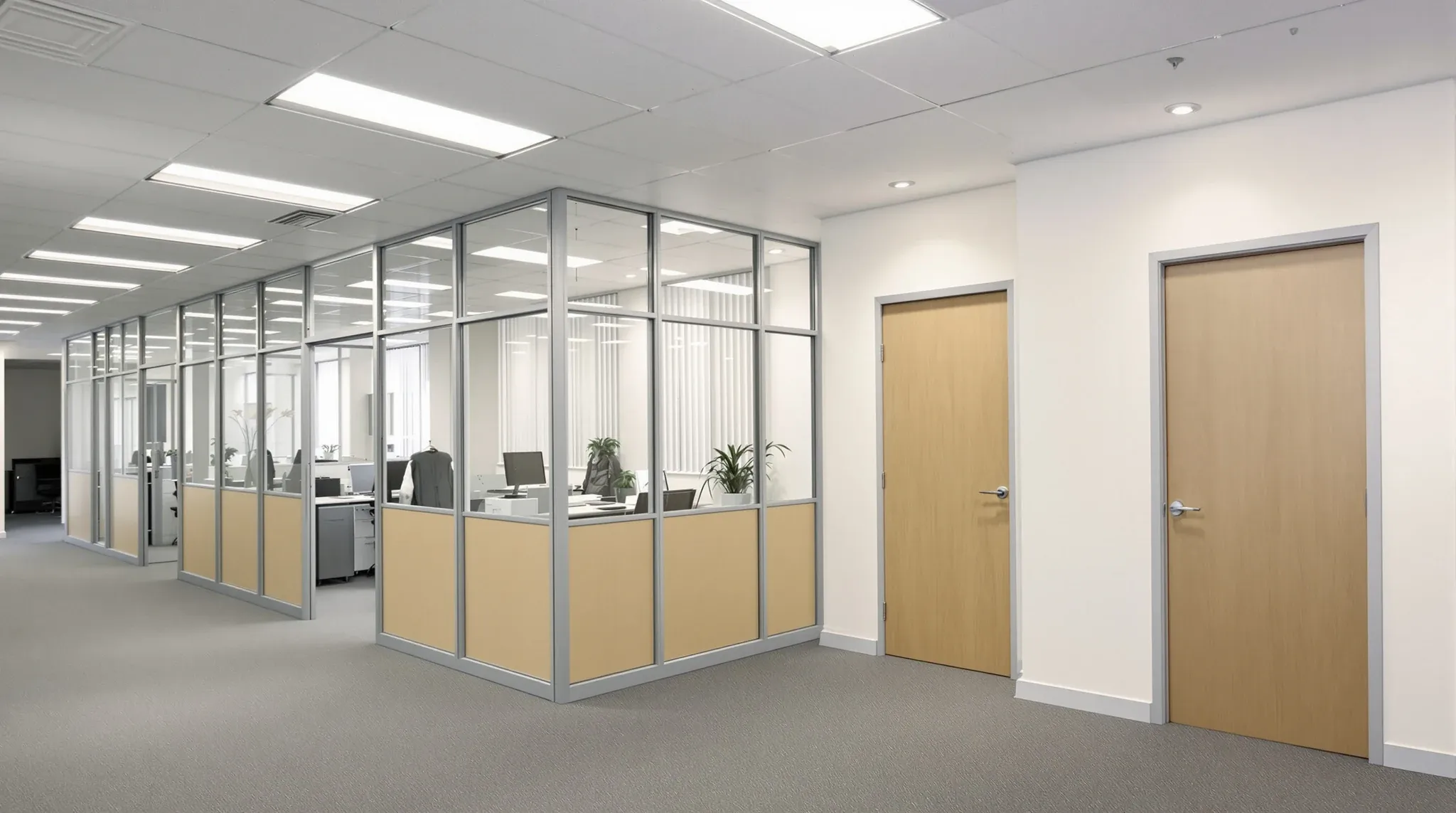
The decision between modular and fixed office partitions is rarely as simple as choosing flexibility over permanence. Both systems have genuine strengths, and the right choice depends on how long the business will occupy the space, how likely the layout is to change, and whether the total cost over the lease term favours the higher upfront investment of modular systems or the lower installation cost of fixed plasterboard construction.
Most tenants approach this decision by comparing the installation price, which almost always favours fixed partitions. But the installation price tells less than half the story. The real comparison is between the total cost of ownership across the full lease term, including maintenance, reconfiguration, and make good costs. When those additional factors are included, the economics shift in ways that can favour either system depending on the specific circumstances of the tenancy.
What Fixed Partitions Deliver Over a Long Lease
Fixed partitions, typically built from plasterboard on steel or timber stud frames, offer a mature and well-understood construction method that delivers strong acoustic performance, a solid feel, and a finished surface that accepts paint, wallpaper, and mounted fixtures without special hardware. The construction process is straightforward, the materials are readily available, and the labour pool of plasterers, painters, and carpenters who can build and finish these walls is large.
Over a long lease of seven to ten years, fixed partitions perform well because they are durable, require minimal structural maintenance, and provide consistent acoustic performance throughout the tenancy. The plasterboard surface may need repainting every three to five years to maintain its appearance, and occasional patching may be needed where fixings have been removed or furniture has caused damage, but these maintenance tasks are inexpensive and can be managed within normal building maintenance budgets.
The acoustic performance of well-built plasterboard partitions is one of their strongest long-term attributes. A properly specified and installed plasterboard wall maintains its acoustic rating indefinitely, provided the wall is not penetrated by new services or modified in ways that compromise the seal. For offices where acoustic privacy is a firm requirement throughout the lease, the reliability of fixed partition performance over time is a significant advantage.
What Modular Partitions Deliver Over a Long Lease
Modular partitions offer adaptability as their primary long-term advantage. Over a seven to ten-year lease, most businesses undergo at least one significant organisational change that affects how the office is used. Teams grow or shrink, new functions are added, work patterns evolve, and the spatial requirements that seemed right at the start of the lease no longer match how the business operates. Modular partitions accommodate these changes without the cost and disruption of demolition and reconstruction.
The ability to reconfigure the layout also has value in how the business responds to external changes. A shift toward hybrid working may mean that fewer individual offices are needed and more collaborative spaces are required. A new client project may demand a dedicated secure area that did not exist in the original layout. A subletting arrangement may require the floor to be divided differently. Each of these scenarios is easier and cheaper to manage with modular partitions than with fixed walls.
The long-term durability of modular systems depends heavily on the quality of the system and the care with which it is maintained. Higher-specification modular systems from established manufacturers are designed for multiple reconfigurations over their lifespan and use hardware that withstands repeated assembly and disassembly. Lower-specification systems may show wear at the connection points after two or three reconfigurations, with loosening joints, damaged clips, and panel alignment issues that affect both the appearance and the acoustic performance.
Comparing Total Cost of Ownership
The installation cost of modular partitions is typically 25 to 50 per cent higher than fixed plasterboard construction for a comparable layout. On a fitout with 50 linear metres of partitions, that premium might represent $10,000 to $25,000 of additional spend at the outset. This is the number that most tenants focus on, and it is a genuine cost difference that needs to be justified by the downstream benefits of the modular system.
The maintenance cost comparison generally favours modular systems over a long lease. Modular panels do not need painting, do not crack at joins, and do not show the settlement marks that plasterboard walls develop as the building ages. Fixed partitions typically need one full repaint during a five-year lease and two during a ten-year lease, with additional patching and touch-up work in between. Over a ten-year term, the maintenance saving from modular panels can amount to several thousand dollars.
The reconfiguration cost is where the comparison produces the largest variance. A single layout change using modular partitions might cost $3,000 to $8,000, involving disassembly, repositioning, and reassembly of the affected panels. The same layout change using fixed partitions requires demolition of the existing walls, construction of new walls in the revised positions, and full finishing including plastering, painting, and caulking, which typically costs $8,000 to $20,000 or more depending on the extent of the change. If two or three reconfigurations occur during the lease, the cumulative saving from modular systems can exceed the original installation premium.
The make good cost at lease end also differs. Modular partitions can usually be removed in one to two days with minimal damage to the building fabric, and the restoration of the floor and ceiling where the tracks were fixed is typically straightforward. Fixed partition removal involves demolition, waste disposal, floor and ceiling repair, and repainting of the areas where the walls were connected to the base building. The make good cost for fixed partitions is consistently higher than for modular systems, and the difference is proportional to the extent of the partitioning. Designing offices that are cost-effective to restore at lease end is one of the practical reasons tenants choose modular over fixed construction.
Acoustic Performance Over Time
Fixed plasterboard partitions generally start with better acoustic performance and maintain that performance more reliably over time than modular systems. A plasterboard wall built to a specific acoustic rating will deliver that rating consistently for the life of the wall, provided it is not modified or penetrated in ways that create new sound paths.
Modular partitions have more potential failure points for acoustic performance. The panel-to-panel joints, the head and base track seals, and the junction details at corners and T-intersections all rely on compression gaskets or silicone seals that can degrade over time or lose their effectiveness after the system is reconfigured. Each reconfiguration carries a small risk that the reinstalled system does not achieve the same seal quality as the original installation, which can result in a gradual decline in acoustic performance.
For offices where acoustic performance is the primary concern and layout flexibility is secondary, fixed partitions are the more reliable long-term choice. For offices where a moderate level of acoustic performance is acceptable and the ability to adapt the layout is more valuable than maximum sound isolation, modular systems provide a workable compromise. Understanding what drives acoustic performance in partition walls helps tenants set realistic expectations for both system types.
Durability and Wear Patterns
The durability comparison between modular and fixed partitions is nuanced. Fixed plasterboard walls are robust against incidental contact but vulnerable to point impacts. A trolley wheel or a chair back hitting a plasterboard wall can create a dent or puncture that requires patching and repainting. These repairs are straightforward but they accumulate over a long lease, particularly in high-traffic areas and near doorways.
Modular panels, depending on their construction, may be more resistant to point impacts because the panel substrates are often denser and harder than plasterboard. Laminate-faced modular panels can withstand impacts that would damage plasterboard, and they do not require painting to maintain their appearance. However, if a modular panel is damaged, the replacement process may be more complex and expensive than patching plasterboard, particularly if the panel is a custom size or finish that needs to be ordered from the manufacturer.
Glass panels in modular systems have their own durability considerations. Toughened glass is highly impact-resistant but cannot be repaired if it chips or cracks, and a damaged panel must be replaced entirely. Over a long lease in a busy office, the probability of at least one glass panel requiring replacement is not negligible, and the cost of a replacement panel, including removal of the damaged glass and installation of the new one, should be factored into the long-term ownership cost.
How Lease Type Influences the Choice
The lease structure has a direct bearing on which system delivers better value. On a standard lease with a full make good obligation, modular partitions offer a clear advantage in the end-of-lease calculation because they can be removed more cleanly and cheaply. On a lease where the landlord has agreed to accept the fitout as-is, or where a contribution toward make good is built into the lease terms, the advantage narrows because the tenant’s exposure to restoration costs is already reduced.
Sublease arrangements add another layer to the consideration. If the tenant expects to sublease part of the floor during the term, modular partitions make the subdivision process faster and less expensive. A modular wall can be installed to create a separate tenancy zone in days rather than weeks, and it can be removed just as quickly when the sublease ends. For businesses on larger floor plates where subletting is a realistic possibility, this flexibility can generate income that more than offsets the modular premium.
Lease renewal negotiations also interact with the partition choice. Tenants with modular partitions can demonstrate to the landlord that their fitout is easily removable and low-impact, which can simplify the make good negotiation at renewal time. Tenants with extensive fixed partitions may face a more detailed make good assessment, particularly if the landlord wants to reposition the space for a different use or tenant profile.
Making the Right Long-Term Decision
The best long-term partition choice is the one that matches the way the business is likely to use the space over the full lease term, not just the way it uses the space today. Tenants who can predict with reasonable confidence that their layout will remain stable for the duration of the lease are well served by fixed plasterboard partitions, which offer lower upfront cost, reliable acoustic performance, and a solid, permanent feel that suits established office environments.
Tenants who know or suspect that their spatial requirements will change, or who value the ability to adapt without major construction projects, should seriously consider modular systems despite the higher initial investment. The total cost of ownership over a lease with one or two reconfigurations is often comparable between the two systems, and the operational flexibility that modular partitions provide has real commercial value for businesses in growth or transition.
For tenants who are unsure, a hybrid approach often works well. Fixed partitions for the rooms that are unlikely to change, such as server rooms, bathrooms, and core utility spaces, and modular partitions for the spaces that may need to adapt, such as meeting rooms, office partitions around open plan areas, and team zones. This approach captures the cost advantage of fixed construction where flexibility is not needed and the adaptability of modular systems where it is.
If you are deciding between modular and fixed partitions and want a detailed cost comparison based on your specific lease term, layout, and operational requirements, we can run the numbers for both options and help you choose the system that delivers the best long-term value.
Call us on 1300 60 93 93