
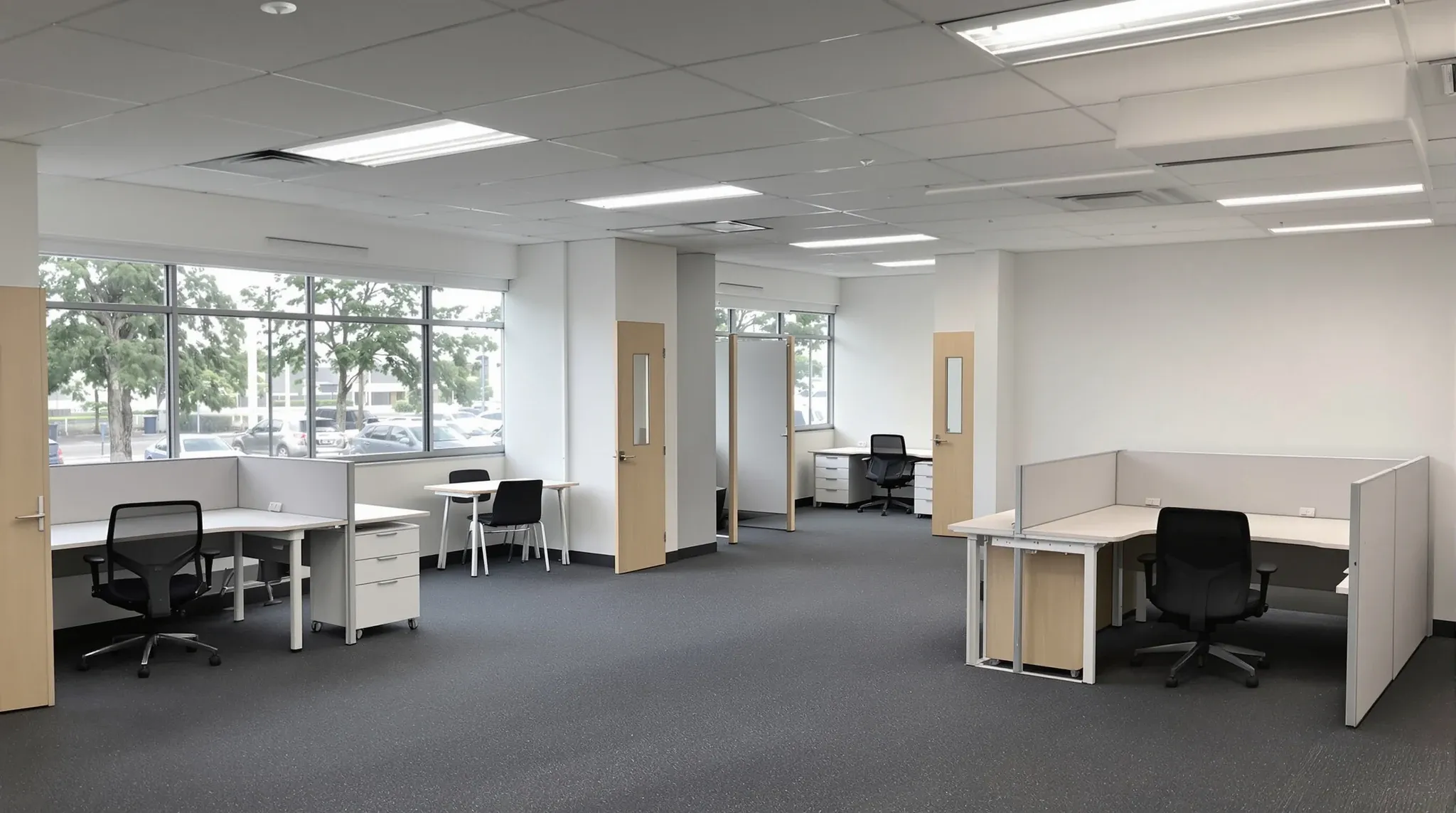
Temporary make good is the quiet middle ground of lease-end negotiation in commercial Sydney offices. Instead of stripping a tenancy back to base-building condition at the cost of weeks of works and a material six-figure line item, the outgoing tenant and the landlord agree to a reduced scope that leaves most of the fitout in place for the next occupant. It is a practical decision, driven by the commercial realities of re-letting, not a loophole.
The short version: temporary make good works when the landlord has a credible incoming tenant who can use the existing fitout, when the building strategy supports a fitted handover, and when both parties are prepared to document the agreed scope carefully. It does not work when the lease clause is held to strictly, when the incoming tenant’s needs are incompatible with the existing fitout, or when the landlord prefers a clean base-building handover regardless of the commercial context. Knowing which case applies early in the exit window is where the savings come from.
What Temporary Make Good Actually Is
In most NSW commercial leases, the tenant’s end-of-lease obligation is to reinstate the tenancy to a defined condition, usually “base-building” or “original” or a specific agreed standard. That obligation is the default. Temporary make good is a negotiated variation of that default, under which the tenant performs a reduced scope and the landlord accepts the space in a condition closer to the current fitted state than to base building.
The negotiation is usually triggered by a specific commercial context rather than a general preference. A landlord with an incoming tenant lined up, for whom the existing fitout is substantially usable, has a commercial reason to accept a reduced scope: avoiding the redundant cycle of strip-out followed by a fresh refitout. A landlord without such a tenant prefers full make good, because bare space is easier to market and sign than fitted space the new tenant may not want.
Typical temporary make good scopes include: remove tenant branding, signage, and wayfinding; reinstate meeting room names and nameplates to neutral; deep-clean the tenancy; make good any visible damage to partitions and ceilings; reinstate any services that were specifically tenant-installed and would interfere with the incoming tenant’s needs; retain the general partition layout, the ceiling, the flooring, and the kitchen, in substantially existing condition.
The elements retained are usually the ones that would be expensive for the incoming tenant to rebuild and that suit their planned use. The elements reinstated are usually the ones that are unambiguously tenant-specific (branded or bespoke) or that would impede the incoming tenant (specialist installations, unusual room layouts, or equipment-specific infrastructure).
When Temporary Make Good Is The Right Answer
Three conditions usually need to be present for temporary make good to work commercially.
The first is that the existing fitout is genuinely reusable. A tenancy with a standard-quality fitout, typical partition layout, functional kitchen, clean meeting rooms, and generic branding is far easier to hand over fitted than a tenancy with unusual specialist spaces, equipment-specific infrastructure, or layouts designed around one tenant’s very particular operating model. The more generic the existing fitout, the more candidates the landlord has for a fitted handover.
The second is that the landlord has either an incoming tenant for whom the fitout suits, or a strong market thesis that fitted space will re-let faster than base-building in the current cycle. In some Sydney precincts and at some points in the cycle, fitted tenancies let faster because smaller tenants increasingly want space they can occupy immediately. In other precincts and cycles, landlords prefer bare space because they see more control over the eventual quality of the fitout.
The third is that both parties are willing to document the agreed scope carefully enough to survive a later dispute. Temporary make good is a deviation from the lease’s written obligation, and the paper trail matters. A short written agreement between the tenant and landlord, signed at scoping stage and confirmed at handover, protects both sides if the relationship sours later.
When Temporary Make Good Is The Wrong Answer
It is worth being direct about the situations in which temporary make good is not commercially available or not worth pursuing.
Where the landlord’s portfolio strategy demands a clean handover, temporary make good usually is not on the table. Some institutional landlords hold to the principle that every tenancy returns to base-building at end of lease, to preserve flexibility in how the space is re-let. That position is usually inflexible, and the tenant pushing back against it tends to spend more time than it saves.
Where the incoming tenant’s requirements are incompatible with the existing fitout, the commercial benefit evaporates. A landlord who has signed an incoming tenant planning a significantly different layout has no reason to accept a fitted handover, because the incoming tenant will strip it out anyway. The tenant pays twice: once to avoid make good, then indirectly through the fitted handover being pulled out by the new occupant.
Where the existing fitout is genuinely tired, damaged, or near end of design life, the landlord is unlikely to accept it fitted even if an incoming tenant would use the space. Fitouts at end of life need reinstatement work anyway, and the savings from avoiding a full strip-out disappear in the cost of bringing the retained fitout back to an acceptable handover standard.
Where the lease contains a specific reinstatement standard that the landlord is prepared to enforce, temporary make good is legally a variation requiring landlord consent. A landlord who will not consent cannot be forced. Tenants sometimes confuse the commercial logic (which favours a fitted handover) with the legal position (which favours the landlord’s written clause), and end up exposed.
The Conversations That Make Temporary Make Good Happen
The tenant’s first conversation is usually internal: a realistic assessment of what a full make good would cost, what temporary make good might cost, and what the savings would be worth after the time and risk of negotiation. If the full scope is modest relative to the total lease-exit cost, the commercial room to negotiate is small and the effort rarely pays back.
The second conversation is with the landlord or building manager. The useful framing is pragmatic rather than adversarial: “We are exiting on date X. We understand the clause calls for reinstatement to base-building. Given the likely re-letting profile, would you consider accepting the tenancy in substantially current condition with a reduced scope of work?” A landlord open to the conversation will usually respond with an indication of appetite and any commercial considerations that would shape their position.
The third conversation, if the landlord is open, is about the specific scope. This is usually a walk-through of the tenancy against the lease clause, agreeing what stays, what reinstates, and what disputes. For a detailed walkthrough at this stage a joint landlord walk-through often works well as the formal meeting, because it documents the agreed scope in the same framework that would otherwise be used for full make good.
The fourth conversation is with the incoming tenant, if one is lined up. The landlord usually leads this, but the outgoing tenant’s fitout information (floor plans, services locations, equipment specifications, acoustic ratings) is often needed to give the incoming tenant confidence in what they are taking on.
Pricing And Commercial Exchange
Temporary make good rarely lands at the same net cost as the original obligation, and the difference is usually negotiated as part of the deal.
The most common commercial exchange is a cash contribution from the outgoing tenant to the landlord, in lieu of the full reinstatement cost. The contribution typically sits somewhere between zero and the full estimated make good cost, depending on how much value the fitted handover gives the landlord and how much cost the tenant avoids.
Another common structure is the tenant performing a defined reduced scope (for example, the branding, cleaning, and high-visibility items listed above) and contributing a cash amount in lieu of the remainder. This is often easier to document than a pure cash exchange, because the residual reinstatement obligation is discharged through a mix of physical works and payment.
A third structure, used where the landlord has a specific incoming tenant, is a direct exchange: the outgoing tenant leaves the fitout for the incoming tenant, and the landlord accepts the handover fitted against a waiver of the make good clause, sometimes with a symbolic cash contribution and sometimes with none. This is the cleanest commercial outcome when the incoming tenant genuinely wants the existing fitout.
Whichever structure is used, the numbers only work if the tenant’s baseline understanding of full make good cost is honest. Tenants who overstate the baseline (and therefore overstate the savings from temporary make good) often find the landlord’s assessment of the savings is more modest, and the deal economics are smaller than initially thought.
Documentation And The Legal Position
A temporary make good agreement needs to be documented in writing. A casual verbal understanding is insufficient because the lease clause governs unless formally varied, and a landlord or building manager can later change position, be replaced, or dispute what was agreed.
The standard form is a short side agreement or deed of variation signed at scoping stage, confirming the agreed reduced scope, any cash contribution, and releasing the outgoing tenant from the balance of the reinstatement obligation on handover. The side agreement does not usually need to amend the lease itself; it sits alongside it, applying only to the end-of-lease handover.
On the tenant side, legal input is worth getting for any temporary make good agreement that involves a meaningful cash contribution or a significant deviation from the clause. The cost of a short legal review is small relative to the risk of an agreement that does not hold up later.
On the landlord side, the agreement is usually prepared by the landlord’s legal team or property manager, because they have the template language and the incoming-tenant context. Tenants signing an agreement without their own legal review are taking a position that usually suits the landlord more than them.
What Temporary Make Good Does Not Change
Two things typically remain the tenant’s responsibility regardless of the temporary make good arrangement. Any damage caused during the original fitout installation or during the life of the tenancy (structural, services, base-building) remains a tenant cost, outside the scope of the negotiated reinstatement. This is identified during the joint walk-through and billed separately from the fitout-related make good.
The bank guarantee or security bond typically remains in place until the landlord signs off the agreed scope, whether full or temporary. A temporary agreement does not usually accelerate the return of the guarantee. The release process follows the same steps: final inspection against the agreed scope, sign-off, and then guarantee release. Tenants expecting faster release through a reduced scope are left disappointed.
Tenancy utilities, cleaning to handover standard, and general condition of the floor at handover all still apply. A fitted handover does not mean a messy handover. The landlord’s expectation at sign-off, even under temporary make good, is a clean, presentable, defect-free tenancy ready for an incoming occupant.
We handle commercial office defit and make good across Sydney, including the scoping and delivery of temporary make good arrangements where they suit both sides, and we can help you assess whether your tenancy and your landlord relationship make temporary make good a realistic option, what the scope and commercial structure would look like, and how to document the agreement so it holds up at final handover. If full reinstatement is the cleaner path, we can help you scope and deliver that too.
📞 Call us on 1300 60 93 93