
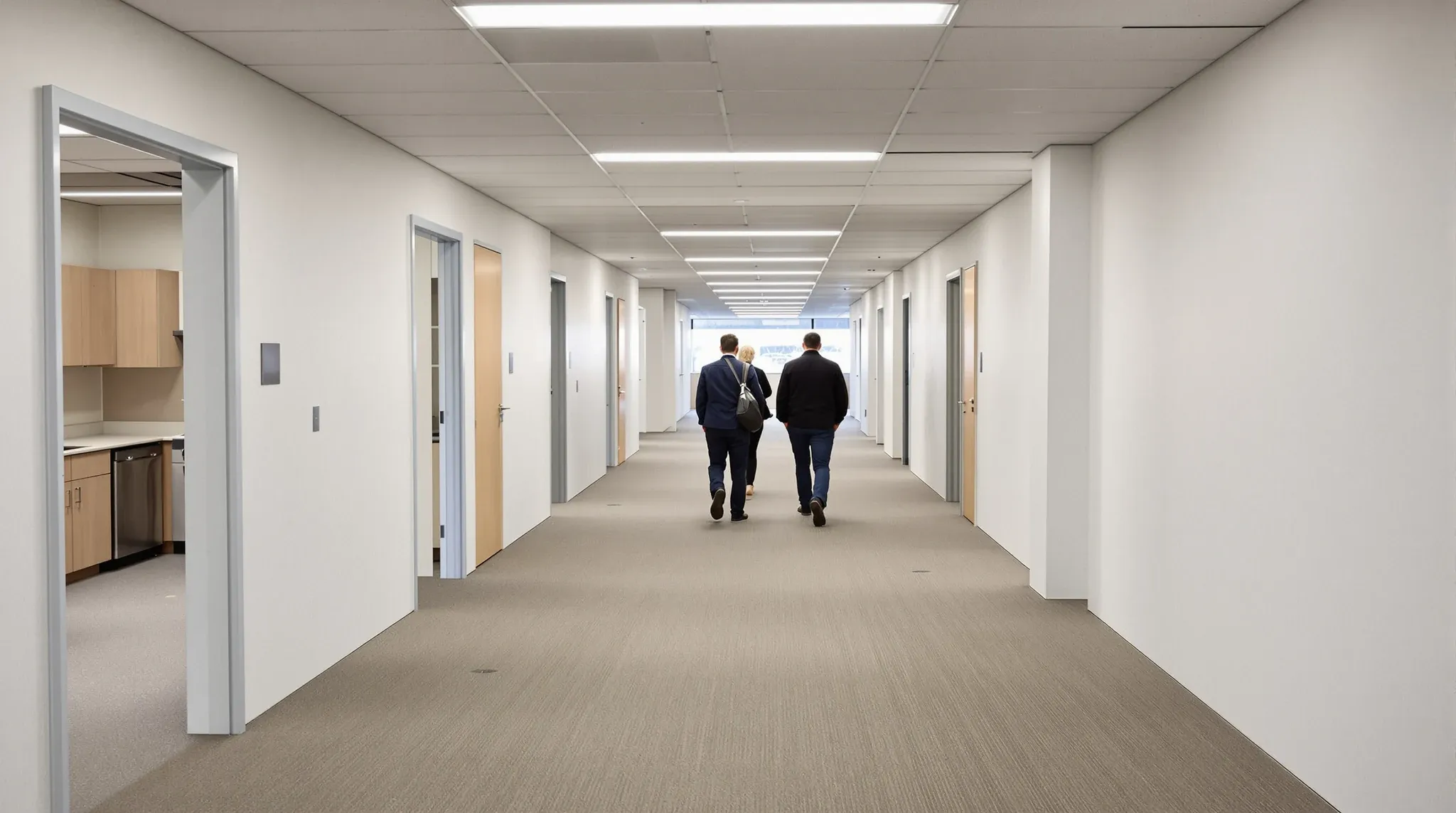
The joint walk-through before make good works start is the single most useful meeting in the whole lease-end process for a commercial Sydney tenant, and it is the one tenants most often skip. Scheduled thirty to sixty days before the programmed exit date, it turns make good from a scope the tenant guesses at into a scope the landlord has physically agreed to in the tenancy itself, with the fitout still in place to reference against the lease clause. Handled well, it removes most of the back-and-forth that causes make good disputes. Handled badly, or skipped, it usually produces a more expensive programme and a final sign-off that drags.
The purpose is simple: to walk the tenancy together, item by item, with the lease clause in hand and a scope spreadsheet on site, and record what the tenant will remove, what the tenant will retain, what the landlord will accept at current condition, what requires reinstatement, and what is disputed. Everything the walk-through agrees becomes the working scope. Everything it leaves unresolved becomes a risk that the tenant carries into the programme.
Why The Walk-Through Matters More Than The Checklist
Most commercial tenants approach make good by reading the lease clause, building a scope from their interpretation of it, briefing a contractor, and running the works. The landlord’s position on that scope is inferred rather than agreed. The first formal landlord contact is usually the final inspection at handover, by which time the works are complete and any disagreement becomes retrospective.
The problem with that approach is that make good clauses are almost always written in general language that refers back to “base-building condition“, “original condition”, or “landlord’s standard”, and the specific interpretation of those terms against a real fitout always involves judgement. A tenant working from the clause alone is effectively guessing what the landlord will accept. A tenant who has walked the space with the landlord’s representative and agreed the interpretation line by line is working from a shared scope.
The joint walk-through is where that shared scope is built. It is not the same as a defit checklist (which is the tenant’s own scoping tool), and it is not the same as the final sign-off inspection (which comes after the works are complete). It sits between the two, and it converts the tenant’s draft scope into an agreed working scope before the contractor starts on site.
When The Walk-Through Should Happen
The useful window is thirty to sixty days before the programmed make good start date. Earlier than that and the tenant’s planning is usually too incomplete for the conversation to be productive. Later than that and the timeline is compressed: if the walk-through identifies items that were missed, or surfaces disputed items that need further landlord discussion, the tenant has no room to adjust the scope before works begin.
Some tenants run a preliminary walk-through even earlier, six to nine months before the exit, as part of lease-end planning. That earlier walk is typically informal, covers high-level scope, and is a useful tool for budgeting and contractor selection. It does not replace the formal walk-through thirty to sixty days before works, which is the meeting that produces the working scope.
If the tenancy is being vacated through a partial surrender or a mid-lease downsizing rather than an end-of-lease exit, the walk-through logic is the same but the boundary is sharper. The surrendered portion gets walked, and the retained portion is normally excluded from the scope.
Who Are The Key Participants Involved
Attendance shapes whether the walk-through produces an enforceable agreement or a polite conversation that everyone remembers differently afterward.
From the landlord side, the representative with authority to agree scope is essential. That is typically the building manager or asset manager, sometimes with the leasing agent or the landlord’s make good consultant. An agent or property manager without authority produces a walk-through output that the landlord can repudiate later, which defeats the purpose.
From the tenant side, the representative briefing the make good contractor should be present, and ideally the contractor’s estimator or project lead too. The contractor hearing the scope agreed in person, rather than reading a summary afterward, reduces the interpretation gap between what was agreed and what gets built.
If the lease has been assigned, sublet, or restructured during the term, the walk-through may need additional attendees. An incoming tenant who has agreed to take over the space in partly fitted condition, for example, will want to confirm that specific items are retained rather than removed. A sublessor whose make good obligation has been passed back to the head tenant may need to confirm the scope on the portion they occupied.
The building services manager, or a services subcontractor nominated by the landlord, is useful for complex services reinstatement (HVAC, fire, data backbone, electrical). On larger tenancies these conversations can get detailed enough that having the services voice in the room prevents later disagreement about what acceptable reinstatement looks like.
What The Walk-Through Should Actually Cover
The walk-through is not a quick tour. For a mid-sized tenancy it typically runs two to four hours, sometimes longer, because the scope is covered room by room and element by element against the lease clause.
Partitions and rooms are the first category. Every room and partition run gets identified: removal or retention, reinstatement standard, any specific interfaces with base-building elements (columns, perimeter walls, ceilings), and any items the landlord is prepared to accept at current condition. Glass partitions, plasterboard partitions, and specialist walls all get itemised, because the make good treatment can differ by partition type.
Ceilings come next, including any ceiling modifications the tenant made, any bulkheads added, and any tiles or grid sections that need replacement. Ceiling patches around services removal are typically discussed here, because they are one of the more common sources of disagreement at sign-off.
Flooring is walked zone by zone, looking at carpet condition, damaged or stained areas, floor boxes that need reinstatement, and any specialist flooring (timber, tile, vinyl) that requires specific treatment. Traffic paths are often agreed for replacement even when the rest of the floor is acceptable.
Services reinstatement is usually the most technical part of the walk: HVAC diffuser reinstatement, fire and life-safety reinstatement, electrical and data cabling removal, plumbing caps, and any specialist services the tenant installed. Each item gets agreed against the landlord’s reinstatement standard, which can vary significantly by building.
Finishes, joinery, and signage round out the interior scope. Tenant branding, wayfinding, door vinyls, meeting room names, wall graphics, and kitchen joinery all get itemised. The landlord often accepts these at current condition if they are neutral enough, and the tenant is not obliged to strip unnecessarily.
Finally, any base-building interfaces (entries, shared corridors, lift lobbies, common areas affected by the tenancy) get checked. Damage to base-building elements during the fitout life is a tenant cost, and the walk-through is the moment to identify it before the contractor is on site removing the tenancy fitout.
How To Properly Document The Output
A walk-through that produces only a handwritten note or a verbal agreement is much weaker than one that produces a scope document signed or acknowledged by both parties. The specific format matters less than the principle.
The usual format is a scope spreadsheet, room by room and element by element, with four columns: description, agreed action (remove, reinstate, retain, accept current), standard (where reinstatement is required), and notes. Photographs of contested or unusual items are attached, often taken during the walk itself. The document is circulated to both parties within a day or two of the walk, for acknowledgement by the landlord’s representative and the tenant’s make good lead.
Any items that were disputed or unresolved during the walk get flagged in a separate section with a plan for follow-up. Sometimes these are items that need a specialist opinion (structural, services, fire) before they can be scoped. Sometimes they are items where the landlord and tenant simply did not agree on the day and need a further round of discussion. Either way, flagging them separately keeps the main scope clean and forces the unresolved items to be addressed before works begin.
What Not To Try To Agree At The Walk-Through
The walk-through is for scope. It is usually not the right venue for cost negotiation, payment terms, or formal lease variation. Tenants who try to combine the walk-through with a commercial negotiation about make good cost often end up with neither a clean scope nor a clean commercial outcome.
The commercial conversation, if there is one (for example, the tenant offering the landlord a cash contribution in lieu of reinstating certain items), is better handled separately, after the walk-through has produced the scope. Once both sides know what the default scope looks like, they can assess whether a commercial alternative makes sense for specific items.
Lease interpretation disputes, where the two sides read the make good clause differently, are also better handled outside the walk-through. The walk produces a scope that reflects the agreed interpretation; genuine clause-level disagreement usually needs legal input and sometimes a formal variation to resolve. Trying to settle interpretation through informal consensus on the day tends to produce outcomes that neither side later holds to.
What Good Looks Like, At The End Of The Walk-Through
A well-run walk-through ends with four things in place. A scope document, itemised room by room, that both parties have seen and substantively agreed. A short list of items that were flagged for further discussion, with a timeline for resolution. A clear handover of the scope to the contractor, usually in a brief meeting immediately after. And a shared understanding of the final inspection process, including what the landlord will look for at sign-off and who from each side will attend.
Tenants who achieve those four outputs typically run clean make good programmes from that point onward. The contractor knows what to build. The landlord knows what to expect at sign-off. Disputes at handover are the exception, and usually relate to execution quality rather than scope disagreement.
Tenants who skip the walk-through, or who run it informally without producing an agreed scope document, carry scope risk through the whole programme. The make good contractor works to the tenant’s interpretation of the clause. The landlord’s inspection at handover may disagree with that interpretation, and the tenant has no written record of what was agreed earlier. The result is usually rework, which is almost always more expensive than building to the correct scope first time.
Getting Landlord Cooperation When It Is Hard
Most landlords engage with the walk-through process because it benefits them: they get a handover that matches their expectations, without the dispute cost of litigating the scope afterward. A small minority of landlords, particularly in portfolios with tight reinstatement standards or active re-letting programmes, can be harder to engage.
Where the landlord is reluctant to schedule a walk-through, the tenant’s useful response is to send a written request with a draft agenda and a proposed date, copied to the relevant building manager and leasing contact. Silence on that request creates a record that the tenant attempted to engage. If the landlord still does not participate, the tenant proceeds with the scope based on their own interpretation of the clause and documents the attempted engagement, which is not the best outcome but at least positions the tenant if a dispute later arises.
More commonly, the resistance is about timing rather than principle. Landlords who want to delay the walk-through until immediately before works begin do so because their resource availability is limited. In those cases, pushing for an earlier walk-through and offering to work around the landlord’s availability usually gets the meeting scheduled.
We plan and deliver commercial office defit and make good across Sydney, and when the walk-through with your landlord is coming up we can help you scope it properly, attend on your side, and turn the outcome into a working brief for the make good contractor. If the walk-through identifies items where the commercial option (a cash contribution, a reduced scope, a retained fitout element) would serve you better than the default reinstatement, we can help you work out which items are worth that conversation.
📞 Call us on 1300 60 93 93