
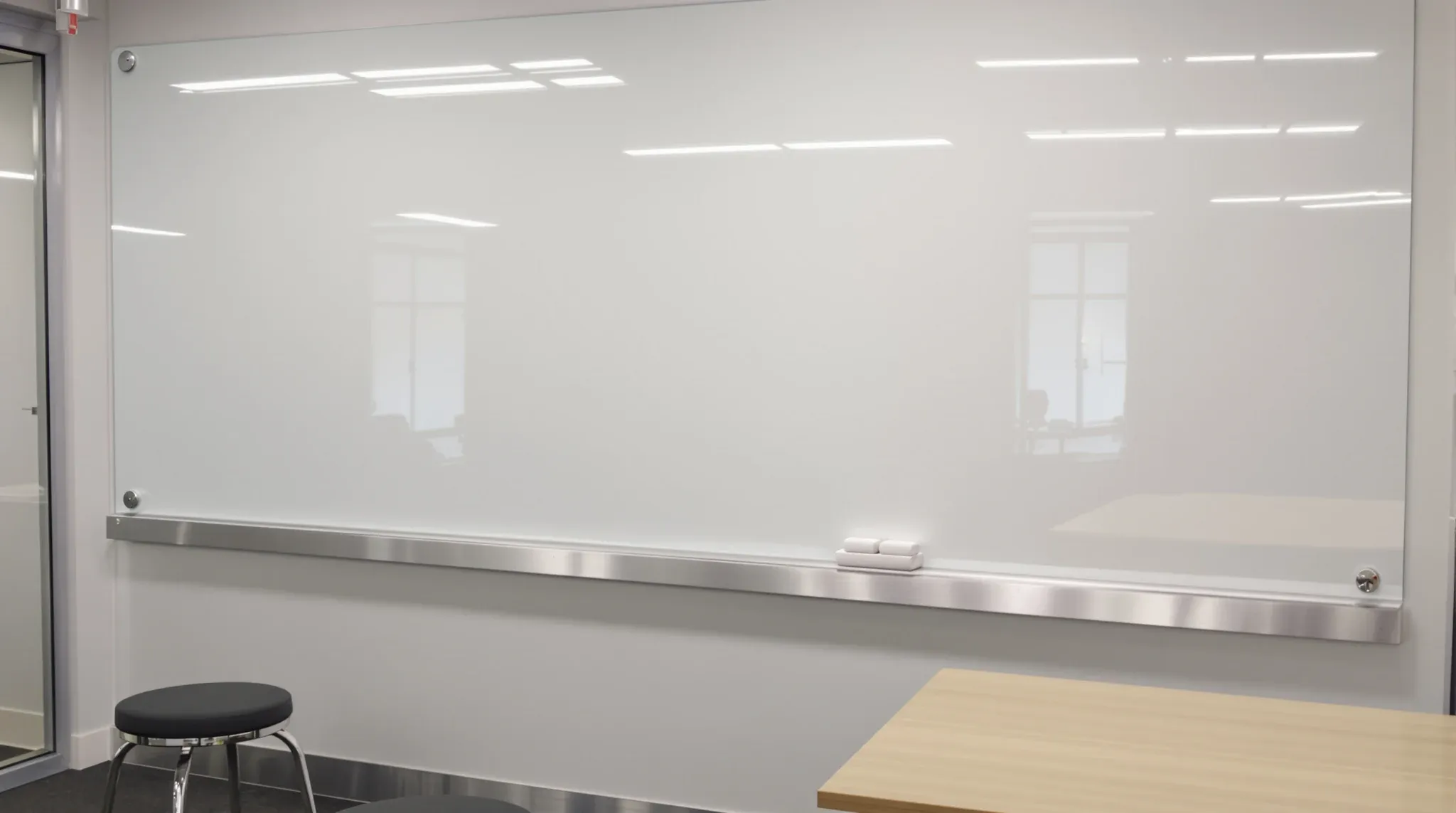
Three writable surfaces get installed into Sydney commercial office partitions: conventional magnetic whiteboard panels, painted-back glass marker-boards, and whiteboard-coating paint applied directly to plasterboard. They look similar in a product photo. In five years of daily commercial use they behave differently enough that choosing the wrong one is one of the more visible fitout mistakes.
The practical question is not which product looks best on a showroom sample but which survives intensive office use without staining, ghosting, chipping or losing its magnetic grip. The answer depends on how the wall is actually going to be used, which is a conversation worth having before the specification lands on the partition drawing.
Primary Writable Surface Options At A Glance
Magnetic whiteboard panels are prefabricated boards, usually ceramic-steel or melamine-steel, mounted onto the partition face. They are the most durable of the three options and the easiest to replace if damaged. They are also the most visually dominant, because the panel edge reads as a separate object stuck on the wall.
Glass marker-boards are tempered glass panels with an opaque painted back, mounted directly onto the wall. They look more refined and modern, they resist ghosting almost entirely, and they clean to a streak-free finish with any decent glass cleaner. The trade-off is weight, cost, and limited magnetic performance unless a specific magnetic back construction is chosen.
Whiteboard paint is applied directly to prepared plasterboard, turning a section of wall into a writable surface with no visible frame or edge. It is the cheapest option, the most flexible in terms of size and shape, and the most likely to fail within a few years of real commercial use. It suits some applications and should never be specified for others.
Standard Magnetic Whiteboard Panel Specifications
Ceramic-steel magnetic whiteboards are the commercial workhorse. The writing surface is a fused ceramic enamel over a steel substrate, which resists ghosting and staining even under heavy daily use with aggressive dry-erase markers. They hold magnets firmly, they clean quickly, and they are rated to last 20 to 25 years of continuous use without the surface degrading.
Melamine-steel boards are the cheaper cousin. The writing surface is a melamine laminate bonded to steel, which writes and erases acceptably out of the box but tends to ghost and stain within 18 to 36 months of heavy commercial use. They are the right answer for low-use applications like departmental stand-up boards in open-plan zones, but they are the wrong choice for a primary meeting room whiteboard that is used several times a week.
Both types mount with concealed Z-clips or screw-fix brackets directly to the partition. The mounting position has to land on studs or solid backing: melamine boards at 1200 x 900 mm are light enough for drywall anchors, but ceramic boards at the same size are heavy enough to want structural fixing. Specifying where the backing sits inside the partition during stud framing is far easier than trying to find it again once the wall is closed up.
Professional Glass Marker Board Applications
A glass marker-board is a tempered glass panel, usually 6 mm thick, with an opaque painted or foil-backed rear surface. The front face is the writing surface, cleaned with standard glass cleaner and erased with a standard dry or wet cloth. Ghosting is effectively absent because the glass surface is non-porous and releases marker ink completely.
Standard glass marker-boards are not magnetic. A magnet sitting on a glass surface falls off. Where magnetic performance matters, a magnetic version uses a steel backing panel behind the glass, which shifts the price up and adds weight. The magnetic grip through 6 mm of glass is noticeably weaker than through a bare steel panel, so the magnets need to be rare-earth types rather than standard whiteboard magnets.
Glass boards are heavy. A 1200 x 1800 mm glass marker-board typically weighs 35 to 45 kg; a magnetic version with steel backing can reach 60 kg. Mounting uses stand-off fixings or concealed brackets, both of which need structural backing behind the plasterboard. The wall has to be specified to carry the load, which usually means solid-framing or specific timber-backing patches inside the stud cavity.
The refined look comes with a cost premium. A 1200 x 1800 mm glass marker-board costs roughly two to three times a comparable ceramic whiteboard, and four to five times a melamine one. On a reception-visible or client-facing wall the premium usually earns itself in visual quality. On a back-of-house team stand-up board it usually does not.
Whiteboard Paint Performance On Plasterboard
Whiteboard paint is a two-part coating applied to properly prepared plasterboard, producing a writable surface without any visible frame. It comes in standard white and in clear formulations that can go over an existing painted colour, which means the same wall can serve as both a coloured feature and a writing surface.
Application quality determines everything. The plasterboard beneath has to be finished to a high level, sanded flat, primed correctly, and coated in the specified number of layers with the correct drying time between each. A single application error anywhere in that sequence shows up as a streak, a roller mark or a patchy area that will not wipe clean. It is not a forgiving product.
Even when applied correctly, whiteboard paint is the least durable of the three options. Under heavy daily use it typically ghosts within 18 to 30 months, stains within 24 to 36, and needs to be recoated every three to five years to look acceptable. For high-frequency writing walls in meeting rooms, that cycle rarely makes financial sense. For a large ideation wall in a design-led studio space where the occasional recoat is part of the cycle, it can be a legitimate choice.
Whiteboard paint is also not magnetic unless a specific magnetic primer is applied beneath it, and magnetic primers hold magnets poorly compared to any steel-backed board. If magnets matter, whiteboard paint is the wrong product.
Strategic Magnetic Backing Decisions
Whether the writable wall needs to hold magnets depends on the use case. Meeting rooms that use the board for structured discussion rarely need magnets: the whole wall is written and erased. Project rooms that pin up drawings, printouts or reference material benefit from magnets far more than from the writing surface itself, and a magnetic-only steel panel with no writable surface is sometimes the right answer.
The product choice follows the use. Ceramic-steel whiteboards hold magnets strongly. Glass marker-boards need the magnetic-back construction and rare-earth magnets. Whiteboard paint effectively cannot hold standard magnets. A combination wall with a large glass marker-board alongside a smaller magnetic steel panel often solves the split-use case cleanly.
Magnet specification matters more than people expect. Standard whiteboard magnets that came with the board 10 years ago are usually the wrong strength for today’s thicker glass boards or for holding heavier materials like laminated reference sheets. Providing a pack of appropriate rare-earth magnets at handover is a small detail that keeps the wall usable from day one.
High Impact Placement For Writable Walls
A writable wall earns its cost when it is used weekly or more often. Boardrooms where teams review strategy, project rooms where documents are marked up, training rooms where facilitators work from whiteboards, and design studios where ideation happens daily all justify the investment. Writable walls installed in rooms that rarely use them become expensive decoration.
Placement within the room matters as much as the decision to install. A writable wall positioned opposite a large window usually glares into unreadability for several hours of the day. A wall behind the primary seating orientation of a meeting room makes the board hard to use during a session. The useful position is usually on the long wall of a meeting room, perpendicular to the primary seating axis, with enough clearance from furniture to let a facilitator stand in front of it.
Size is the other common misjudgement. A 1200 x 900 mm board in a 20-person boardroom is effectively a symbolic whiteboard: too small for genuine group use. A 2400 x 1200 mm board in the same room starts to be useful. For larger rooms, a full-wall writable surface, whether glass or ceramic, often delivers more value than a smaller higher-end board.
Long Term Commercial Durability Standards
Five-year wear patterns are where the three options diverge most clearly. Ceramic-steel whiteboards still look functional and clean at five years if they have been used with decent markers and wiped regularly. Melamine-steel boards at five years usually show significant ghosting and need replacement. Glass marker-boards at five years look close to new, with the main wear appearing on the mounting brackets rather than the writing surface.
Whiteboard paint at five years has usually been recoated at least once. Without a recoat, the surface shows visible ghosting patterns, dull patches where markers have stained the primer, and chipping along any edge where the coating meets a corner or an adjacent surface. The paint is salvageable with a recoat cycle, but the cycle is part of the real cost of the choice.
The maintenance discipline matters across all three. Cheap or aged markers accelerate ghosting on every surface. Using alcohol-based cleaners on a melamine board or whiteboard paint damages the coating. A simple written maintenance note at handover, plus the right marker stock kept in the room, protects the surface for much of the fitout’s life.
Specifying Writable Surfaces Within Partitions
Writable walls should be decided at the same stage as the partition drawings, not added as a late-stage request. The partition build needs to include stud backing or timber pattressing at the mounting positions, electrical outlets need to be positioned to clear the board, and the wall colour around the board needs to be considered so the edge detail works.
For glass marker-boards in particular, integrating the mounting detail into the partition build is significantly cheaper than trying to retrofit the fixing later. Cutting back a finished wall to install backing adds cost, disruption and usually some visible patching. Building the backing in at stud stage is invisible.
If you want us to walk through a floor plan and work out which rooms genuinely need writable walls, which product suits each position, and how the mounting should be built into the partition, we can do that as part of a full fitout or as a standalone partitions scope. The decisions are small individually and stack up to a meaningful difference in how the finished space works.
📞 Call us on 1300 60 93 93