
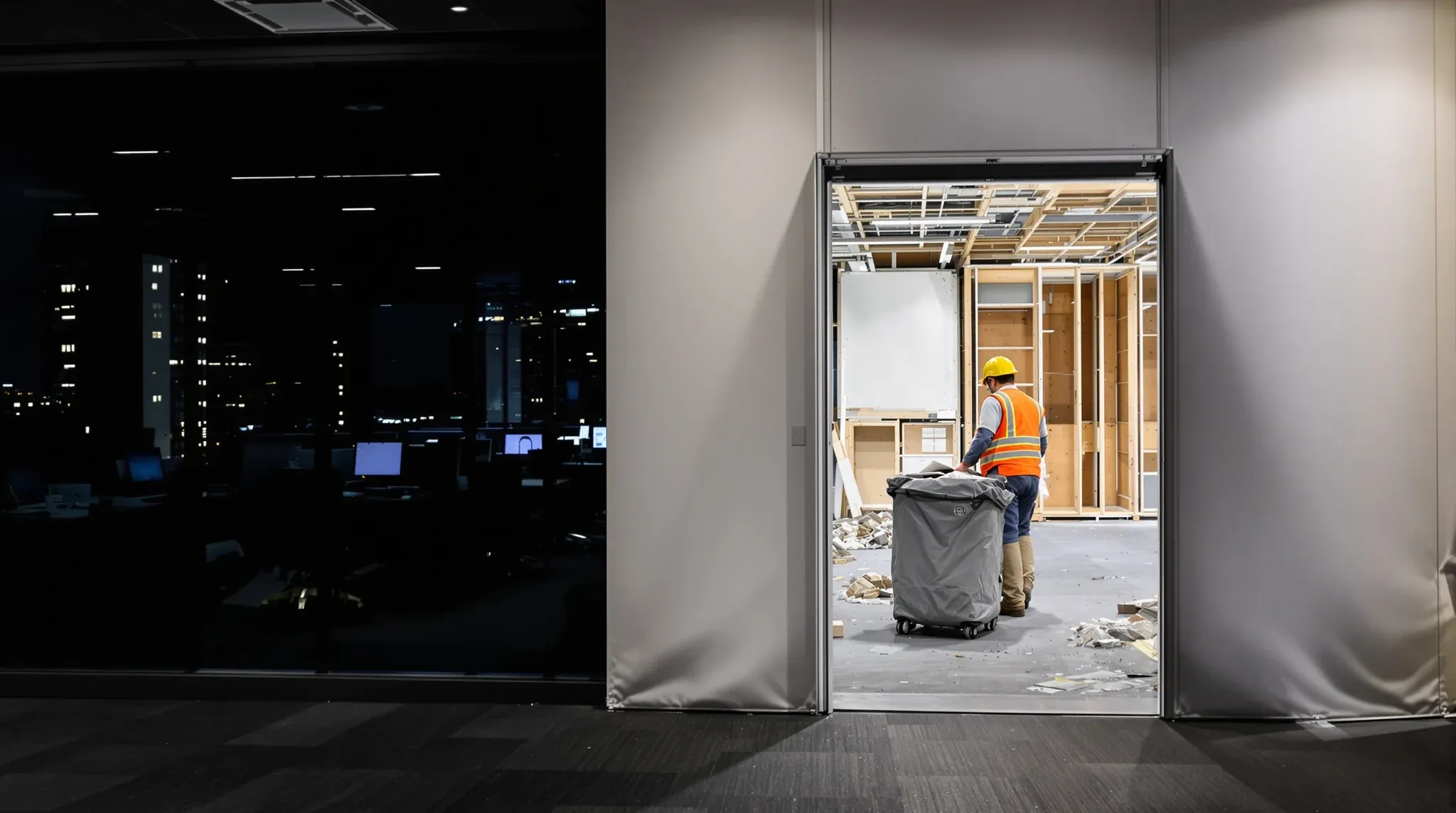
When part of a floor has to be stripped out while the rest stays occupied, the work moves to evenings and weekends so staff arrive to a tidy, safe office each morning. Running a strip-out after hours changes how the job is staged, how dust and noise are contained, and what each shift can realistically clear. For the facilities manager carrying it, the measure of success is simple: the team should barely know it is happening.
That is harder than it sounds, because a strip-out is demolition. Partitions come down, ceilings open up, services are cut back and a lot of material has to leave the building. Doing that next to people who will sit at those desks the next morning is a planning exercise as much as a construction one.
What an after-hours strip-out covers
A strip-out is the removal of the tenant’s fitout back to the base the next stage needs, which can mean taking out partitions, joinery, floor coverings, ceilings and the services that fed them. It is the demolition phase, distinct from the reinstatement that follows, and the line between the strip-out and the make good matters for what each shift is actually doing.
Run after hours, the same scope is broken into shifts that each have to finish in a clean, safe state. The crew cannot leave a half-demolished partition or a live edge for the morning, so every shift is planned to reach a tidy stopping point rather than simply running until the clock stops.
The work sits within the wider defit and make good scope, but the after-hours constraint reshapes it. Where a vacant-floor strip-out can run continuously and messily until it is done, an occupied-floor strip-out is a series of self-contained nightly operations, each one designed to hand the space back usable by morning.
How the work stages across shifts
Sequencing is everything when the floor is occupied. The work is divided into zones and the zones are taken one at a time, so the disruption stays contained to a defined area rather than spreading across the floor. A zone is set up, stripped, cleared and cleaned within its shifts before the next zone starts.
Within each zone the order runs from soft to structural. Loose fitout and joinery come out first, then floor coverings and partitions, then ceilings, with the services isolated ahead of whatever depends on them. Sequencing it this way means the dirtiest, dustiest tasks can be timed for the start of a weekend block when there is the most time to clean up afterwards.
What each shift can clear is set by two things: how much can be demolished and bagged in the hours available, and how much can physically leave the building that night. Knowing the realistic clearance per shift, and how that adds up against how long a defit takes overall, is what keeps the program honest rather than optimistic.
A pre-start survey makes the sequencing possible. Before any shift begins, the zone is walked to mark what stays and what goes, identify the services feeding it, and confirm what is hidden in the walls and ceiling that the drawings may not show. That walk is what lets the crew work quickly and safely in the dark hours, because the decisions about what to cut and what to protect have already been made rather than improvised at 9pm with the floor empty.
The constraints that shape every shift
Three constraints drive an occupied-floor strip-out: dust, debris and live services. Each one is manageable, but each one has to be handled every single shift, because the floor has to be safe and clean by morning regardless of how far the demolition got.
Dust is the constraint staff notice. Demolition throws a lot of it, and without containment it settles across the working area and lingers in the air, so the zone is sealed off and the air managed before the heavy work starts. Noise and dust together are the part of the job that people actually experience on site, and after-hours timing exists largely to keep both away from occupied hours.
Debris removal is the constraint that limits the pace. Stripped material has to be carried out, often through shared lifts and loading docks with their own after-hours rules, and a zone cannot be cleared faster than the building lets material leave. Live services are the constraint that governs safety: power, data and any services feeding the zone are isolated and confirmed dead before demolition, while services that serve the occupied area are kept live and protected, so the strip-out never cuts something the working floor still needs.
The building’s own systems add a layer that vacant-floor work never has to think about. Smoke detectors in the work zone may need isolating so demolition dust does not trigger an alarm across the building, security and after-hours access has to be arranged for the crew, and any work affecting fire or sprinkler services has to be managed so the rest of the floor stays protected the whole time. These are coordination tasks with the building, not just the site, and they are booked ahead of each shift rather than sorted on the night.
Keeping the occupied floor working
The point of going after hours is that the team keeps working as normal, so the morning handover from crew to floor has to be clean every day. That means the worked zone is sealed, cleaned and made safe, walkways are clear, and anything that was disturbed for the working area is back in service before staff arrive.
For the facilities manager, the coordination is mostly about the boundary between the work zone and the live floor. Keeping the rest of the floor operating while one part is stripped is the same challenge as operating the remaining floor during a partial make good, and the same disciplines apply: a hard boundary, protected access, and a daily reset. Where the building has shared amenities or single points of access, those are mapped so the work never blocks the team’s normal routine.
Communication carries the rest. Staff who know which zone is being worked, that it will be clean by morning, and who to raise an issue with, tolerate the disruption far better than staff who arrive to surprises. The role here is close to operating through a live fitout, where the manager’s visibility over the program is what keeps the floor calm.
Much of the facilities manager’s load is the interface with building management rather than the demolition itself. Dock and lift bookings, after-hours access lists, security sign-in, and notice to neighbouring tenants on the floors above and below all sit with the building, and a missed booking can cost a whole shift. Setting those arrangements up once, as a standing routine for the run of works, is what stops the program stalling on something administrative rather than physical.
What after-hours work costs
An after-hours strip-out costs more than the same scope on a vacant floor, and it is worth understanding why so the premium is expected rather than a surprise. The labour is at evening and weekend rates, the work is slower because of containment and cleaning, and each shift carries set-up and pack-down that a continuous job would only do once.
The main drivers are the number of shifts the staging requires, the containment needed to protect the occupied area, and the building’s rules for after-hours access and waste removal. A floor that allows generous dock and lift access overnight strips far more cheaply than one with tight windows, because access pace sets how many shifts the job takes.
The trade the premium buys is continuity: the business keeps running, no one is relocated, and there is no downtime cost from closing the floor. Weighed against the cost of moving a team out or stopping work, the after-hours premium is usually the cheaper path overall, which is the case worth making when the strip-out budget is set.
There is a middle option worth weighing on larger jobs. Where the work is extensive, a mix of after-hours shifts for the noisy, dusty demolition and daytime shifts for the quieter clearing and make-good can bring the cost down without disturbing staff, because not every task has to happen at night. Deciding which parts genuinely need the after-hours window, and which can run by day behind a sealed boundary, is how the premium is kept to only the work that truly needs it.
Running the strip-out so staff barely notice
The most useful discipline is to plan the job as a series of self-contained shifts, each zoned, contained and reset to a clean, safe state by morning, with the building’s access and waste rules built into the program from the start. That is what lets demolition happen beside a working floor without the floor feeling it.
Run this way, with services isolated safely, debris cleared within each shift and the boundary held tight, an after-hours strip-out delivers the same result as a vacant-floor job while the team works on uninterrupted. The measure of a job done well is that staff arrive each morning to a tidy office and a little less of the old fitout, and never to a building site.
📞 Call us on 1300 60 93 93