
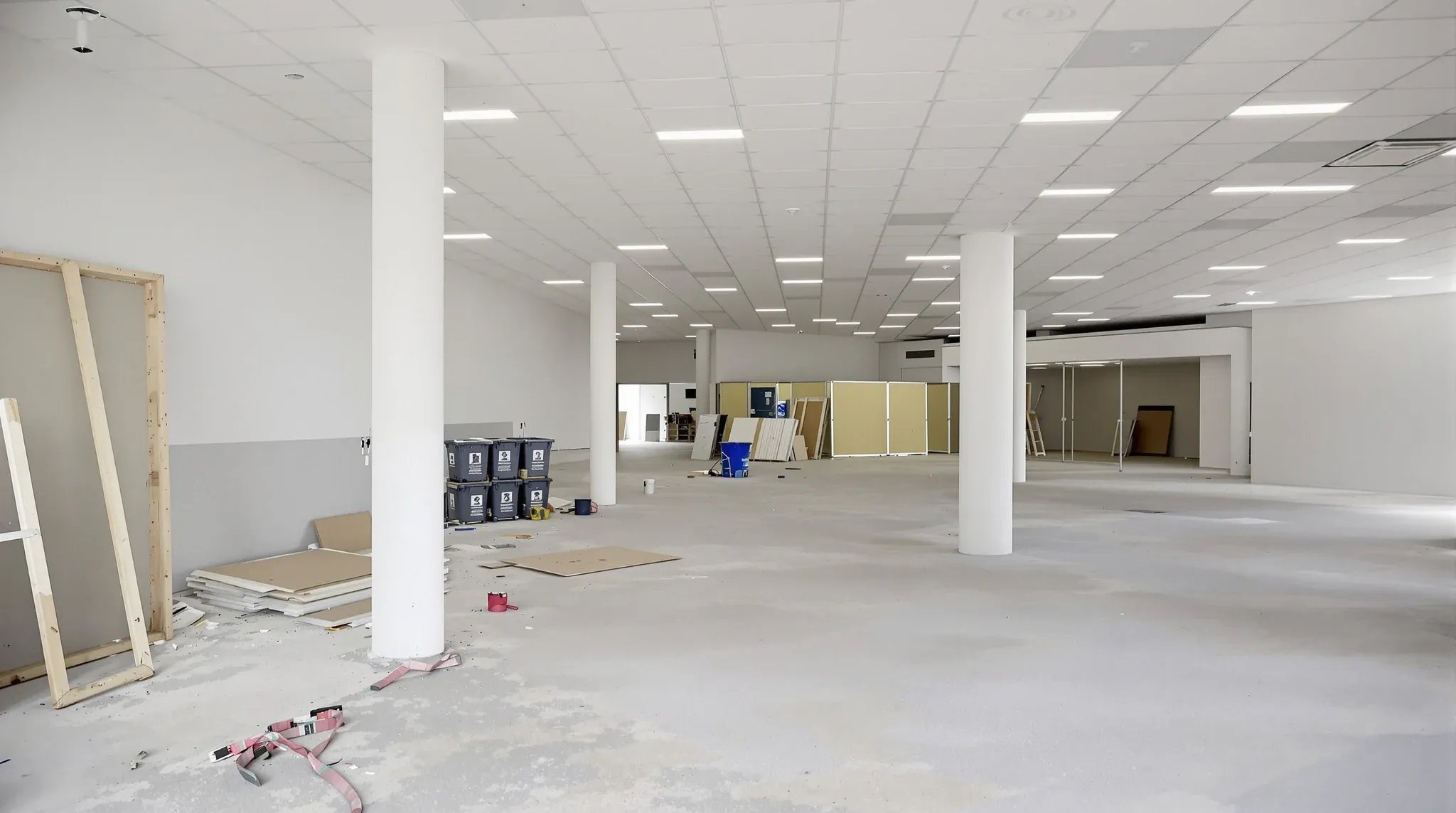
When a Sydney office defit lands back to back with the next tenant moving in, the defit window stops being negotiable. The landlord has a handover date with the next tenant, the next tenant has a fitout start they have already booked their team and trades around, and the outgoing tenant’s defit has to clear cleanly before the new program lands on the floor. The schedule that runs is the one that treats the demo and the reinstate as a single program against the new fit start, not as two separate jobs handed across an empty week that does not actually exist.
What goes wrong on these is rarely the demolition itself, which is a well-understood scope on most office floors. The slip happens at the boundary, where the reinstate work has been compressed against the handover date and the trades have been asked to absorb the slip from earlier stages. The way we plan the program is to put the handover date on the wall, work backward from there, and protect the reinstate window from the demo phase eating into it.
The handover date frames everything else
The handover date the landlord has agreed with the next tenant is the only fixed point in the program. Every other date is negotiable to varying degrees: the demo start can move earlier, the cleaning and inspection can compress slightly, the strip-back of services can run in parallel with other trades. The handover itself sits where it sits because the next tenant has signed for it.
We start the planning by writing the handover date at the right-hand end of the wall and the building manager’s inspection requirement immediately before it. Both are fixed. Between them sits the reinstate window: the patch and paint to the partition surfaces that are staying, the floor finish reinstate, the ceiling line tidy-up, and the final clean. The size of that reinstate window is what protects the handover, and it almost always needs more days than the first version of the program gives it.
Working backward from the reinstate window, the demolition slot is what is left. If the lease end is six weeks before the next tenant’s fitout start and the reinstate needs two of those weeks, the demo has four. If the gap is shorter, the demo gets shorter or runs more aggressively, often with weekend or after-hours shifts to keep the reinstate window intact.
What the next tenant’s fitout schedule tells us
The next tenant’s fitout schedule shapes the defit more than tenants usually expect. Their first week on the floor sets the trades that will be in the building during the days immediately after handover; if their first phase is partition build, the goods lift will be running cable and stud deliveries; if their first phase is services strip-and-redo, the trades will be different but the access pressure is the same.
We get more useful coordination when the next tenant’s program is shared with us early. Their crane bookings, their goods-lift slots, and their out-of-hours requirements often overlap with the building’s standard capacity, and the building manager has to allocate access across both tenancies. A defit program that knows where the new program’s heaviest access days are can plan its own debris removal and waste-trucking around them rather than colliding.
The other piece of intelligence we use from the new program is whether the new tenant wants any retained elements on the floor. Sometimes the new tenant has indicated they will keep the existing kitchen, the existing comms room build, or a particular run of partitions, and the defit scope can be reduced accordingly. The landlord has to agree, but the conversation often goes well when the saving on the defit is offset against a corresponding saving on the next tenant’s fitout. The build-side advantage of knowing this before the demo starts is significant; once a wall has been demolished it cannot be retained.
Sequencing the demo to clear before the new program lands
The demo phase has its own internal order that does not always show on a high-level program. Services strip-back comes first; partitions come down after services have been stripped from them; ceiling strip-back, if required, runs in parallel with partition strip on most floors; floor finishes lift after the partitions and ceilings have been taken back, because the lift work needs the floor clear.
The internal order matters because it controls the dust path and the noise pattern. Services strip-back is a relatively quiet trade and can run during normal building hours. Partition strip-out is the noisiest phase and almost always carries an after-hours premium on a CBD tower because of the impact on neighbouring tenants. Ceiling strip is quieter but dustier; we run it earlier in the day so the cleanup can finish before the building manager closes the goods lift in the afternoon.
The sequence we plan against is the one that lets the floor be clean by the end of every working day, not just at the end of the program. A floor that finishes each day in a clean state can be inspected, re-secured, and handed back to building services overnight without leaving exposed services or unsecured debris. A floor that runs hot and tries to compress the demo into longer shifts ends up with cleanup compressed into the reinstate window, and the reinstate slips.
The reinstate work that has to finish ahead of handover
Reinstate is the part of the defit that the schedule most often underestimates. The trades involved are patching, painting, floor finishing, and ceiling tile or grid reinstate where the lease asks for it. None of them is technically demanding; all of them need clean dry conditions and most of them need the trade before to have finished.
The patch-and-paint on retained partition surfaces is usually the longest single line. The walls that stay on the floor after the demo have edges, fixings, and ghost-lines from removed elements that have to be patched flat, sanded smooth, and painted to match the original finish. On a floor with a lot of retained partition, this work runs into days rather than hours, and it cannot start until the partition trade has finished the demo.
Floor finish reinstate depends on what the lease asks for. A simple carpet lift and trolley-roll back to base condition is a one or two day job; a full new carpet to match the original specification is a five to seven day job with order lead times that have to be factored in earlier than the reinstate window itself. We confirm the lease wording on this line early because the floor finish is the most schedule-sensitive trade in the reinstate.
Ceiling tile reinstate, where required, is usually quick. The slow part is sourcing tiles that match the original specification if the lease asks for like-for-like reinstate. We have spent more time chasing matching tile stock on a defit than the install itself takes, and the way we avoid that on a back-to-back program is to confirm the tile spec at the start of the program and order ahead.
How we coordinate with the next tenant’s builder
The coordination conversation with the next tenant’s builder usually starts informally and becomes formal as the handover gets closer. We share the demo program with their builder early so they can see when the floor will become accessible for their pre-start activities, and we share our reinstate program closer in so they know which areas of the floor will be in final condition when.
The two coordination points that surface most often are pre-occupation access for the new builder and shared use of building access. New tenant builders frequently want to walk the floor a few days before handover to take measurements, photograph the slab, or stage equipment in the lobby. The defit program can usually accommodate these visits if they are flagged early; they get awkward when they are sprung on the team during the cleanup phase.
Shared goods-lift use is the other recurring point. If the building manager allocates morning lift slots to the defit waste-out and afternoon slots to the new builder’s bring-in, the two programs can run alongside each other in the final week without colliding. Where the lift schedule has not been settled, the program almost always slips, because two programs cannot share an unallocated resource cleanly.
Where the program slips and what we plan against
The slips we plan against are usually in the same three places. The first is services strip-back, where the demolition team finds cabling or pipework that was not on the drawings and has to wait for a trade decision on how to handle it. The second is partition removal, where heritage or modified walls require a different demolition method than the standard scope assumed. The third is the patch-and-paint reinstate, where a damaged surface beneath a removed element needs more work than a simple skim and topcoat.
We carry a contingency line in the program against each of these, sized to the floor and the likely complexity. On most office floors the contingency runs to two to three days across the full program, held centrally rather than allocated to specific tasks, and released as the work surfaces what it actually needs. A program that does not carry contingency has a handover date that depends on nothing going wrong, which is not a useful planning assumption.
The other planning move that protects the handover is the daily cleanup discipline mentioned earlier. A floor that finishes clean every day produces a defit that lands inside its window; a floor that defers cleanup to the reinstate phase produces a defit that finishes a few days late, which is exactly what the back-to-back program cannot absorb.
If your defit is bumping up against the next tenant’s fitout start date, we can plan the demo and the reinstate as a single program against the handover so the floor clears cleanly and the new program lands on the day it was booked.
📞 Call us on 1300 60 93 93