
Strip-out looks like the simplest phase of an office lifecycle. A crew arrives, walls come out, ceilings come down, rubbish leaves the building, the floor is handed back. In the order we write it, that sequence is correct. In the order it plays out on site, it is rarely that clean. Strip-out is the phase where every loose thread from the original fitout, every informal arrangement with the landlord, and every half-documented change through the tenancy shows up at the same time.
The problems do not arrive evenly. They cascade. An issue in one layer quietly triggers an issue in the next, and by the time a tenant notices, the scope and the cost have both moved sideways. This article walks the cascade the way it plays out on site, so the early warning signs are easier to read.
It starts with the paperwork that was never kept
The first thing to slip is usually the documentation. The original fitout drawings exist somewhere but are out of date. The change mid-tenancy went through without landlord approval, or with an informal approval that left no paper trail. The condition report from the start of the lease is not where anyone remembers leaving it. A pre-start meeting that should take an hour ends up taking three, and none of the decisions made at that meeting can be tied back to the lease clause they are meant to satisfy.
The consequence is not visible on the programme. It shows up in the scope. Every element of the fitout that cannot be proven as approved, or proven as base building, drifts into the “remove to be safe” column. A better-documented tenancy would have retained half of those items by negotiation. This is also the moment at which earlier shortcuts taken in the name of saving money during defit planning start compounding into something more expensive than a proper process would have cost.
First day on site: the scope is bigger than the drawings said
The next layer hits on day one. The strip-out crew opens the first wall and finds services running through it that were not on the drawings. A partition that looked freestanding is tied into the fire wall behind it. A ceiling grid that was supposed to stay has hidden modifications that were not captured during the walk. A floor box that was thought to be redundant is still live. None of these are rare. All of them rewrite the day’s plan.
The crew makes a choice: stop and escalate, or work around the discovery and keep the day moving. Crews under time pressure tend to choose the second option, because the programme does not forgive pauses at this stage. Every work-around taken on day one becomes a question on day five, and the questions start to interfere with each other.
The ceiling comes down and the services layer reveals itself
Ceilings are where the biggest surprises live. Above the tiles sit data cabling runs that were added progressively through the tenancy, supplementary air conditioning units tied into the base building without clean documentation, lighting circuits that cross zones in ways the original drawings never recorded, and sometimes a layer of old cabling from the previous tenant that was never removed. The strip-out scope now includes the work of identifying, isolating, and cleaning up each of these.
A second effect shows up here that tenants rarely picture. Any cabling or services left live during demolition has to be protected or isolated by the right trade before the section of ceiling above it can come down. The strip-out crew on its own cannot do this. The programme now has a sequencing dependency between two trades who were not booked to overlap, which tends to create a small but expensive gap in the schedule each time it happens.
The cost effect is direct. Electrical and data cabling tidy-up is slower than demolition, because it cannot be done by the same crew or at the same pace. The programme has to absorb either a specialist visit or a gap while the demolition waits. Both options cost money. The tenant who assumed the ceiling was a fast section of the programme is usually the tenant who discovers the scope above it the hard way. This is the point at which the defit phase earns its reputation as the most misunderstood phase of the office lifecycle.
Fire systems, penetrations, and things that have to be certified
The next layer that catches tenants off guard is the fire and life safety system. Any penetration through a fire-rated wall, any alteration to a sprinkler zone, any modification to detector coverage, and any change to an evacuation path typically needs to be returned to a documented, compliant state before the landlord will accept hand-back. The crew that was moving fast through ceilings now has to slow down to accommodate certification work that sits outside the strip-out trade altogether.
Tenants sometimes assume this part of the work can be picked up at the end of the programme. It usually cannot, because it needs to follow demolition in the right sequence: open, close, inspect, certify. Compressing it into the final week is where this layer most often goes wrong. A planned engagement with the building’s fire specialist early in the programme often costs less than a rushed engagement in the final days, and it removes a category of risk that sits inside fire services for the life of the fitout regardless of which phase you are in.
Waste and logistics become their own programme
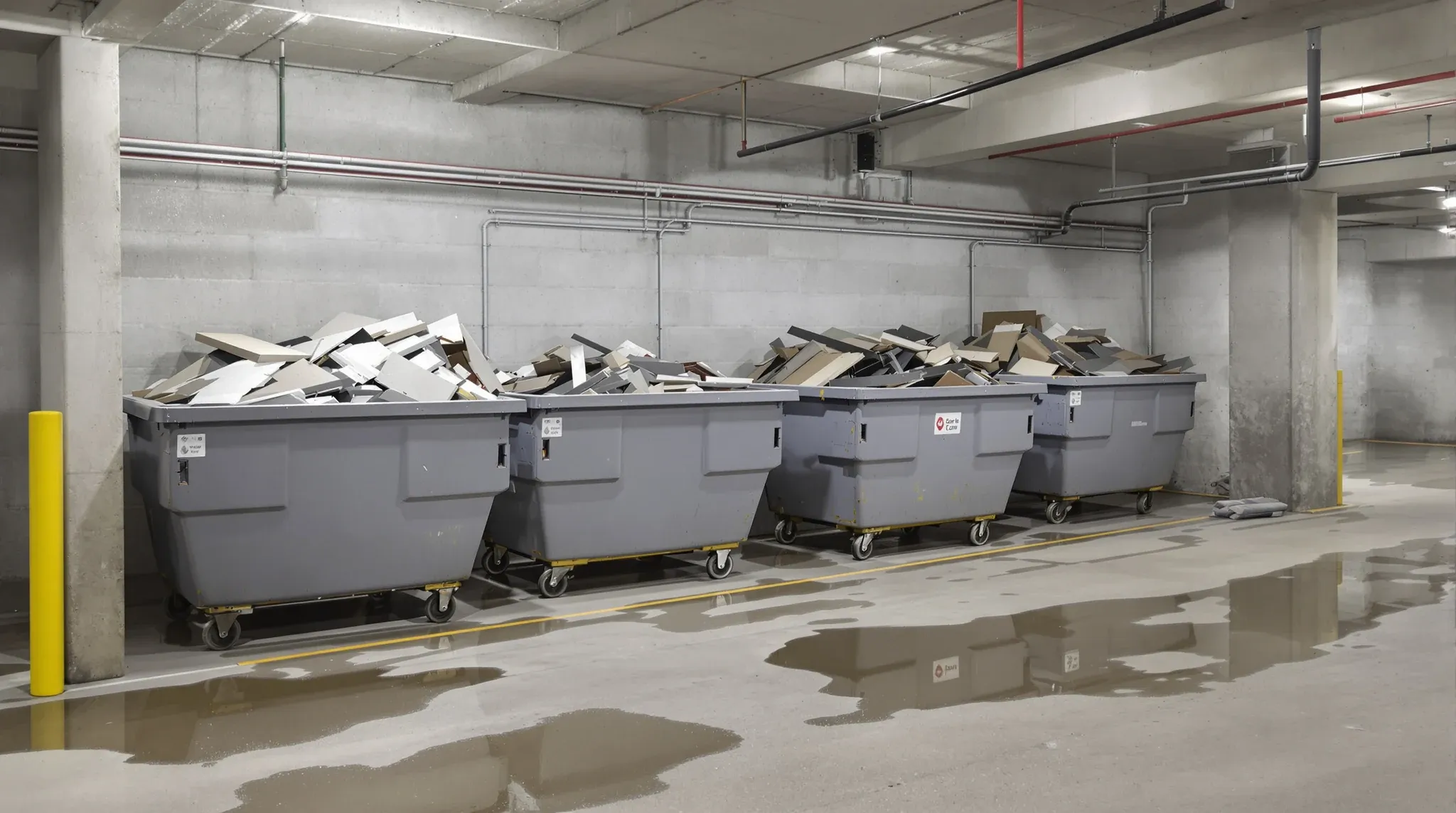
By mid-programme, the waste problem is usually visible. A strip-out generates a volume of material most tenants did not picture. Plasterboard, ceiling tiles, carpet, cabling, joinery, signage, and partition glass all have different disposal and handling requirements. The loading dock has a fixed capacity, the lift has a fixed schedule, and the building manager has a fixed view of how long a dock booking is allowed to take.
If the waste removal path was not planned before mobilisation, the site starts to stack up. A stacked site slows every other trade. It also introduces a dust and noise footprint that neighbouring tenancies will push back on, especially in multi-tenant floors. The knock-on effect is the kind of noise and dust disruption that quickly becomes a building management problem, not just a site problem. At this point, the strip-out has stopped being a single-trade job and has become a logistics exercise with trades attached.
Time runs out and the cost multiplies
By the final week of the programme, the tenant who started with a clean scope and a tight budget is usually looking at a different picture. Discoveries have added to the scope. Coordination gaps have added to the programme. Waste logistics have added to the cost. And the lease clock is still running, which means any delay at the end is met with after-hours labour, extended dock bookings, and rushed certification visits. Each of those carries a premium. Each of those is invoice-visible.
The compounding effect is what makes the final week so painful. A scope surprise in week one is a week-two problem. A sequencing gap in week two is a week-three problem. By the time the programme is in its final quarter, three earlier layers are all demanding resolution inside the same remaining days. The work that would have taken an ordinary day at the start of the programme takes two compressed days at the end, with premium labour and a stressed crew. The tenant who could have paid for the properly sequenced version of the same scope in week one ends up paying for the compressed version in week six.
The cascade is compounding because the decisions that created each layer were individually small. No one of them looked like a programme risk on its own. The combined effect is where the cost lives. This is also why tenants running a defit alongside a new fitout at another location feel this layer first: the attention split doubles the programme sensitivity at both ends.
Where the cascade gets arrested early
Almost every strip-out problem in the sequence above gets smaller when the planning starts earlier. An early walk of the space with a scoping team, a clean read of the lease, a review of whatever paperwork does exist, and an early conversation with the building manager and the building’s fire consultant remove most of the discovery risk before the crew arrives. A properly sequenced programme that respects the services layer, the waste path, and the certification steps prevents the cascade from accelerating.
The second lever is the scope negotiation with the landlord. A shorter scope is a shorter programme with fewer discovery points and less waste, which shortens the cascade before it starts. Tenants who go straight to crew mobilisation without first settling the scope with the landlord usually pay for elements they could have kept in place with a conversation.
If you are planning a strip-out and you want it delivered without the cascade, we can help. Our defit and make good delivery is built around the reading, the sequencing, and the landlord conversation first, not around the demolition day itself, because that is where the avoidable cost sits. Where the strip-out is feeding into a new tenancy somewhere else, our fitout team can manage the overlap so the two programmes stop pulling against each other.
📞 Call us on 1300 60 93 93