
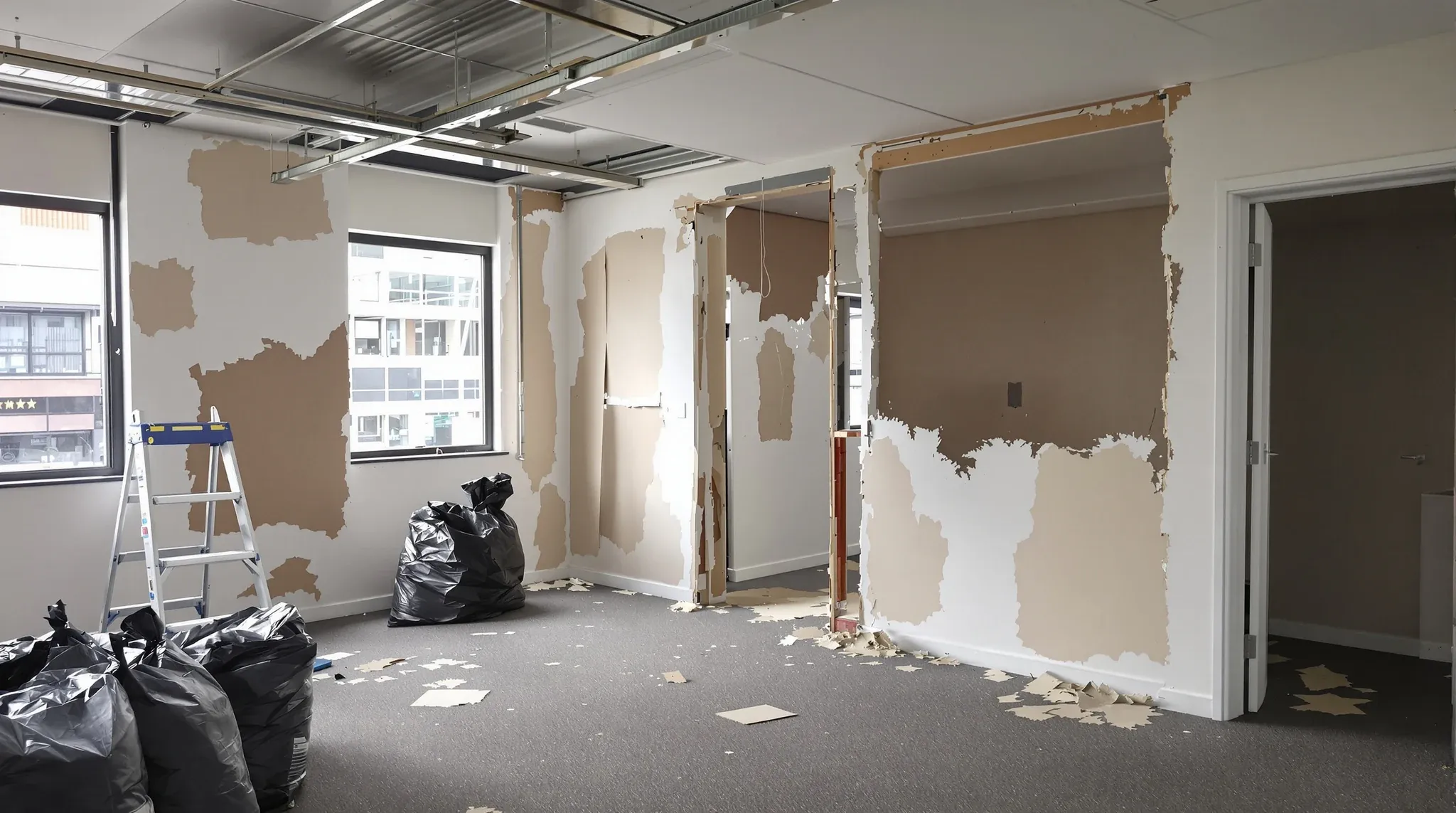
Self-managing a defit looks like a way to save money. The logic seems straightforward: why pay a contractor to pull out walls and clear a space when you can organise the labour yourself, hire a skip, and get it done for less? The answer, in almost every case, is that the apparent saving disappears once the hidden costs start stacking up, and they start stacking up early.
Tenants who manage their own defit without commercial strip-out experience consistently spend more than those who engage an experienced team from the start. The reasons are predictable and avoidable, but they require understanding what actually goes wrong when a defit is treated as a simple demolition job rather than a coordinated project.
Why the DIY Approach Seems Attractive
The appeal of a self-managed defit usually comes down to cost perception. A tenant looking at quotes from commercial defit contractors sees a number that feels high for what appears to be demolition and waste removal. They compare it to the cost of hiring a labourer or two, renting a skip bin, and spending a weekend pulling things apart. The gap between those two numbers looks like profit margin they can capture.
What that comparison misses is the scope difference between what the tenant is pricing and what the contractor is pricing. The contractor’s quote includes not just the physical removal but the building management coordination, waste disposal compliance, services decommissioning, surface restoration, and project management that a proper defit requires. The tenant’s estimate typically covers only the visible demolition and ignores everything that happens around it and after it.
There is also a confidence factor. Tenants who have managed office moves, minor renovations, or residential projects sometimes assume that a commercial defit is a similar exercise at a larger scale. In practice, commercial buildings operate under a different set of rules, and the consequences of getting it wrong are financial rather than merely inconvenient.
The Cost of Getting the Scope Wrong
The first and most expensive mistake in a DIY defit is underestimating the scope. Tenants who have not done this before typically think of the defit in terms of what they can see: partitions, joinery, kitchen fittings, and floor coverings. They do not account for the services that were installed as part of the fitout and now need to be decommissioned or removed.
Electrical circuits that were added for additional power points, lighting, or dedicated equipment need to be isolated and removed by a licensed electrician. Data cabling needs to be pulled from the ceiling void. If the fitout included a kitchen with plumbing, those connections need to be capped by a licensed plumber. If the fire system was modified to accommodate the layout, a fire protection contractor needs to reinstate it. None of this work can legally be done by a general labourer, and discovering the requirement mid-project means engaging specialist trades at short notice and at premium rates.
Small decisions that compound into budget overruns are a persistent feature of self-managed projects, because each discovery creates a new cost that was not in the original estimate. By the time the scope is fully understood, the cumulative cost often exceeds what the contractor would have charged to manage the entire process.
How Inexperience Creates Collateral Damage
Removing fitout elements without understanding how they are connected to the base building creates collateral damage that the tenant is responsible for repairing. Pulling a partition off a wall without cutting the connection cleanly tears the plasterboard face on the adjacent surface. Ripping a floor channel out of a slab without properly extracting the fixings damages the concrete. Disturbing ceiling tiles while removing partition heads dislodges the ceiling grid framework and breaks adjacent tiles that were not part of the defit scope.
Each of these incidents adds to the make good cost. Patching a damaged wall is not expensive in isolation, but when it happens at every partition junction, along every floor channel, and across every ceiling interface, the cumulative repair cost is substantial. An experienced defit team minimises this collateral damage because they understand the connection details and remove elements in a sequence that protects adjacent surfaces.
Collateral damage also extends to base building services. A labourer who cuts through a cable in the ceiling void without knowing what it serves can disable building systems that affect other tenants. Damaging a fire sprinkler pipe creates a water damage event that can be catastrophic. These incidents are not just costly to repair; they create liability for the tenant and damage the relationship with the landlord and building management at exactly the moment when that relationship matters most.
Building Management Problems That Add Cost
Commercial buildings have rules about how work is conducted on site, and those rules exist for good reasons. They protect other tenants, maintain building services, and ensure that work does not create safety hazards. A self-managed defit that does not comply with these rules will be stopped by building management, and the delays that result add cost.
Common compliance failures in DIY defits include working outside permitted hours, using the passenger lifts instead of the goods lift for waste removal, failing to obtain hot work permits for cutting or grinding, not providing a safe work method statement, and not carrying adequate contractor insurance. Any one of these can result in building management shutting the work down until the issue is resolved, which can cost days of lost progress.
Coordination complexity increases when the tenant is trying to manage the building relationship themselves while also directing the physical work. An experienced defit contractor handles this interface as part of their service, maintaining the approvals, schedules, and documentation that building management requires without the tenant needing to be involved in every interaction.
The Holding-Over Penalty When Work Runs Late
One of the most financially punishing consequences of a DIY defit is running past the lease expiry date. Most commercial leases include a holding-over provision that charges the tenant at a rate significantly above the standard rent for every day they remain in the premises beyond lease end. This rate is typically 150 to 200 per cent of the daily rent, and it accrues regardless of whether the tenant is still occupying the space or simply has not completed the make good.
DIY defits run late for predictable reasons: the scope was underestimated, the timeline was not realistic, trades could not be coordinated at short notice, building management approvals took longer than expected, and the restoration work after strip-out was not factored into the programme. Each of these delays is a few days, but together they can push the make good completion past the lease expiry by weeks.
At a daily holding-over rate of $500 to $1,500 depending on the tenancy size and location, two weeks of overrun adds $7,000 to $21,000 to the total cost. That single cost often exceeds the difference between the DIY estimate and the professional quote that the tenant was trying to avoid. It is the most common and most avoidable cost overrun in self-managed defits.
Rectification Costs: Paying Twice for the Same Work
When a DIY defit is completed, the landlord inspects the premises and identifies deficiencies. Common deficiency findings include incomplete surface restoration, missed services that were not decommissioned, damaged ceiling grid components, inadequate floor preparation, and insufficient cleaning. The tenant then has a choice: rectify the deficiencies themselves or allow the landlord to engage contractors to do it and deduct the cost from the bond.
Rectifying deficiencies after the initial attempt means paying twice: once for the original work and once for the fix. If the landlord engages their own contractors, the cost is typically higher than market rate because the landlord is not incentivised to obtain competitive pricing, and they will add a management fee on top.
The hidden cost of mid-project changes applies equally to make good work. Every deficiency that requires a return visit to site involves mobilisation costs, trades coordination, and building access that would have been unnecessary if the work had been done correctly the first time. An experienced defit contractor knows what the landlord’s inspection will cover and delivers the work to that standard from the outset.
What the Full Cost Comparison Actually Looks Like
A fair cost comparison between a DIY defit and a professionally managed one needs to include all costs, not just the direct labour and waste removal. The DIY column needs to account for specialist trades engaged at short notice, collateral damage repair, building management delays, potential holding-over charges, rectification costs, and the tenant’s own time spent managing a process they are not experienced in.
When all of these costs are included, the DIY approach typically costs 20 to 50 per cent more than a professional engagement, with significantly more risk and stress. The professional quote may look higher at face value, but it covers a defined scope delivered to a standard that will pass the landlord’s inspection the first time, on a timeline that avoids holding-over penalties.
Working with an experienced fitout company for the defit and make good provides cost certainty, programme reliability, and the peace of mind that comes from knowing the work will be done to the standard the landlord requires. For most tenants, the apparent saving from going DIY is not a saving at all.
If you are weighing up how to manage your defit and make good, we can provide a fixed-scope quote that covers everything from strip-out to handover, so you can compare like with like.
Call us on 1300 60 93 93