
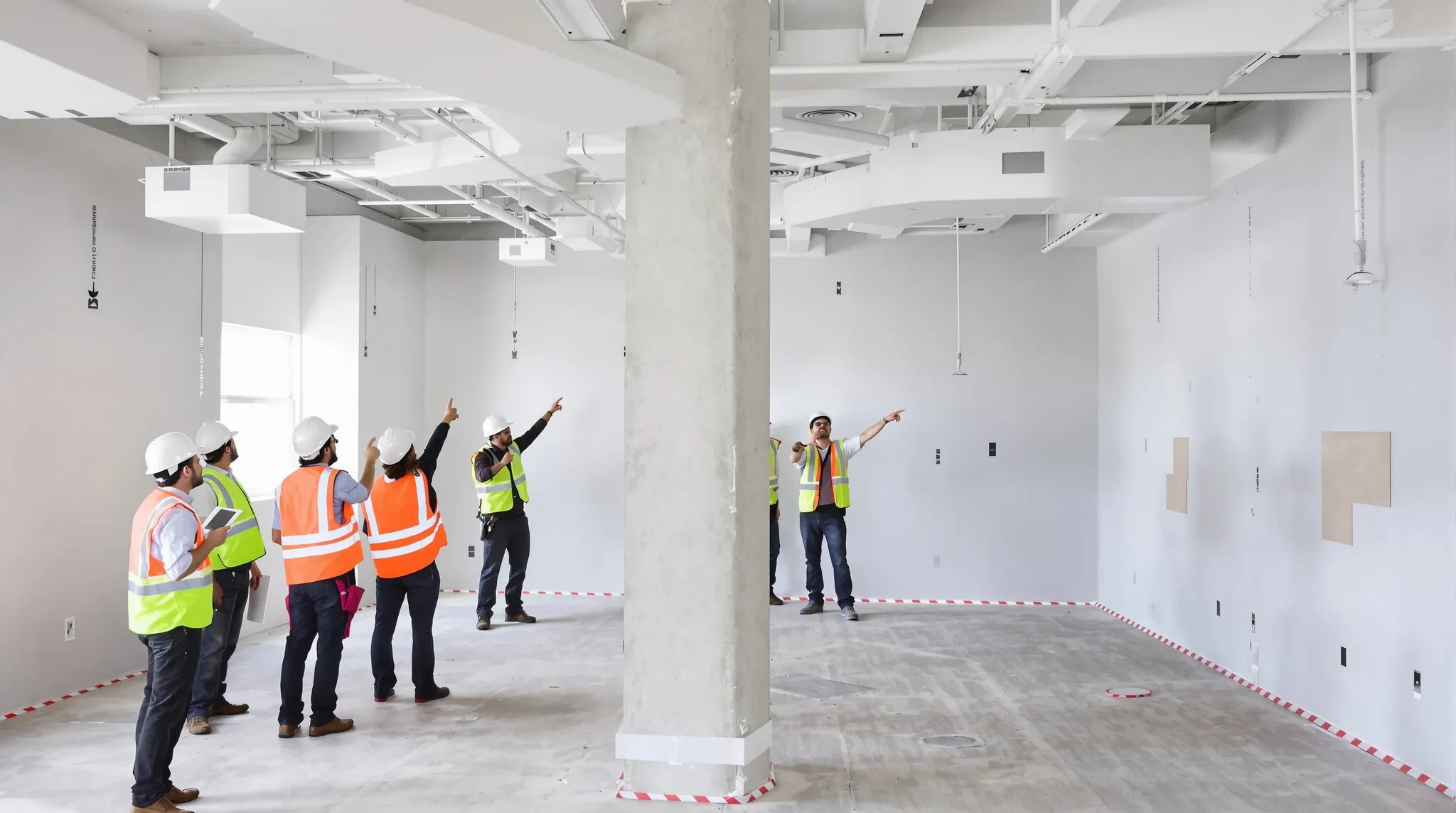
A fitout with four decision-makers moves faster, costs less, and produces a better office than a fitout with twelve. Not because fewer people means less expertise, but because fewer people with clear authority means decisions are made once, made well, and made in time. When authority is diffused across a large group where everyone has input but nobody has final say, decisions get made slowly, revisited repeatedly, and eventually forced through under programme pressure in a form that satisfies nobody.
The cost of too many people “involved” in a fitout is real. It shows up in programme delays, late variations, design compromises, and an office that reflects the average of competing preferences rather than a considered strategy for how the business actually works.
How Input Without Ownership Creates Friction
Most fitout projects attract a wide circle of contributors. Leadership, operations, IT, HR, property, facilities, and sometimes individual team leaders all have a view on what the office should look like and how it should work. Each perspective is valid. The problem is not the input. It is that input without ownership of consequences creates friction that slows the project and increases cost.
When someone suggests a change to the partition layout but does not own the budget impact, the cost implication falls to someone else to absorb. When someone requests an additional meeting room but does not own the programme impact, the schedule compression falls to the builder to manage. When someone changes a finish preference after materials are ordered, the abortive cost falls to the project to carry.
Each individual suggestion may be reasonable. Collectively, they create an environment where the project is constantly responding to new input rather than progressing through resolved decisions. The programme stretches, the budget creeps, and the delivery team spends time managing stakeholders instead of managing construction.
Decision Speed Degrades as Consensus Expands
Fitout programmes are built on the assumption that decisions will be made at specific points in the process. The layout is confirmed by a certain date so the ceiling design can proceed. The partition types are locked so materials can be ordered within lead time. The services coordination is approved so the builder can sequence trades.
When decision authority is spread across many people, each decision point takes longer. What should be a two-day turnaround becomes a two-week round of reviews, comments, counter-proposals, and compromise. The programme absorbs the first few delays. Eventually it cannot, and the project either extends or compresses later phases to recover, both of which cost money.
In Sydney fitouts, where lease dates are fixed and building access windows are tight, programme slippage concentrates at the same stages: layout approval, partition specification, and services coordination. These are exactly the stages where diffused decision-making does the most damage, because they are the stages where delay cascades most aggressively into construction.
Late Input Costs More Than Wrong Input
A partition decision made early and later found to be imperfect is almost always cheaper than a partition decision delayed until the “right” answer emerges from extended consultation. Early decisions can be refined during design. Late decisions force rework during construction.
This is counterintuitive for many stakeholders, who believe that more consultation produces better outcomes. In construction, the relationship between consultation and outcome quality is not linear. There is a point of diminishing returns beyond which additional input costs more than it improves, and most fitout projects pass that point well before the stakeholder group is satisfied that every voice has been heard.
The most expensive form of late input is the senior stakeholder who has been absent from the process, reviews the near-final design, and requests changes that unwind weeks of resolved work. This pattern is common enough to be predictable, and the most effective defence against it is ensuring that senior decision-makers are involved at two or three key milestone points rather than arriving late with a fresh perspective that the project cannot afford to accommodate.
Fragmented Authority Invites Variations
Variations on fitout projects are often framed as pricing disputes or scope disagreements. In many cases, they are governance failures. One party approved a change assuming another party would absorb the cost. Another party flagged an issue but assumed it was being managed elsewhere. A decision was made in a meeting that the builder was not part of, and the instruction reached site in a form that did not match what the builder had priced.
When authority is clear, these gaps close. One person approves changes, one person owns the budget, and one person is accountable for how design decisions translate into built outcomes. Variations still occur, because fitouts are complex and buildings surprise, but they occur for genuine reasons rather than governance failures.
The commercial difference is significant. Projects with clear authority structures tend to have fewer and smaller variations. Projects with fragmented authority tend to accumulate variations throughout delivery, not because the projects are more complex, but because the decision-making process introduces cost that would not exist under tighter governance. The variations are a symptom. The governance structure is the cause.
Partition and Ceiling Decisions Are Particularly Vulnerable
Partition and ceiling decisions sit at the intersection of multiple interests. The CEO wants glass for visibility. HR wants plasterboard for privacy. IT wants easy access to the ceiling void for cabling. Facilities wants low-maintenance finishes. The property manager wants landlord compliance. The designer wants visual consistency.
Each perspective has merit, and in a well-structured process these inputs are gathered early, weighed against the functional requirements, and resolved into a coherent strategy. In a poorly structured process, these perspectives compete throughout the project, with each stakeholder advocating for their priority at different stages and the delivery team absorbing the resulting churn.
The churn is expensive because partitions and ceilings are early-stage elements that other trades depend on. A partition decision that changes after the ceiling design is resolved forces the ceiling to be redesigned. A ceiling decision that changes after services coordination forces the mechanical and electrical layouts to be revised. The cascade effect means that partition and ceiling decisions carry disproportionate weight, and getting them right early through clear governance pays for itself across the rest of the project.
This is also where the value of a single delivery team becomes most visible. When one team is responsible for partitions, ceilings, and the coordination between them, the competing stakeholder inputs are resolved within that team’s design process rather than playing out across separate contractors who have no mechanism to reconcile them.
How to Structure Involvement Without Creating Paralysis
The goal is not to exclude people from the process. It is to structure involvement so that the right input arrives at the right time, and decisions are made by people with the authority and context to make them stick.
The most effective structure separates input from authority. A broad group provides input at defined milestone points: layout review, partition strategy review, and pre-construction review. A small group, usually two or three people with genuine decision authority and budget accountability, makes the final calls. The broad group is informed of decisions. The small group is accountable for them.
This structure respects expertise without creating paralysis. The HR team’s privacy requirements are captured during the partition strategy review. The IT team’s access requirements are captured during the ceiling and services review. Neither team needs to approve every subsequent detail, because their requirements are already embedded in the design.
Where this structure breaks down is usually where nobody has been explicitly appointed to make final decisions. In the absence of clear authority, every stakeholder assumes their input carries equal weight, and the delivery team has no mechanism to resolve competing preferences. The result is either extended negotiation that delays the programme or a compromise that nobody is genuinely satisfied with. Both outcomes cost more than a clear decision made by the right person at the right time.
What Effective Decision Governance Looks Like in Practice
On projects that run well, the governance structure is simple. One person from the client side has authority to approve design decisions and budget changes. That person has access to the stakeholder inputs they need but is not required to achieve consensus before deciding. The delivery team has a single point of contact for instructions, which prevents the common problem of conflicting directions arriving from different stakeholders.
This does not mean the process is autocratic. It means it is structured. The right people are consulted at the right stages, decisions are documented clearly, and once a decision is made it stays made unless a genuinely new piece of information warrants reopening it. The project moves forward at the pace the programme requires, rather than at the pace the slowest decision-maker allows.
We help clients set up this governance as part of every project, whether it is a full office fitout or a standalone partition or ceiling scope. Getting the decision structure right before construction starts is one of the simplest ways to protect both budget and programme. If you want a fitout where involvement adds value rather than friction, we can help.
📞 Call us on 1300 60 93 93