
Tenants picturing a fit-out usually picture dust, drills, and a week of noise. The reality is less uniform. Different phases of a build create different kinds of disruption, at different intensities, in different parts of the floor, and the way a site feels to an adjacent tenant on Tuesday morning is not the way it will feel on Friday afternoon. Understanding how the site reality layers across the programme is what lets a tenant plan for the disruption rather than react to it.
The important thing is that disruption does not run at a constant level and then stop at handover. It moves in waves, with each wave carrying its own signature of noise, dust, vibration, smell, and interruption. Knowing which wave is currently on site makes the difference between “the project is out of control” and “this is the demolition week, it will be quieter next week”. The layers below cover the main waves that show up on most commercial fit-outs.
The quiet weeks nobody sees: site protection and set-up
Before any trades arrive, a fit-out usually starts with a quiet week that tenants rarely notice. Hoarding goes up, dust curtains are installed, floor protection is laid down, temporary power is set up, and signage is installed to warn adjacent tenants and staff of the work to come. Nothing loud happens during this phase, but the preparation determines how much noise and dust the rest of the programme can contain.
The layer of disruption here is minimal, but the investment in containment pays off in every later phase. A fit-out that skimps on hoarding, dust extraction, and air handling arrangements will end up with complaints from adjacent tenants in week three. Investing properly at this stage is what makes the noisier phases tolerable. The set-up quality is usually where the difference between a well-run and a disruptive job first shows up.
Demolition: the loudest, dirtiest, shortest phase
Demolition is the phase most people picture when they think of a fit-out. Partition framing is cut down, plasterboard is removed, ceiling tiles come out, carpet is lifted, and redundant services are disconnected. The noise is significant. Dust is constant. Small vibrations carry through the slab. The phase is usually short, measured in days or a handful of weeks depending on the scope, but it is intense while it runs.
The disruption layer here is the one tenants worry about most, and it is the one that is usually easiest to plan for. The work can be concentrated in known windows, contained behind proper hoarding, and scheduled around the client’s operational calendar where possible. Most noise complaints from neighbouring tenants on a fit-out come from this phase, and most of them could have been avoided with better containment or better communication. The layer of demolition and strip-out pitfalls is usually where the first real tension between a site team and a client lives, because it is where the disruption is most visible.
Services rough-in: quieter than demolition but longer
Once demolition is finished, the site goes through a quieter but longer phase of services rough-in. Electrical cabling, data backbone, sprinkler modifications, detector wiring, mechanical duct adjustments, and fire panel programming all happen in the ceiling void. The noise is moderate but constant. Dust is much lower. The vibration is mostly gone. The phase typically runs over two to four weeks depending on the scope.
The disruption layer at this stage is mostly about activity rather than noise. Trades are on site every day, ladders and platforms are everywhere, and the floor looks messy even though most of the real work is above head height. Tenants visiting the site sometimes worry because “nothing seems to be happening”, when the reality is that the most technically demanding coordination is in full swing. A fit-out running cleanly through services rough-in looks like steady progress even if the dramatic noise of demolition has gone quiet.
Partition framing: the skeleton appears
As services finish, framing for partitions starts to go up. This phase brings back a moderate layer of noise as stud walls are fixed, plasterboard is screwed into place, and the skeleton of the rooms becomes visible. Dust is present but containable. Vibration is minimal. The disruption is more visible than the rough-in phase, because for the first time the shape of the rooms starts to emerge.
Tenants walking the site at this point often want to make changes. A meeting room feels smaller than expected, a corridor feels narrower, a breakout zone feels exposed. The disruption layer here is as much about decision-making as noise: every change request at this stage cascades into services, ceilings, and sometimes doors. Walking the framed layout with the people who will use it daily is the right discipline, but it has to happen quickly because the walls are about to close.
There is also a quieter disruption that tenants rarely notice during framing: vibration through the slab. Impact drivers fixing tracks into concrete can carry a low-level hum into adjacent tenancies above and below, especially in older buildings. The vibration is usually harmless but it can trigger complaints from tenants who are doing fine detail work or running audio recording studios. A programme that factors vibration-sensitive neighbours into the framing schedule tends to keep complaints down without changing the pace of the work itself. The pattern around risks that drive fit-outs off track often includes neighbour tensions that started in exactly this kind of quiet moment.
Plasterboard, ceilings and finishes: the dust peaks a second time
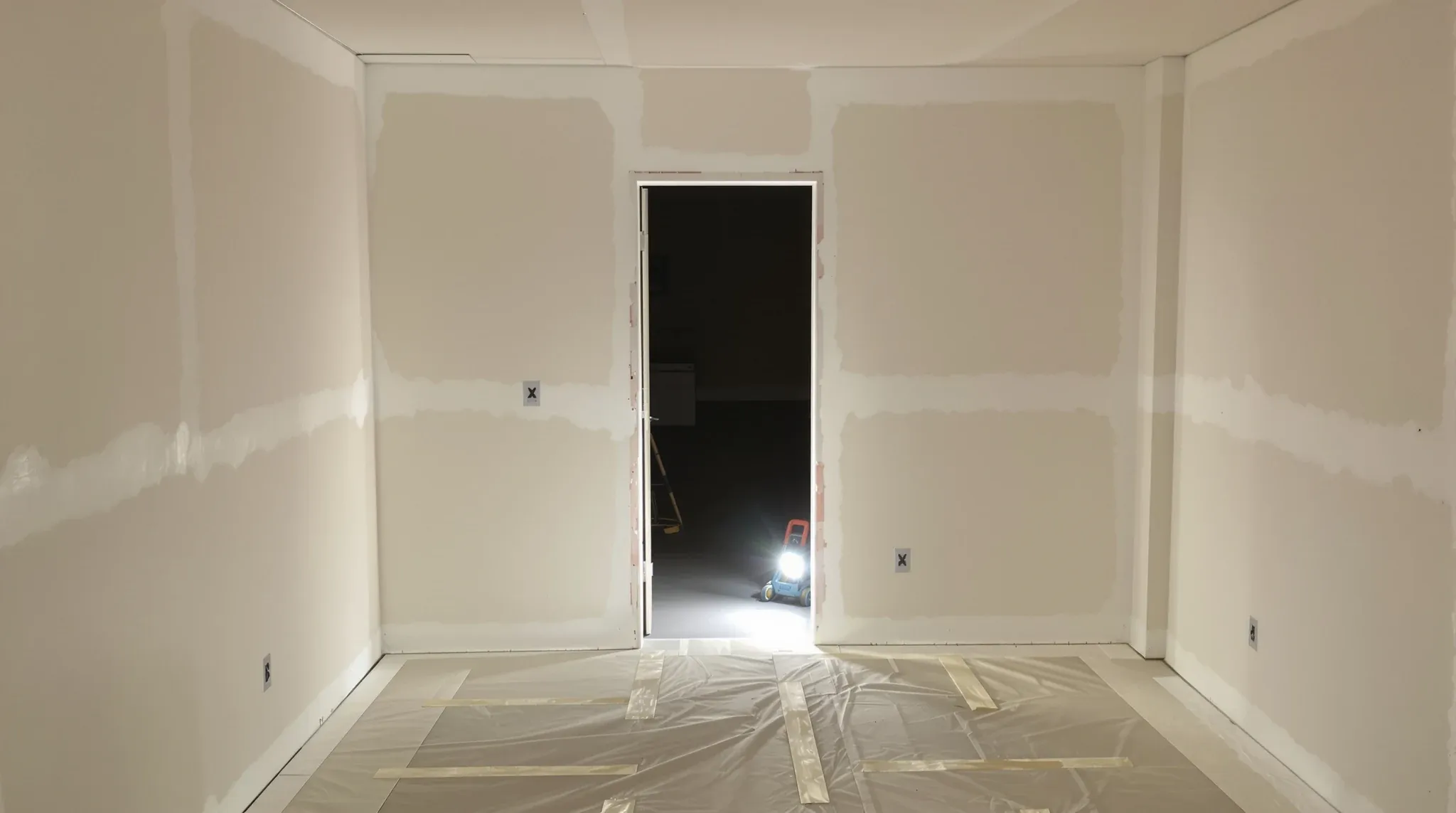
Plastering and painting bring back a dust layer that rivals demolition in intensity, although it is finer and less dramatic. Sanding plasterboard, preparing surfaces, and spraying paint all generate airborne dust that needs proper extraction and containment, especially on floors where adjacent tenants are sensitive to air quality. The noise is moderate but the dust is the issue.
Ceiling work overlaps with this phase. Tile installation, lighting fit-off, diffuser placement, and sprinkler trimming all happen in the same zone, usually under the same scaffold. The layer of disruption here is a combination of dust, moderate noise, and significant trade density in the same space. The cost of being sloppy about containment during this phase shows up as soot marks on adjacent floors, dust in air conditioning filters, and complaints about smell from paint and sealants. The overlap with waste removal and site logistics is where most of the containment judgement lives, because waste streams and dust management need to run in step.
Joinery and fit-off: noisy in short bursts
Joinery delivery and installation bring a different disruption layer. Large items arrive through the lift and the loading dock, often in pieces that have to be assembled on site. Cutting, fitting, and securing joinery to walls generates short bursts of noise and dust but nothing like the earlier phases. Electrical fit-off, data tail termination, and AV installation happen around the same time, adding trade density but not much noise.
The disruption layer here is mostly logistical. Deliveries through the building, staging of joinery in corridors, and the need to protect already-finished surfaces while heavy items are moved all create friction in adjacent parts of the floor. A fit-out running cleanly at this stage is usually one where the delivery schedule was planned carefully and the site team protected the finished surfaces properly. The broader pattern around staging works in a live environment becomes obvious in the joinery week, because a badly planned delivery can undo a week of quiet operation.
Commissioning and handover: quiet but attention-heavy
The final phase is quiet by any measure. Commissioning involves testing services, running through fire panel programming, balancing mechanical systems, and walking the defects list. Noise is minimal. Dust is gone. The disruption layer is almost entirely about attention rather than site impact: inspectors, commissioning engineers, and the fit-out team are all on the floor at the same time and they need access to specific zones without interference.
Tenants sometimes assume the quiet of this phase means the work is over. It is not. Small defects, final adjustments, and the handover walk-through all happen in this window, and any issue that does not get captured here will surface during occupation instead. Holding the discipline through the quiet weeks is what makes the difference between a clean handover and a programme that drifts into the occupation phase with unresolved items. Where a complete office fitouts programme handles all of these waves under one team, the transitions between phases tend to feel cleaner because the people setting up the dust containment in week one are the same people walking the defects list at the end.
One final note worth making explicitly: the disruption profile of a fit-out is not a fixed property of the build. It is a function of how carefully each phase is planned and contained. Two fit-outs of the same scope on similar floors can feel completely different to adjacent tenants depending on how the dust, noise, vibration, and logistics were handled week by week. The work is the same. The experience is not.
If you are trying to plan around the noise, dust, and disruption of a fit-out in a sensitive building or a live tenancy, we can help you map the phases against your operating needs and containment requirements.
📞 Call us on 1300 60 93 93