
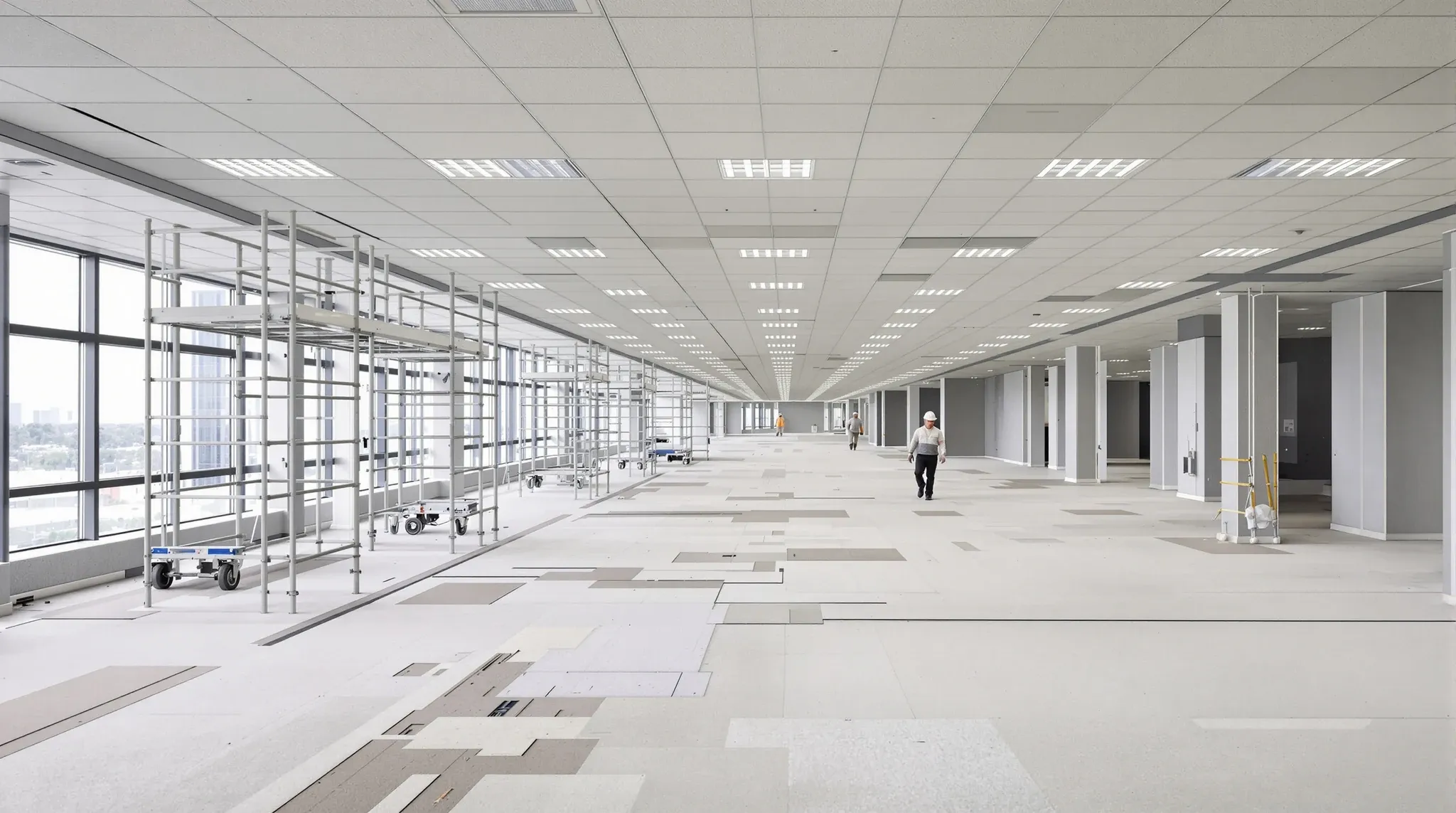
A commercial office defit in Sydney typically runs between one and four weeks for the physical works. Small tenancies under 200 sqm usually complete in a few days, mid-size tenancies in the 200 to 1,000 sqm band sit at one to two weeks on site, and full-floor strip-outs above 1,000 sqm often stretch to four weeks or more once services strip-back is heavy. That is only part of the picture. The full programme a tenant actually needs to plan against, from the first scope conversation with the landlord through to a cleared, inspected space handed back inside the lease date, typically runs two to three months end to end, and in some buildings longer.
The reason the headline duration and the working programme differ so much is that the physical defit sits inside a longer choreography of scoping, paperwork, landlord approvals, services isolation windows, and final inspection. A tenant who treats the defit as a one-to-four-week job tends to start it one to four weeks before handover and discover at the end that the landlord’s sign-off process was the critical path all along. The tenants who exit cleanly work back from handover with the full programme in view, not just the on-site days.
Standard Defit Durations By Tenancy Size
Defit duration scales with size but not linearly. A small tenancy with light partition work, retained carpet, and a simple ceiling grid can usually be stripped in two to three working days. A mid-size tenancy in the 200 to 1,000 sqm range typically runs one to two weeks on site, and a larger tenancy above 1,000 sqm with dense partitions, meeting-room boxes, and heavy services strip-back generally runs three to four weeks, sometimes longer.
Within each band the range is wide. Two 500 sqm tenancies can land at very different programme lengths. One might strip in five working days because the previous fitout was light, the ceiling grid is mostly intact, and the services run back to clean isolation points. Another at the same footprint might take fifteen working days because the fitout was densely packed, the ceiling was heavily modified around custom bulkheads, and the data and power circuits were progressively extended over the lease rather than installed cleanly at the start.
What typically drives the difference is not the footprint, it is the density of what was built and the state it is in when stripping begins. Tenants scoping their own programme are better served working from fitout density than from floor area alone.
Factors That Extend Project Timelines
A short list of recurring factors adds days or weeks to the physical works. Understanding them early is how a realistic schedule gets built.
Partition density is the biggest single driver. A tenancy with two meeting rooms and a reception screen strips quickly. A tenancy with a dozen offices, three meeting rooms, a boardroom and partitioned circulation takes far longer, not just because there is more wall, but because each removal leaves patching, ceiling reinstatement and floor coverings behind that have to be addressed before handover.
Ceiling reinstatement is the second driver and often the most underestimated. Where partitions penetrated the ceiling grid, tiles need to be replaced, grid members reinstated, and damaged sections matched back. If the building uses a discontinued tile pattern, replacements may need to be sourced from a different supplier or substituted, which adds lead time. Landlord inspections pay close attention to ceiling reinstatement because that is where the evidence of the outgoing fitout most obviously lives.
Services strip-back extends the programme further on tenancies with heavy data, power, or mechanical works. Every tenant-installed circuit needs to be disconnected and pulled back to the base-building connection point, not just cut and abandoned. Data cabling runs, particularly those retrofitted through ceiling voids during the lease, take longer to trace and remove than to install in the first place. Mechanical modifications to air-conditioning or supplementary units tied back into base-building systems need isolation windows, which are rarely available during business hours in shared buildings.
Floor coverings and finishes add the final extension. Where the tenant installed carpet, vinyl, or polished concrete treatments over the base floor, removal and reinstatement back to the base-building finish is usually in scope. Stubborn adhesives, damaged screed, and level changes built around raised platforms all add days that rarely appear on the initial scope brief.
Effective Strategies For Program Compression
Defit programmes can be compressed in a small number of ways, and most of the good compression happens off-site before any physical work begins.
Early scope agreement with the landlord is the single biggest compressor. A defit scope that has been agreed in writing four to six weeks before the strip-out begins runs significantly faster than one that is still being negotiated while the floor is being demolished. Agreement usually covers which elements stay, which go, what the reinstatement standard is, and where negotiation has landed on items the lease treats ambiguously.
A clean paperwork trail helps compress the scope itself. Tenants who can produce the original lease, any agreements for lease, variations over the term, approved drawings for fitout works, and any landlord approvals issued during the tenancy, tend to settle the defit scope materially faster than tenants who arrive with memory alone. Where the paperwork supports retaining an element, that element often stays, which reduces removal work and avoids the reinstatement that would otherwise follow.
Retained elements are the second compressor. If the landlord is willing to keep particular partitions, joinery, or floor coverings because they suit the next tenancy, those items drop out of both the strip-out and the reinstatement, and every retention compounds the saving.
After-hours access, where the building permits it, unlocks parallel works that daytime-only sites cannot run. Services isolations that need to happen outside of business hours are the most common bottleneck, and after-hours access moves them off the critical path.
Landlord Approvals And Inspections On The Critical Path
On most commercial defits, the physical works are not the critical path. The critical path is usually the sign-off cycle around them. Scope agreement, method approval, services-isolation scheduling, and final inspection all sit inside the landlord’s process, and each of them has lead time that the tenant does not control.
Scope agreement typically runs two to six weeks depending on how complex the fitout was and how responsive the landlord is. A straightforward tenancy with a cooperative building manager can lock a scope inside two weeks. A contested scope with a busy or risk-averse landlord can take twice that. Tenants who leave scope agreement until the last month before lease end are almost always the ones who run hot at handover.
Method approval for the physical works, where the landlord requires it, sits on top of scope agreement. The landlord wants to see the sequence, the protection to base-building surfaces, the services isolation plan, and the waste removal method. That approval is usually quicker than scope agreement but still carries days, not hours.
Final inspection is the other gate. Landlords generally inspect the space at handover against the lease’s reinstatement standard, and any items flagged have to be corrected before the keys are formally accepted. A cleanly managed defit often completes inspection in a single visit with a short punch list. A rushed defit often triggers a second or third inspection round as items are corrected, each round adding days and cost to the programme when the tenant has already assumed they are finished.
Programming Backwards From Lease Expiry
Most of the programme failures we see are not caused by the physical works running slow. They are caused by the programme being built forwards from “when we can start” rather than backwards from the lease-end date. Forward-built programmes drift. Backward-built programmes force early decisions.
A useful working assumption for a mid-size tenancy is to start scope conversations with the landlord around ten to twelve weeks before lease end, target scope agreement around six to eight weeks out, schedule the on-site defit to complete two to three weeks before lease end, and leave a two-week buffer for inspection, remediation and any late adjustments. Shorter tenancies can compress this at the front. Longer or more complex tenancies need to start earlier.
The two-week buffer matters. Final inspection items are rarely zero. Even well-run defits usually come back with a short list, such as a patched section that needs a second coat, a ceiling tile that was the wrong pattern, or a services termination the landlord wants seen inside a panel rather than capped behind a cover. Those items take days to resolve, not hours, and the tenant who has not budgeted buffer time either takes the hit on the bond or delays handover past the lease date and pays holdover.
For larger tenancies, the backwards schedule starts earlier. A 1,500 sqm full-floor strip-out with substantial services work, partition density and ceiling reinstatement should typically have scope conversations beginning four to six months out, not ten to twelve weeks out.
Common Program Risks Depleting Contingency
A short list of recurring risks tends to absorb whatever buffer the programme contains, and they are predictable enough that a realistic schedule should account for them.
Older-building discoveries are the first risk. Commercial buildings from the 1970s and 1980s sometimes contain hazardous-materials-era products in ceiling tiles, thermal insulation, or flooring adhesives. Where those products are disturbed during a defit, the programme has to absorb testing, licensed removal, and clearance certification. None of that is recovered in days.
Services that cannot be isolated during business hours are the second recurring risk. Shared mechanical systems, common power, and fire services often need to be isolated outside business hours, and the building manager’s availability for those windows is finite. A tenant who hits an after-hours-only isolation midway through a daytime programme can lose multiple days waiting for the next available window.
Dilapidation-report disputes are the third risk. Where the condition at lease start was not recorded photographically or was recorded incompletely, the landlord and tenant can end up negotiating the line between base-building condition at handback and tenant-installed condition in the middle of the defit itself. That negotiation is a programme killer because it freezes individual elements while the rest of the work continues around them.
Late discovery of scope the tenant did not budget for is the final recurring risk. Supplementary cooling units installed mid-lease, additional data racks in comms rooms, branded signage with concealed fixings, and floor penetrations around server rooms are the items tenants most often forget were added, and each of them carries its own removal and reinstatement clock.
Components Of A Realistic Project Schedule
Pulling the picture together, a realistic working programme for a mid-size Sydney office defit is less about hitting a single duration and more about sequencing a set of gates in the right order with sensible buffers between them.
Scope and paperwork review starts early, typically ten to twelve weeks before lease end for a mid-size tenancy, four to six months out for a large one. Scope agreement with the landlord is negotiated in parallel and usually settles six to eight weeks before lease end. Method approval follows. The on-site strip-out is scheduled to complete two to three weeks before lease end, with a realistic duration based on partition density, ceiling reinstatement, services strip-back and floor coverings, not on floor area alone. A buffer of at least two weeks is held for final inspection and remediation.
Tenants who work to that shape tend to exit cleanly. Tenants who work forwards from “we’ll deal with it when we get there” tend to pay for the shortcut at handover, usually in holdover rent, punchy remediation bills, or a contested bond release that drags on after they have moved into the new space.
If you are scoping a defit ahead of a Sydney lease exit and want to test your programme against the realities of your tenancy size, building and services strip-back, we can help. We plan and deliver defit and make good works across Sydney commercial offices, and we can walk you through the schedule honestly before you commit to a handover date.
📞 Call us on 1300 60 93 93