
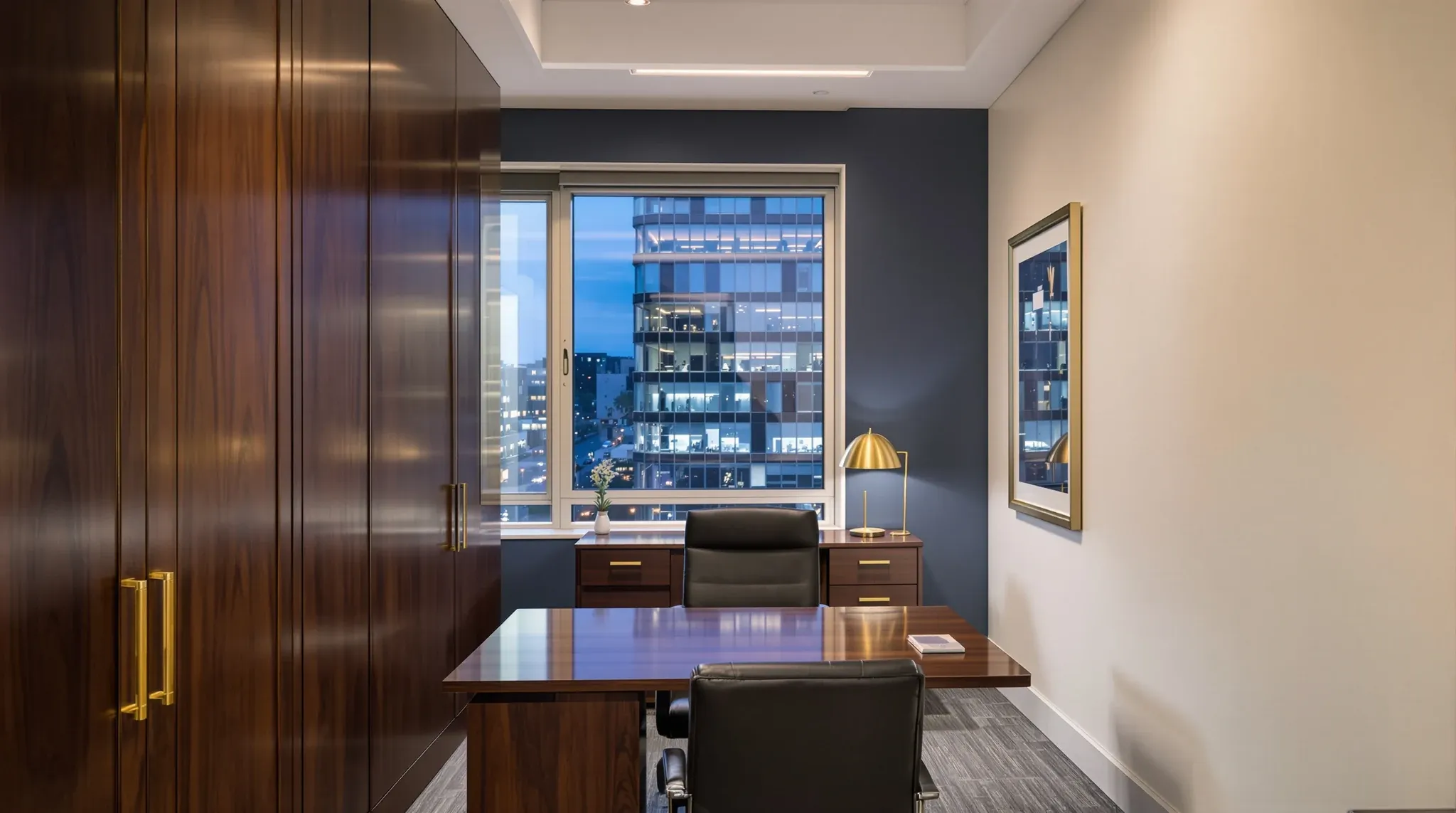
A law firm fitout involves considerably more coordination than a standard commercial office project. The scope typically extends across partitioning, joinery, electrical and data infrastructure, ceilings, lighting, flooring, and finishes, with each element needing to accommodate the particular way legal teams work. Getting the scope right at the outset determines whether the project runs smoothly or becomes a series of late-stage compromises.
What makes a law firm fitout different is not just the list of trades involved but the way those trades need to interact. Partition systems need to accommodate security hardware. Electrical layouts need to support technology-heavy meeting rooms. Joinery needs to handle both display-quality reception areas and high-density document storage. When these dependencies are understood early, the project can be sequenced efficiently. When they are discovered mid-build, the cost and time impacts compound quickly.
This is a practical look at what a full law firm fitout involves, from the first design decisions through to handover and occupation.
What a Law Firm Fitout Scope Actually Covers
A complete office fitout for a law firm typically includes partition walls, ceiling works, electrical and data cabling, lighting, flooring, joinery, painting, and building services coordination. Depending on the tenancy, it may also include mechanical services modifications, fire services upgrades, and hydraulic work for kitchenettes or bathroom amenities.
The scope is shaped by the size of the practice, the type of law being practised, and the condition of the base building. A boutique litigation firm taking a half-floor in the CBD will have different requirements from a mid-tier commercial practice occupying two full floors in Parramatta. The number of enclosed offices, the ratio of meeting rooms to workstations, and the nature of client-facing areas all influence the bill of quantities.
One common mistake is treating the fitout as a series of separate purchases rather than an integrated project. When partitions, ceilings, electrical, and joinery are procured independently, the coordination burden shifts to the client, and the risk of gaps, conflicts, and rework increases. Understanding what a complete fitout includes helps avoid that fragmentation from the start.
Design and Layout Planning for Legal Environments
Layout planning for a law firm needs to balance several competing demands. Partners and senior lawyers typically expect enclosed offices. Meeting rooms need to accommodate clients, opposing counsel, and sometimes larger settlement or mediation groups. Support staff need efficient workstation clusters with proximity to the teams they serve. And shared facilities like libraries, file rooms, and break areas need to be accessible without disrupting working zones.
The design phase is where these competing demands get resolved. A well-briefed design team will start by understanding headcount, growth projections, practice group structure, and the firm’s preferences around partner offices, open-plan areas, and meeting room ratios. From there, the layout takes shape around the floorplate, with circulation paths, service zones, and the front-of-house sequence all considered together.
In law firm fitouts, the design phase often takes longer than in standard commercial projects because the requirements are more specific and the stakeholders more involved. That additional time at the front end is almost always worthwhile, because changes made on a drawing cost a fraction of what they cost on site.
Partitions, Walls, and Space Division
Partitioning makes up a significant portion of a law firm fitout budget. Legal practices require more enclosed rooms per square metre than most commercial offices, and the performance requirements for those enclosures are higher. Acoustic performance, fire rating, and structural capacity for wall-mounted storage all need to be considered when specifying the partition system.
Most law firm fitouts use a combination of plasterboard and glass. Plasterboard walls handle the bulk of the enclosed offices, corridors, and service rooms where acoustic performance and durability matter most. Glass partitions are typically used for meeting rooms, reception-area screening, and partner offices where natural light distribution is a priority. Glass partition systems specified for a law firm need to perform differently from those in a general commercial space, particularly around acoustic sealing and the treatment of vision panels.
The sequencing of partition installation matters too. Plasterboard walls typically go in first to establish the room structure and provide a substrate for services rough-in. Glass systems follow once the ceiling grid, electrical, and data cabling are in place. Getting that order wrong creates clashes that slow the project and can compromise the finished quality.
Electrical, Data, and Technology Infrastructure
Law firms are among the most technology-dependent commercial tenants, and the electrical and data infrastructure needs to support that from the start. Every enclosed office, meeting room, and workstation requires power and data connectivity. Meeting rooms in particular often need AV provisions, video conferencing infrastructure, and presentation systems that all require pre-wired cabling and power before the wall linings go on.
The comms room or server room is a critical element. Legal practices that maintain on-premises servers, document management systems, or dedicated phone systems need a properly ventilated, access-controlled, and fire-separated IT room. The location of that room relative to the main distribution pathways affects cable run lengths, and getting it wrong creates both performance problems and cost overruns.
Office electrical and data cabling in a law firm fitout requires close coordination between the electrical contractor, the data cabler, and the AV integrator. When these trades are managed independently, the risk of conflicting cable paths, insufficient conduit capacity, and missed power points increases significantly. In a well-managed project, all three are briefed from the same layout drawings and scheduled to work in sequence.
Ceilings, Lighting, and Finishes
Ceiling systems in a law firm serve functional and aesthetic purposes simultaneously. The ceiling grid provides a platform for lighting, air conditioning diffusers, sprinkler heads, and access panels. It also contributes to the acoustic performance of the space, particularly in open-plan areas and corridors where sound management matters.
Lighting design in a legal office needs to accommodate task-intensive work at desks, comfortable ambient lighting in meeting rooms, and a more considered approach in client-facing areas where the quality of light affects the feel of the space. A combination of recessed panel lights, pendant fixtures, and accent lighting typically achieves the right balance, but the specification needs to be confirmed before the ceiling grid is installed to ensure the grid module aligns with the lighting layout.
Finishes across flooring, wall linings, paint, and joinery surfaces set the tone for the practice. In law firm fitouts, the finish quality in reception, meeting rooms, and partner offices tends to be higher than in general office areas, and that variation needs to be designed into the project rather than treated as an afterthought. Lighting design decisions made early in the fitout process have a much larger impact on the finished environment than those made once the ceiling is already in place.
Joinery, Storage, and Built-In Furniture
Joinery plays a larger role in a law firm fitout than in most commercial offices. Reception desks, library shelving, partner office cabinetry, kitchen and pantry fitouts, and built-in credenzas all need to be designed, manufactured, and installed as part of the project sequence. The lead time for custom joinery is typically four to six weeks, which means the design and approval process needs to happen well before the on-site installation window.
Storage requirements in legal practices remain high despite the shift toward digital records. Physical file storage, archive rooms, plan storage for property practices, and secure storage for client materials all need dedicated space. The structural capacity of the floor may need to be considered where high-density mobile shelving is specified, particularly in older buildings with lighter slab construction.
The joinery specification also affects the project’s overall aesthetic. In a firm where the reception area and meeting rooms represent the brand, the joinery quality in those spaces needs to be consistent with the finish level the firm expects. Cost-conscious approaches work well in back-of-house areas, but the client-facing zones typically need higher-grade materials and detailing.
Coordination, Sequencing, and Handover
The number of trades involved in a law firm fitout makes coordination the single most important factor in whether the project runs on time. A typical project involves partitioning, ceilings, electrical, data, mechanical, fire services, joinery, flooring, painting, glazing, and cleaning, each with its own lead times, installation sequence, and finishing requirements. The correct order of construction is not arbitrary. It reflects the physical dependencies between trades, and deviating from it almost always creates problems that slow the project down.
A well-managed law firm fitout follows a clear programme from demolition or base-building works through to final clean and occupation. The programme identifies hold points, inspection milestones, and the critical path items that determine whether the project meets its target completion date. In most cases, the critical path runs through services rough-in, ceiling installation, and joinery, because each of those trades has lead times that cannot be compressed without compromising quality.
Handover is more than handing over keys. It typically includes defect inspection, building compliance sign-off, cleaning, furniture delivery and installation, IT commissioning, and a walk-through with the client. For a law firm, handover also means confirming that access control is operational, security systems are commissioned, and the communication infrastructure is functioning before staff move in.
Why Integrated Delivery Matters for Law Firms
The difference between a well-delivered law firm fitout and a disjointed one is usually not visible in the materials or the design drawings. It shows up in the coordination, the sequencing, and the way problems are resolved before they reach the site. When the design, construction, and finishing trades are managed as one integrated scope, the project team can identify and resolve clashes during planning rather than during construction.
Integrated delivery also gives the client a single point of accountability. For law firm partners who are managing a fitout alongside a full caseload, that simplicity is often the most valuable thing the fitout team provides. One programme, one set of progress reports, and one team responsible for getting the space finished and operational on time.
The cost of a well-coordinated fitout is not necessarily higher than a fragmented one. It is often lower, because the rework, delay, and waste that come from poor coordination are eliminated. The firm gets a space that works from the first day of occupation, and the fitout team moves on without a trailing defects list.
If you are planning a law firm fitout in Sydney and need a team that can manage the full scope from design through to handover, we can help with the planning, coordination, and delivery.
Call us on 1300 60 93 93