
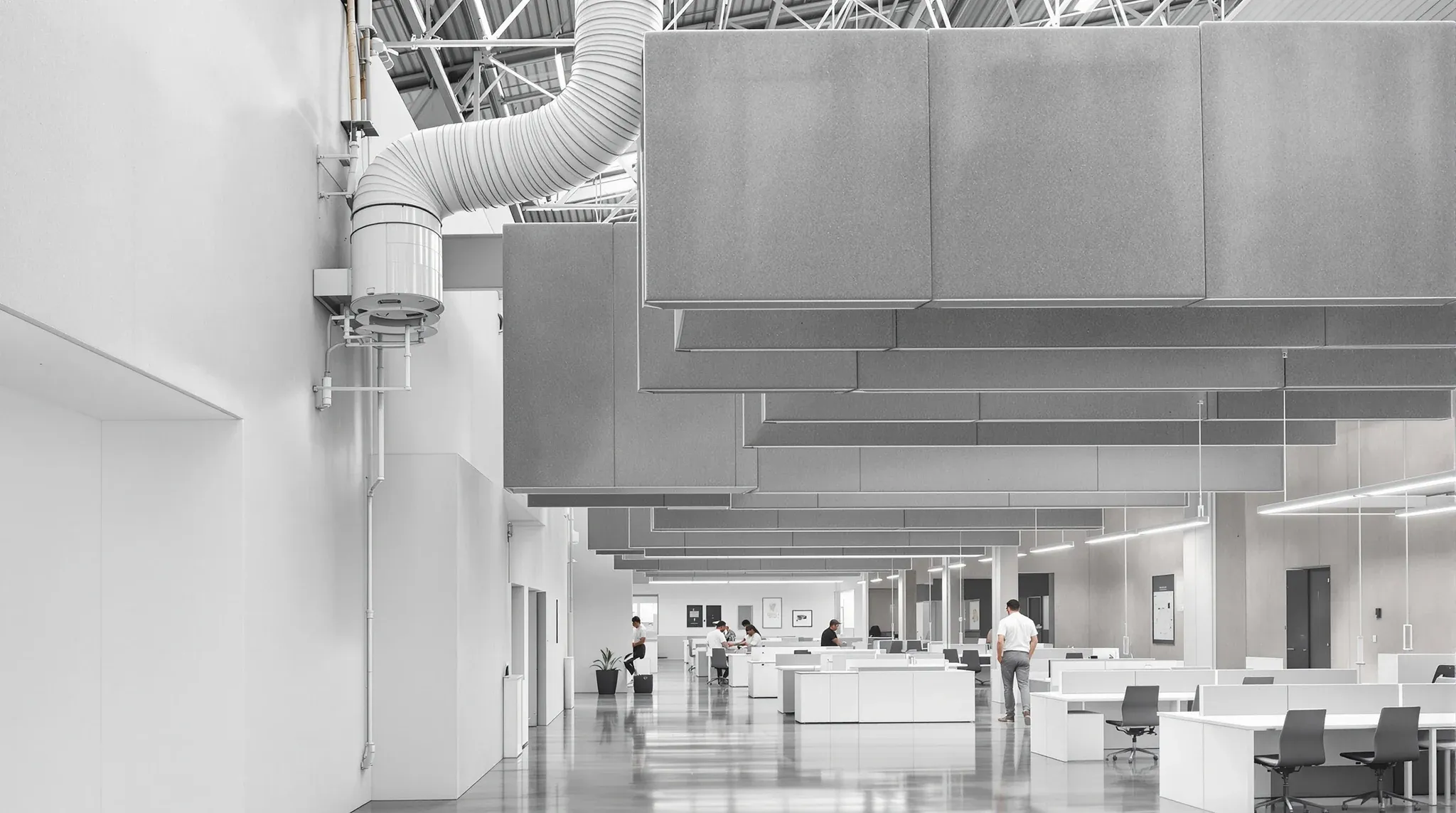
Fitting out an office inside a warehouse or industrial building is a different proposition from fitting out a conventional commercial tenancy. The space itself brings advantages that standard offices cannot match, including generous floor areas, high ceilings, and the kind of raw character that many businesses find appealing. But those same characteristics create fitout challenges that require careful planning, particularly around services coordination, environmental control, and the way different zones within the building interact with each other.
A warehouse or industrial office fitout usually includes:
- Layout and zoning across a large or irregular floor plate
- A ceiling strategy for the high void: suspended, exposed or a mix of both
- The boundary wall between the office and the operational areas
- Heating, cooling and fresh air sized to the office zone
- Power, data and lighting, often installed from scratch
- Slab preparation and office flooring
- Kitchen, bathroom and support spaces
- Acoustic treatment where it is actually needed
All of that assumes the space is already approved for office use. If it is not, converting a warehouse to office space comes first, and that work sits outside the fitout itself.
What Makes an Industrial Office Fitout Different
The most immediate difference is scale. Warehouse office spaces tend to have larger floor plates and higher ceiling voids than conventional commercial buildings. That sounds like an advantage, and in many respects it is, but it changes the way every trade approaches the work. Services that would run a short distance from the ceiling grid to the desk in a standard office may need to travel considerably further in a warehouse environment. Partition walls that would typically run from floor to a standard 2.7-metre ceiling height may instead need to address a 4-metre or 5-metre void above.
The other difference is context. Many warehouse office fitouts sit alongside operational areas, whether that is storage, dispatch, light manufacturing, or workshop space. The fitout needs to create a comfortable and functional office environment while managing the interface between office and operational zones. That interface affects noise, dust, temperature, access, and the way services are distributed across the building.
These factors do not make warehouse fitouts more difficult in absolute terms, but they do make them different enough that applying standard commercial office assumptions without adjustment leads to problems. The fitout scope needs to be considered in the context of the building it occupies.
Layout Planning for Large and Irregular Floor Plates
Warehouse floor plates are often wider and deeper than commercial office floors, and they may not follow the regular rectangular shapes that most office planning tools assume. Columns may be spaced at 6-metre, 9-metre, or even wider intervals, giving the designer more flexibility than a typical commercial grid. However, the lack of a regular core, with lifts, stairs, and amenities in a central location, means that the layout needs to establish its own logic for circulation, services access, and zoning.
Most warehouse office fitouts benefit from a clear zoning strategy that separates administrative and meeting areas from operational zones. The boundary between these zones is typically defined by partition systems that provide both visual and acoustic separation. Where the office occupies one end of the warehouse, a full-height partition wall between office and warehouse space is usually the most effective approach. Where the office wraps around an operational core or sits in a mezzanine above it, the zoning becomes more three-dimensional and the relationship between zones requires more thought.
Circulation within the office area itself follows similar principles to any commercial fitout, but the larger distances involved mean that wayfinding and connectivity between spaces matter more. In a deep floor plate, it is easy to create dead-end corridors or isolated pockets that feel disconnected from the rest of the office. A considered layout avoids this by establishing clear sightlines and logical pathways through the space.
Ceiling Strategy in High-Void Spaces
The ceiling is one of the defining decisions in a warehouse office fitout. The available height, often 4 to 8 metres or more in a warehouse environment, creates options that do not exist in standard commercial buildings but also introduces challenges that need to be managed.
A suspended ceiling installed at a conventional height, typically around 2.7 metres, creates a familiar office environment and conceals services neatly above the grid. It also establishes a defined thermal envelope for the air conditioning system to manage, which improves energy efficiency compared with trying to condition the full volume of the warehouse space. The trade-off is that it conceals the height and character of the warehouse structure, which may be part of what attracted the tenant to the space in the first place.
An exposed ceiling that leaves the warehouse structure visible preserves the industrial aesthetic and takes full advantage of the height. However, it creates challenges around noise, lighting, and thermal comfort. Sound reflects differently in a tall, hard-surfaced space, and the larger air volume takes more energy to heat and cool. Services that would be hidden above a ceiling grid become visible and need to be routed and finished with more care.
A hybrid approach is common in warehouse fitouts. Enclosed spaces like meeting rooms and private offices receive a suspended ceiling for acoustic and environmental performance, while open-plan areas and circulation zones retain the exposed structure. This gives the fitout both the character of the industrial space and the functional performance that office occupants need. The transition between the two treatments needs to be handled cleanly to avoid an unfinished appearance at the junction.
Partitioning Between Office and Operational Zones
The boundary between the office area and the operational warehouse is one of the most important elements in the fitout, and it is often underspecified. A single layer of standard plasterboard is not sufficient to manage the noise, dust, and temperature differential between a conditioned office and an unconditioned warehouse with forklifts, machinery, or open roller doors.
Plasterboard partition systems at this boundary typically need to be built to a higher specification than internal office partitions. Double-stud or staggered-stud configurations with acoustic insulation are common where noise from the warehouse side would otherwise intrude into the office. Where fire rating is required between the two zones, the partition specification needs to incorporate fire-rated linings and firestopping at penetrations.
The door or access point between the two zones is another detail that affects daily performance. A standard office door between a clean, air-conditioned office and a dusty warehouse with temperature swings creates a weak point. Self-closing doors, airlocks, or vestibule arrangements manage the transition more effectively, particularly in environments where dust control or temperature stability matters.
Internal partitioning within the office area itself follows more conventional patterns. Glass partitions are popular in warehouse office fitouts because they maintain the sense of openness and light that the space naturally offers. Plasterboard partitions serve enclosed rooms where privacy or acoustic performance is the priority. The mix depends on the business requirements, but most warehouse fitouts use a combination of both.
Mechanical Services and Climate Control
Heating and cooling a warehouse office space typically costs more per square metre than conditioning a standard commercial floor, and the system design needs to reflect the specific conditions of the building. The thermal performance of the building envelope, the ceiling height, the volume of air, and the interaction with unconditioned warehouse space all influence the mechanical design.
Split systems and multi-head units are common in smaller warehouse office fitouts because they are relatively quick to install and can be sized to the office area without conditioning the full building. Larger fitouts may warrant ducted systems or package units, particularly where multiple zones need independent temperature control. The mechanical engineer needs to consider solar gain through the roof and walls, which can be substantial in a metal-clad warehouse, and the thermal bridge at the boundary between conditioned and unconditioned zones.
Ventilation is another consideration. Commercial offices have minimum fresh air requirements under the Building Code of Australia, and these need to be met regardless of the building type. In a warehouse, the path for fresh air intake and the quality of that air, particularly if the warehouse handles dusty or odorous materials, affect the system design. Filtration, air handling unit placement, and ductwork routing all need to account for the industrial context.
Electrical, Data, and Lighting Infrastructure
The electrical infrastructure in a warehouse office fitout often starts from a less developed base than a standard commercial tenancy. Power distribution boards may need to be upgraded or supplemented to handle the combined load of office equipment, lighting, and mechanical plant. Data cabling, which is a standard inclusion in commercial building specifications, may not exist at all in a warehouse and needs to be installed from scratch.
Lighting design in a warehouse office is influenced by the ceiling height and the ceiling treatment. A suspended ceiling supports standard office luminaires in the same way as any commercial fitout. An exposed ceiling requires pendant-mounted or surface-mounted fittings that deliver adequate light levels to the working plane from a greater height. The lighting layout needs to account for the higher mounting position and the different light distribution patterns that result from it.
Natural light availability varies significantly between warehouse buildings. Some have large windows or translucent roof panels that flood the space with daylight. Others are essentially sealed boxes with minimal glazing. The fitout lighting design needs to respond to what the building actually provides, supplementing where necessary and controlling glare where natural light is abundant. Changes to the fitout scope that affect lighting, such as adding or relocating partitions, can trigger adjustments to the lighting layout and sometimes to the emergency lighting system as well.
Flooring Considerations for Industrial Environments
Warehouse slabs are built for load-bearing performance rather than surface quality. The slab may be level enough for forklift traffic but not flat enough for direct installation of office flooring products. Surface preparation, including grinding, filling, and levelling, is a common preliminary step before any finish flooring goes down.
The choice of office flooring in a warehouse environment is influenced by the adjacent operational use. Carpet tile is the most common choice for office areas because it is relatively forgiving of minor slab imperfections, provides acoustic benefit, and can be replaced in sections if damaged. Vinyl plank and sheet vinyl offer durability and are easier to clean, which can be an advantage in environments where dust or grime migrates from the warehouse side.
The transition between office flooring and warehouse flooring, typically bare concrete or epoxy-coated slab, needs a durable threshold treatment. High foot traffic at this junction, often with people moving between safety boots and office shoes, creates wear that flimsy trims cannot withstand. Heavy-duty aluminium or stainless steel thresholds are a practical solution that holds up over time.
Amenities and Support Spaces
The amenities required in a warehouse office depend on the number of occupants, the building classification, and whether the warehouse side of the building already has facilities that the office workers share. In many cases, the office fitout includes its own kitchen, bathroom, and storage areas because the warehouse amenities are not suitable for office use or are not conveniently located.
Kitchens and break areas in warehouse offices tend to be more heavily used than in commercial offices, partly because the location often lacks the surrounding cafes and food options that CBD or suburban commercial precincts offer. Designing the kitchen for genuine daily use rather than just as a tea-making station is worth the investment. Good ventilation, sufficient bench and storage space, and durable finishes make the difference between a functional amenity and one that becomes a frustration.
Bathroom facilities need to comply with accessibility requirements and current standards, even if the warehouse previously had only basic industrial amenities. The hydraulic connection points for new bathrooms may involve longer runs than in a standard commercial building, depending on the location of existing drains and water supply. This is a cost and programme consideration that should be identified early.
Acoustic Management Without Over-Engineering
Noise in a warehouse office fitout comes from two directions: the operational warehouse and the office itself. Managing both without over-engineering the solution is a matter of understanding where noise matters most and targeting the treatment accordingly.
The warehouse boundary partition, as discussed earlier, is the primary defence against operational noise. Beyond that, the internal acoustic environment of the office depends on the usual factors including partition types, ceiling treatment, and surface materials. In a warehouse fitout with an exposed ceiling, the hard roof structure reflects sound more aggressively than an acoustic ceiling tile would. Acoustic panels, baffles, or rafts suspended in the open ceiling void can manage this without compromising the industrial aesthetic.
Meeting rooms and phone areas benefit from full acoustic enclosure regardless of the broader ceiling strategy. These rooms are typically built with a suspended ceiling, insulated partitions, and sealed door frames to create a controlled acoustic environment within the larger space. The contrast between the open warehouse character of the general office and the quiet enclosure of a meeting room is one of the appealing aspects of this type of fitout when it is done well.
Programme and Coordination Considerations
Warehouse office fitouts often run on tighter programmes than their commercial equivalents because the business may already be operating from the warehouse and needs the office space brought online as quickly as possible. The fitout planning process needs to account for the longer service runs, the potential for slab preparation work, and any coordination with ongoing warehouse operations.
Working around an active warehouse adds a layer of logistics that does not apply in a vacant commercial tenancy. Deliveries, noisy work, and trades access all need to be scheduled in a way that does not shut down the warehouse operation. Dust-generating work like slab grinding or partition sanding needs to be managed carefully where it could affect stored goods or operational equipment on the warehouse side.
The sequencing of trades follows the same general logic as any fitout, starting with services rough-in, then partitions, then ceilings, then finishes, then fixtures and commissioning. However, the warehouse context means that some elements, particularly the boundary partition and the mechanical system, may need to be completed earlier in the programme to establish the environmental separation between office and warehouse before finish trades begin. Exposing painted plasterboard to warehouse dust or running carpet tile installation with roller doors open is the kind of sequencing error that creates rework.
If you are planning an office fitout within a warehouse or industrial space in Sydney, we can help scope the work and coordinate the trades to suit your building and your operations.
📞 Call us on 1300 60 93 93