
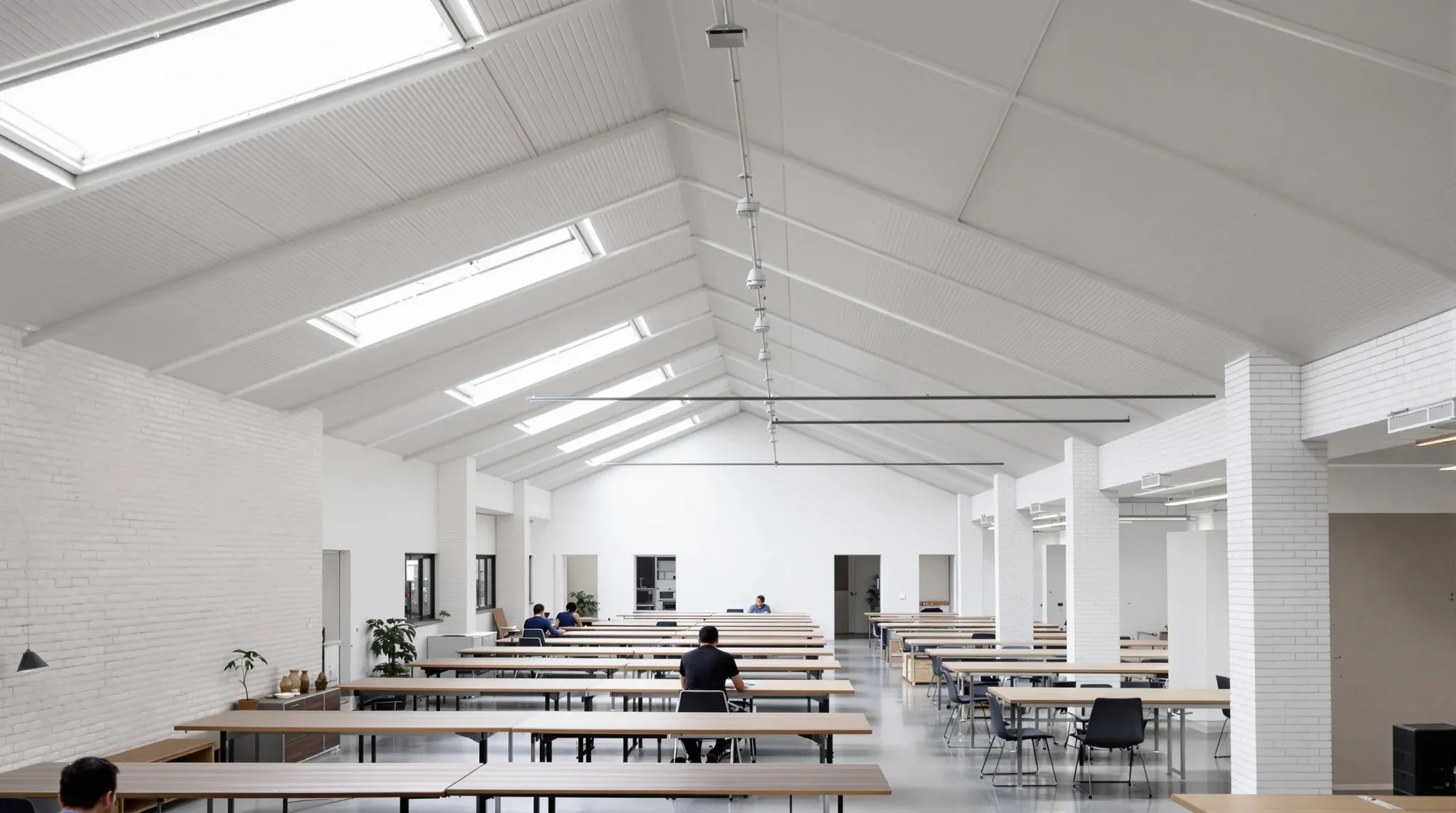
Converting a warehouse into functional office space is one of the more complex fitout decisions a Sydney business can face. Unlike a standard commercial tenancy where the base building already supports office use, a warehouse conversion starts with a structure that was designed for storage, logistics, or light manufacturing. That gap between what exists and what the space needs to become involves a range of building, compliance, and services work that most businesses underestimate at the planning stage.
The appeal is obvious. Warehouses typically offer generous floor plates, high ceilings, and locations in precincts like Alexandria, Marrickville, or Brookvale where rents sit well below CBD rates. Many businesses find themselves in a warehouse because they need a hybrid model where administrative staff, operations, and sometimes dispatch all share one site. But turning that raw or semi-raw space into something that functions as a proper office involves more than adding desks and a kitchenette.
Where the space is already approved for office use, the job is a standard warehouse fitout and most of what follows does not apply. A conversion is the step before that: bringing space designed for storage or production up to the standard office occupation requires, from structure and services through to compliance and sequencing.
Why Warehouse Conversions Are Different from Standard Fitouts
A typical office fitout begins with a tenancy that already has climate control, a ceiling grid, compliant electrical distribution, and fire services designed for office occupancy. A warehouse conversion begins with little or none of that. The slab may be unfinished, the height may be well beyond what office ceiling systems are designed for, and the mechanical, electrical, and hydraulic infrastructure may be sized for industrial rather than commercial use.
This distinction matters because it changes the cost profile, the approval pathway, and the trade sequencing. Work that would be invisible in a standard fitout, such as establishing a base building condition suitable for office occupancy, becomes a significant line item in a warehouse conversion. Businesses that budget based on standard per-square-metre fitout costs often find themselves short because the conversion work sits outside what those benchmarks assume.
The other difference is classification. Under the National Construction Code, warehouses and offices fall into different building classifications with different requirements for fire resistance, egress, accessibility, ventilation, and amenities. Changing the use of the space, even partially, typically triggers a reclassification that brings new compliance obligations.
Classification Changes and What They Trigger
Most warehouses in Sydney are classified as Class 7 or Class 8 buildings, depending on whether they are used for storage or processing. Office space falls under Class 5. When you convert part or all of a warehouse to office use, you are changing the building classification, and that change has consequences that flow through almost every aspect of the project.
A change of classification typically requires a Building Code of Australia assessment to determine what the new use demands in terms of fire compartmentation, structural adequacy, egress pathways, accessible facilities, and services capacity. In many cases, the existing structure will meet some of these requirements and fall short on others. Fire-rated construction between office and warehouse areas, for example, is almost always required where the two uses share a building. Accessible amenities that may not have been required for a warehouse often become mandatory once office workers are occupying the space.
The council approval pathway for a change of use depends on the local government area and the scale of the conversion. Some conversions can proceed through complying development if they meet prescriptive standards, while others require a development application. The approval process adds time and cost, and it needs to be factored in before construction planning begins. Starting physical work before approvals are in place is a risk most businesses should not take.
Structural and Envelope Considerations
Warehouse structures vary enormously. Some are steel portal frames with metal cladding, others are tilt-up concrete, and older buildings may use a combination of materials that were standard decades ago but present challenges now. The structural system affects what you can do with the internal layout, how you introduce mezzanines or enclosed rooms, and how services are routed.
One of the first structural questions in a warehouse conversion is the floor slab. Warehouse slabs are often thicker and stronger than office slabs because they were designed for heavy loads, but they may not be level or finished to a standard that supports office flooring directly. Surface grinding, levelling compounds, or overlays are commonly required before office flooring can be installed.
The building envelope is another area that often needs attention. Warehouses prioritise weather protection and ventilation over thermal comfort and acoustic isolation. Metal cladding with minimal or no insulation may be adequate for storage but creates an environment that is extremely difficult to heat and cool efficiently for office use. Upgrading insulation, sealing gaps, and sometimes replacing sections of cladding are common requirements that sit outside the fitout scope but directly affect the viability of the office space.
Roof penetrations for mechanical plant, new electrical feeds, and hydraulic connections also need structural assessment. Adding air conditioning to a warehouse typically requires roof-mounted or externally mounted plant, and the structure needs to support the additional loads.
Mechanical, Electrical, and Hydraulic Services
Services infrastructure is usually the largest single cost in a warehouse-to-office conversion, and it is the area where the gap between industrial and commercial requirements is widest. A warehouse may have a single power board, basic lighting on a high-bay circuit, and no air conditioning at all. An office needs distributed power, data cabling, climate control, compliant lighting, and usually upgraded hydraulic services for kitchens and bathrooms.
Mechanical services deserve particular attention. Heating and cooling a warehouse space, even a partitioned portion of it, requires a system that can handle the volume. High ceilings mean larger air volumes, and metal-clad buildings gain and lose heat rapidly. The services planning needs to account for both the immediate office area and any interaction with the unconditioned warehouse space adjacent to it.
Electrical upgrades often extend beyond the tenancy. The incoming power supply to a warehouse may not have the capacity to support office-level electrical loads plus air conditioning plant. An upgrade to the switchboard or even the incoming mains supply from the network provider can add weeks to the programme and significant cost to the project. This is worth investigating early because supply authority lead times in Sydney can be lengthy.
Hydraulic work depends on the scope of amenities. If the warehouse already has a bathroom, it may need upgrading to meet accessibility requirements and current standards. If a kitchen or additional bathrooms are being added, new sewer and water connections are typically required, and the distance from existing services affects both cost and layout options.
Fire Services and Compliance Upgrades
Fire services are often the compliance area that creates the most complexity in a warehouse conversion. Warehouses and offices have different fire protection requirements, and a change of use typically triggers an upgrade. The specifics depend on the building size, the number of storeys, the distance to boundaries, and the fire resistance level required for the new classification.
Common fire services requirements in a warehouse-to-office conversion include fire detection and alarm systems compliant with office occupancy standards, emergency lighting and exit signage to support the new egress pathways, fire-rated construction between office and warehouse zones where they share a building, and sometimes sprinkler systems or hydrant upgrades if the existing systems do not cover the new use.
The fire engineering assessment is typically done early in the project because its findings influence the layout, the construction methodology, and the services design. Alternative solutions, where a fire engineer demonstrates that a non-prescriptive approach achieves the required safety outcome, are common in warehouse conversions because the existing building often cannot meet every prescriptive requirement without disproportionate cost.
Partitioning and Internal Layout
Once the structural, services, and compliance framework is established, the internal fitout follows a pattern more recognisable to standard office projects. Plasterboard partitions create enclosed offices, meeting rooms, and service areas. Glass partitions maintain sightlines and allow natural light to penetrate deeper into the floor plate, which is particularly valuable in warehouse conversions where windows may be limited or positioned high on the walls.
The ceiling treatment is one of the more visible decisions in a warehouse conversion. Some businesses choose a suspended ceiling system for the office area to conceal services, improve acoustics, and create a defined office environment. Others prefer an exposed ceiling that celebrates the industrial character of the space while still achieving acceptable acoustic and lighting performance. The choice affects the services routing, the lighting strategy, and the overall feel of the space.
Floor plate dimensions in warehouses tend to be wider and deeper than commercial office floors, which creates both opportunities and challenges. Open-plan layouts work well because there are fewer columns interrupting the space. However, enclosed rooms positioned in the middle of a deep floor plate can create dark zones that are difficult to ventilate and light naturally. Careful placement of partitions, combined with glazed elements, helps manage this.
Sequencing and Programme Management
Warehouse conversions typically take longer than equivalent-sized office fitouts because of the additional base building and compliance work that precedes the fitout itself. The correct build sequence matters more in a conversion because trades are working across a wider scope and earlier decisions constrain later ones.
A typical sequence begins with approvals and design, moves through structural and envelope work, then services rough-in, followed by partitioning, ceiling, and finishes, and finally fixtures, furniture, and commissioning. The critical path usually runs through services because mechanical and electrical work has the longest lead times and the most dependencies.
One common sequencing challenge in warehouse conversions is the overlap between base building work and fitout work. In a standard tenancy, these are usually done by different parties at different times. In a warehouse conversion, the same contractor or project manager is often coordinating both, and the boundaries between the two scopes can blur. Clear scope definition at the start of the project helps avoid disputes about what is included and what is not.
Programme risks specific to warehouse conversions include supply authority delays for power upgrades, longer-than-expected approval timeframes for change of use applications, discovery of latent conditions such as contamination or structural deficiencies, and weather exposure during the period when the envelope is being modified. Building contingency into the programme is important because these risks are difficult to eliminate entirely.
Cost Drivers That Differ from Standard Office Fitouts
The cost of a warehouse-to-office conversion is influenced by factors that do not apply to a standard office fitout. Understanding where the additional cost sits helps businesses budget realistically and make informed decisions about scope.
The biggest variable is the starting condition of the warehouse. A newer warehouse with a level slab, reasonable insulation, and adequate power supply will cost less to convert than an older building that needs structural remediation, an envelope upgrade, and a new electrical feed. The gap between these two scenarios can be substantial, which is why a thorough site assessment before committing to a lease or purchase is important.
Services infrastructure typically represents a larger share of the total cost in a conversion than in a standard fitout. In a standard office, services might represent 30 to 40 percent of the fitout budget. In a warehouse conversion, that figure can reach 50 percent or more because of the need to install systems from scratch rather than modifying existing ones.
Compliance costs are another area where conversions differ. Council fees, fire engineering reports, building certification, and accessibility upgrades all add cost that would not apply to a fitout within an already-classified commercial building. These are often fixed costs that do not scale proportionally with the size of the conversion, which means they represent a larger percentage of the budget for smaller projects.
Working with Landlords and Lease Structures
The relationship between the conversion work and the lease is something that catches many businesses off guard. If you are leasing a warehouse and converting part of it to office use, the landlord needs to approve the change of use and the physical works. Most commercial leases require the tenant to obtain landlord consent for structural modifications, and a conversion typically involves exactly that.
The question of who pays for what depends on the negotiation. In some cases, the landlord contributes to or funds the base building upgrades because they improve the property’s value and classification permanently. In other cases, the tenant bears the full cost. This distinction affects the financial case for the conversion and should be settled before design work proceeds too far.
Make good obligations also require careful attention. If the lease requires the tenant to return the warehouse to its original condition at lease end, the cost of stripping out a full office conversion can be significant. Negotiating realistic make good terms at the start of the lease is far easier than resolving them at the end. Some tenants negotiate for the office improvements to remain in place, particularly where the conversion adds long-term value to the property.
When a Warehouse Conversion Makes Commercial Sense
Not every warehouse is a good candidate for office conversion, and not every business need justifies the additional complexity and cost. The conversion makes the strongest case when the business genuinely needs both warehouse and office space on a single site, when the warehouse location offers significant rent savings compared to commercial alternatives, or when the warehouse itself has characteristics, such as high ceilings, large floor plates, or natural light, that create a distinctive working environment the business values.
The case weakens when the conversion costs approach or exceed what the business would spend on a conventional office fitout in a purpose-built commercial space. It also weakens when the approval pathway is uncertain or the building’s condition introduces too many variables. A realistic assessment of both the costs and the benefits, informed by professional advice, is the best foundation for the decision.
Businesses that proceed with a clear understanding of what is involved typically achieve good results. The key is treating the conversion as a building project with a fitout component, rather than a fitout project with a few extras. That framing sets the right expectations for budget, programme, and complexity.
If you are considering converting warehouse space to office use in Sydney and want a realistic assessment of what is involved, we can help you understand the scope and plan the project from the outset.
📞 Call us on 1300 60 93 93