
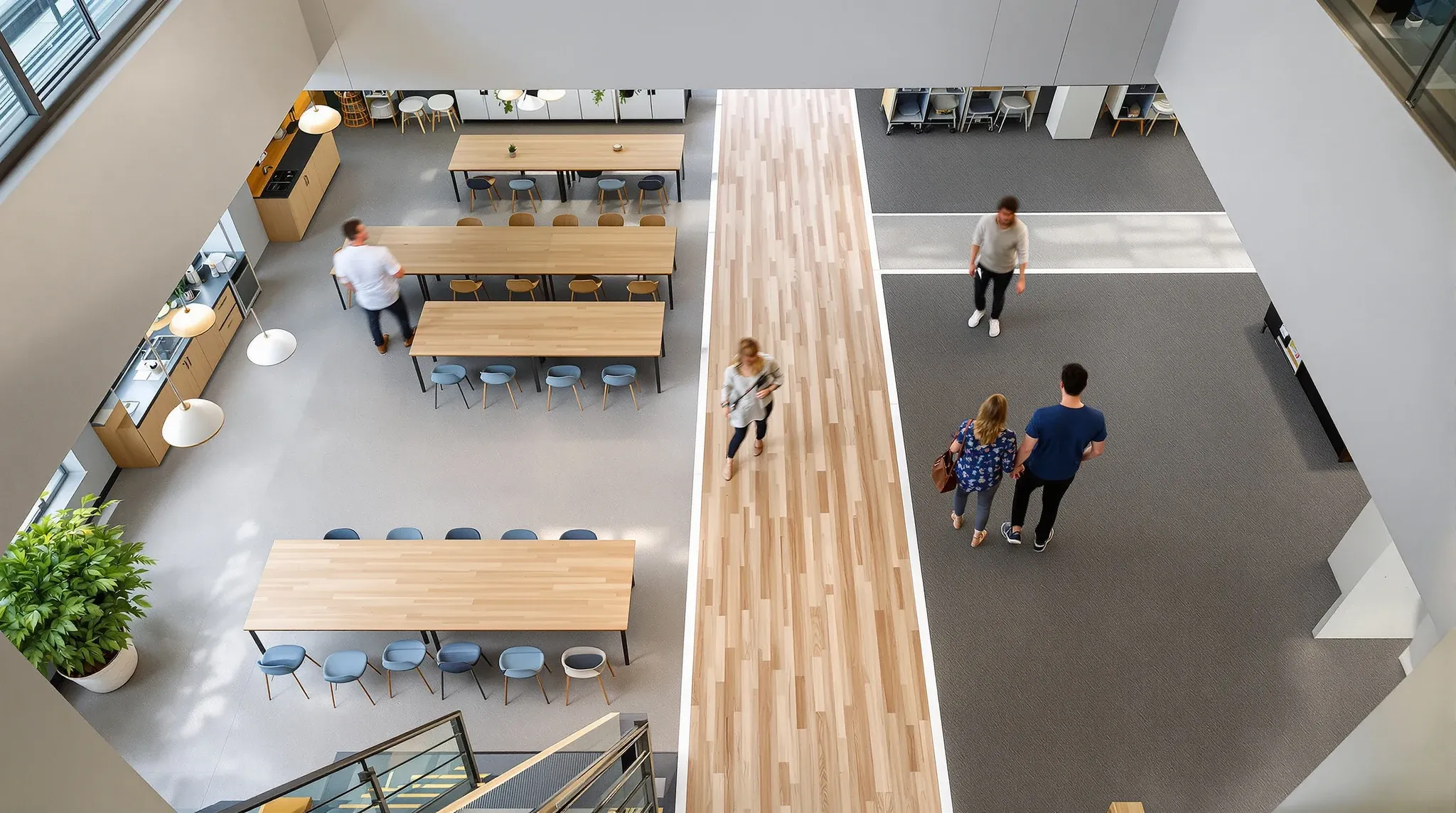
The flooring in a commercial office affects everything from daily comfort and noise levels to maintenance costs and end-of-lease obligations. With several product categories available, each with genuinely different performance characteristics, choosing the right flooring depends on understanding what each type does well and where it falls short. A product that excels in a boardroom may be entirely wrong for a kitchen, and a floor that handles heavy traffic beautifully may be acoustically poor in an open-plan workspace.
This article covers the main flooring types used in Australian commercial office fitouts, explaining what each product is, where it works best, and what practical factors tenants should weigh when selecting flooring for different zones of their office.
Carpet Tiles
Carpet tiles are the most widely installed flooring product in Australian office fitouts, and for most tenancies they represent the practical default for workstation and meeting room areas. Each tile is typically a 500mm square of tufted face fibre bonded to a dimensionally stable backing, installed in a grid pattern using a tackifier adhesive that holds the tile in place but allows individual units to be lifted and replaced.
The key advantage of carpet tiles is modularity. Damaged or stained tiles can be swapped without affecting the surrounding floor. Tiles can be lifted to access underfloor services, including floor boxes, data cabling, and air plenum chambers, and then replaced without cutting or patching. This practical flexibility makes carpet tiles particularly well-suited to offices where desk layouts may change during the lease or where underfloor access is needed periodically.
Acoustically, carpet tiles absorb airborne sound within the room and reduce impact noise transmission through the floor structure. In open-plan offices where noise management is a constant challenge, the acoustic contribution of carpet is significant enough that removing it and replacing with a hard surface would noticeably increase the ambient noise level. Loop pile construction is the most common in commercial settings because it resists the crushing and pile distortion caused by chair castors and heavy foot traffic.
Broadloom Carpet
Broadloom carpet is installed in continuous rolls, typically 3.66 metres wide, and seamed edge to edge to create a seamless floor surface. The absence of visible tile grid lines gives broadloom a more refined, premium appearance that is often preferred in executive offices, boardrooms, and reception areas where visual impression is a priority.
The trade-off for that seamless appearance is reduced practical flexibility. Broadloom cannot be partially lifted for underfloor access, and damaged sections require patch repairs that are difficult to make invisible. Repairs are limited to cutting and replacing sections, and even skilled repairs leave seam lines that age differently from the surrounding carpet. For this reason, broadloom is best suited to low-traffic, low-risk areas where spills and damage are unlikely.
Woven broadloom is a premium subset that offers patterned designs, borders, and colour gradients not achievable with tufted products. Woven carpet is used in high-end reception areas and corporate environments where the floor is part of the brand experience. The cost is significantly higher than tufted broadloom or carpet tiles, but the visual impact in the right setting can justify the investment.
Luxury Vinyl Planks and Tiles
Luxury vinyl planks and tiles have become the dominant hard-flooring product in commercial fitouts, largely replacing materials like laminate and engineered timber in many applications. Modern vinyl products feature highly realistic printed and embossed surfaces that mimic timber, stone, and concrete at a fraction of the cost and with significantly better moisture resistance and durability.
Vinyl is available in two main formats: planks that replicate timber boards and tiles that replicate stone or concrete. Both are available in glue-down and click-lock installation methods. Glue-down products are thinner and more dimensionally stable, making them the preferred choice for commercial use. Click-lock products are faster to install but can be less stable under heavy traffic and may develop gaps at joints over time in high-use areas.
The primary strength of vinyl in a commercial office is moisture resistance. Kitchens, breakout areas, bathroom ante-rooms, and entry lobbies all benefit from a floor that handles spills, cleaning chemicals, and tracked-in moisture without degrading. Vinyl is also easy to maintain, requiring only regular mopping and periodic application of a surface finish to restore its appearance. In zones where carpet would stain or absorb moisture, vinyl is the practical alternative that still delivers an attractive finish. Understanding the base building condition of the subfloor is important when specifying vinyl, as the product requires a level, dry surface for successful installation.
Polished Concrete
Polished concrete is not an installed flooring product but rather a finish applied to the existing concrete slab. The process involves grinding the slab surface to expose the aggregate, then progressively polishing with finer abrasives and sealing with a penetrating or topical sealer. The result is a hard, reflective surface with a distinctive industrial aesthetic that suits certain office styles.
The appeal of polished concrete is its visual character and its durability. A properly polished and sealed concrete slab is extremely hard-wearing and can last the life of the building with appropriate maintenance. It is also one of the most sustainable flooring options because it uses the existing slab rather than adding a new material, which reduces both material waste and embodied energy.
The limitations are practical. Polished concrete is acoustically reflective, meaning it bounces sound rather than absorbing it, which increases the ambient noise level in any space where it is used. It is also hard and cold underfoot, which affects comfort during prolonged standing or in cooler months. The finish quality depends entirely on the condition of the underlying slab, and slabs with significant patching, cracking, or inconsistent aggregate will produce an uneven appearance. In older buildings, the slab condition is often not suitable for polishing without extensive remedial work, which can make the overall cost comparable to or higher than installing a new flooring product.
Engineered Timber and Timber-Look Products
Real timber flooring in commercial offices is uncommon because solid timber is expensive, sensitive to moisture and humidity changes, and requires regular maintenance to protect its surface. Engineered timber, which consists of a thin real timber veneer over a plywood or fibreboard core, offers the appearance of solid timber with better dimensional stability, but it still requires more maintenance than vinyl or carpet and is sensitive to moisture.
In most commercial fitouts, timber-look vinyl planks have replaced engineered timber as the product of choice for areas where a timber aesthetic is desired. Modern vinyl products replicate the look and texture of timber species so convincingly that the difference is difficult to detect visually, and the vinyl product offers vastly superior moisture resistance, durability, and ease of maintenance.
Where real timber or engineered timber is still specified, it tends to appear in premium reception areas, executive offices, or feature spaces where the authenticity of real timber is considered essential to the design intent. These installations require careful environmental control to prevent the timber from expanding and contracting with humidity changes, and the surface needs periodic recoating to protect against wear and spills. For first-time tenants, the maintenance implications of real timber are worth understanding before committing to the product.
Rubber Flooring
Rubber flooring occupies a niche in commercial offices, primarily in gym and wellness spaces, utility areas, and some contemporary breakout or circulation zones where a distinctive aesthetic is desired. Rubber tiles and sheet products are extremely durable, slip-resistant, acoustically effective, and comfortable underfoot due to their inherent resilience.
The cost of commercial-grade rubber flooring is higher than carpet tiles or vinyl on a per-square-metre basis, and the product range is more limited in terms of colours and patterns. Rubber flooring also has a distinctive smell when newly installed that dissipates over several weeks but can be noticeable in enclosed spaces. Maintenance involves regular damp mopping and periodic application of a protective finish.
For most office zones, rubber is over-specified. Its strengths, particularly impact absorption and slip resistance, are most valuable in gym-style spaces, wet areas with heavy foot traffic, and industrial or warehouse office environments where durability is the paramount consideration. In a standard office fitout, carpet tiles and vinyl cover the majority of requirements more economically and with a wider range of aesthetic options. However, where a fitout includes a staff wellness room or multipurpose fitness area, rubber flooring is a natural and durable choice that helps manage noise from exercise equipment and impact activities.
Choosing the Right Product for Each Zone
The most effective approach to office flooring specification is to map each zone by use type and select the product that best matches the demands of that zone. Workstation areas, meeting rooms, and quiet zones typically default to carpet tiles for acoustic and comfort reasons. Kitchens, bathrooms, and entry areas default to vinyl for moisture resistance and cleanability. Boardrooms and executive spaces may warrant broadloom for visual impact, and specialty areas like gyms or creative studios may call for rubber or polished concrete.
Product transitions between zones need to be planned carefully. Where carpet meets vinyl, a trim strip or natural break at a doorway or partition line creates a clean boundary. Where two carpet products meet, the transition is simpler because the heights are usually similar, but colour and texture differences should be considered to ensure the change looks intentional rather than accidental.
The total flooring budget should reflect not just the installed cost but the ongoing maintenance, replacement, and removal costs over the lease term. A product that is cheaper to install but expensive to maintain or remove may cost more over a five or ten-year lease than a slightly more expensive product with lower lifecycle costs. Reducing fitout risk without overspending means making these calculations at the design stage rather than discovering them at the end of the lease.
If you are selecting flooring products for a commercial office fitout and want guidance on product selection, zone allocation, and lifecycle costing, we can help you choose the right product for every part of your office.
Call us on 1300 60 93 93