
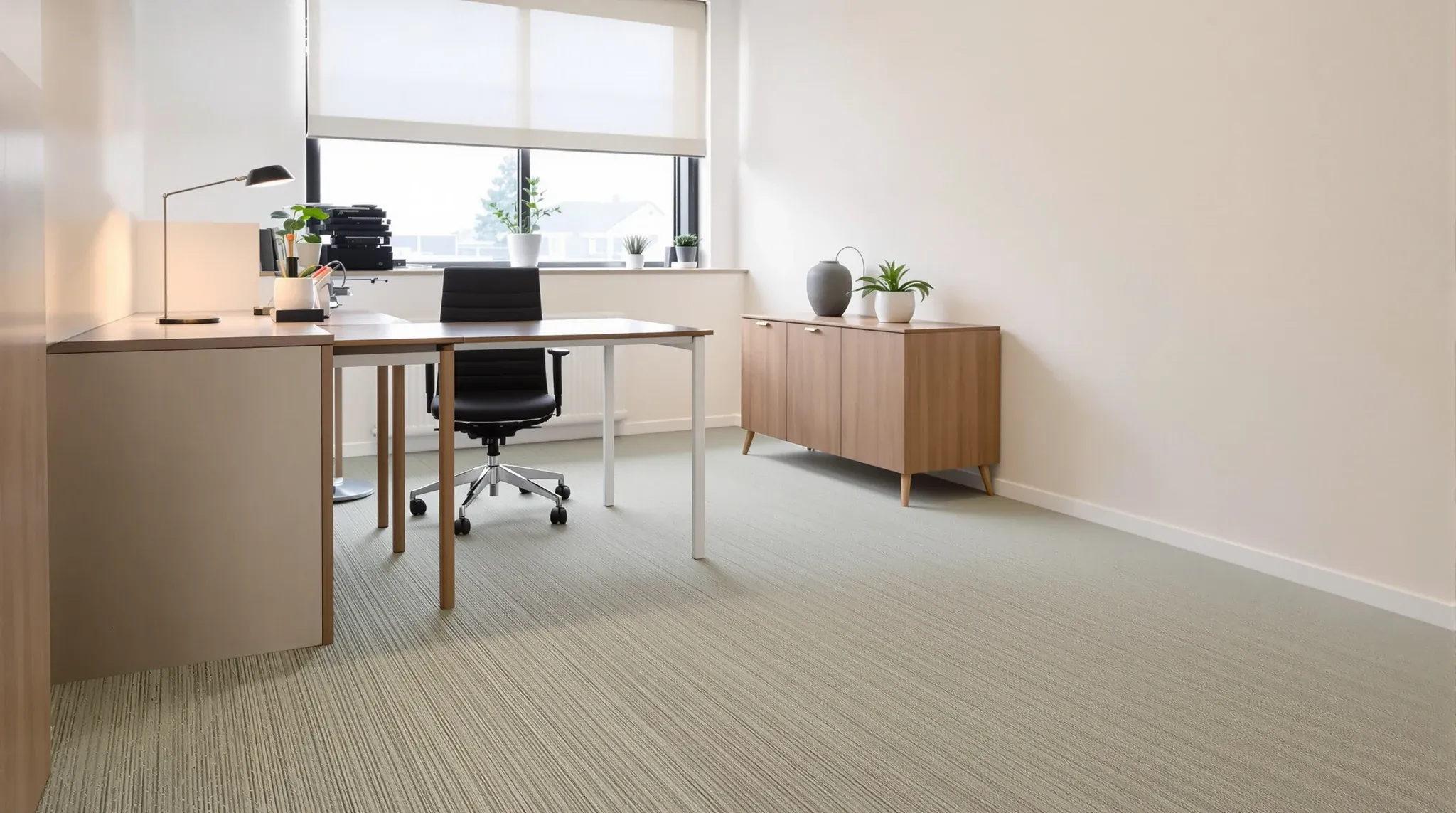
Regular carpet, also known as broadloom, has largely been overtaken by carpet tiles in Australian commercial fitouts. But broadloom has not disappeared, and in certain applications it still offers advantages that modular carpet does not match. Understanding when broadloom makes practical sense, what the trade-offs are, and how to manage it over a lease term helps tenants make an informed choice rather than defaulting to carpet tiles simply because they are more common.
The shift toward carpet tiles in commercial offices has been driven by practical factors: modularity, ease of replacement, and simplified access to underfloor services. But broadloom carpet delivers a seamless visual finish that tiles cannot replicate, and in spaces where appearance takes priority over serviceability, that difference matters. The decision between the two is not about which product is better in the abstract; it is about which product better serves the specific space and how the tenant intends to use it.
What Broadloom Carpet Is and How It Differs from Tiles
Broadloom carpet comes in wide rolls, typically 3.66 metres or sometimes 4 metres wide, and is installed wall to wall with the edges seamed together where rolls meet. The result is a continuous carpet surface without the visible grid lines that characterise carpet tile installations. This seamless finish is the primary visual advantage of broadloom and the main reason it continues to be specified in certain commercial environments.
The construction is broadly similar to carpet tiles. The face fibre is tufted or woven into a primary backing, then a secondary backing is applied for dimensional stability. The key difference is that broadloom relies on edge-to-edge seaming and adhesive or stretch-fit installation rather than individual tile placement. This means the carpet cannot be partially lifted for access to underfloor services, and damaged sections cannot be swapped out as individual units.
In commercial applications, broadloom is almost always fully adhered to the subfloor with a permanent or semi-permanent adhesive, rather than stretch-fitted over underlay as in residential installations. Full adhesion provides better performance under heavy foot traffic and office chair castor loads, and it prevents the carpet from developing ridges or bubbles over time. However, full adhesion also means removal at lease end requires scraping the adhesive residue from the subfloor, which adds to the make good cost.
Why Some Offices Still Specify Broadloom
The spaces where broadloom continues to be a genuine choice rather than a default are typically those where visual impact is the primary requirement. Executive floors, boardrooms, corporate client-facing spaces, and reception areas all benefit from the seamless, uninterrupted surface that broadloom delivers. In a large boardroom, the absence of a visible tile grid creates a cleaner, more refined appearance that many corporate tenants prefer.
Woven broadloom is a particularly premium option that offers patterned designs not achievable with tufted carpet, whether broadloom or tile. Woven products can incorporate complex geometric patterns, borders, and colour gradients that run across the full width of the carpet. These designs are often used in reception areas, foyers, and hotel-style corporate environments where the floor is part of the brand experience.
Acoustic performance is another area where broadloom can outperform tiles. Because broadloom is installed as a continuous sheet without the micro-gaps between tiles, it provides marginally better airborne sound absorption at the floor surface. The difference is small in most practical scenarios, but in spaces where every acoustic improvement contributes to an overall noise management strategy, the continuous surface of broadloom is a minor advantage.
The Practical Trade-Offs
The advantages of broadloom come with practical compromises that tenants need to weigh honestly. The most significant is repairability. When a section of broadloom carpet is stained, burned, or damaged, the repair options are limited. Spot repairs involve cutting out the damaged section and patching with a new piece, which requires access to matching carpet from the same roll or dye lot. Even skilled repairs leave visible seam lines, and the patched section will age differently from the surrounding carpet, becoming more noticeable over time.
Access to underfloor services is the second major trade-off. In offices with floor boxes, access flooring, or underfloor data cabling, broadloom creates a barrier to maintenance. Accessing anything beneath the carpet means cutting into the installed surface, performing the work, then patching the cut section. In a carpet tile installation, the relevant tiles are simply lifted and replaced. For offices with significant underfloor infrastructure, this difference alone typically rules out broadloom in workstation zones.
Waste during installation is higher with broadloom than with tiles. The wide rolls generate off-cuts wherever the room shape requires trimming, and these off-cuts are difficult to use elsewhere. Carpet tiles, by contrast, are sized to minimise waste and can be rotated or rearranged to fit irregular spaces more efficiently. In a fitout where material cost is closely managed, the wastage difference can be meaningful, particularly in floor plans with many small rooms or irregular shapes.
Where Broadloom Works Best
Given the trade-offs, broadloom is best suited to spaces that share several characteristics: low to moderate foot traffic, no underfloor services access requirement, a priority on visual appearance, and a willingness to accept the maintenance and make good implications. In practice, this means boardrooms, executive offices, formal meeting rooms, and reception areas.
Boardrooms are perhaps the strongest case for broadloom. The room is used intermittently, the furniture is typically fixed, and the visual impression of a seamless carpet surface contributes to the room’s gravitas. A large boardroom table sitting on a carpet tile grid looks acceptable; the same table on a seamless broadloom carpet looks intentional. For businesses that invest significantly in their boardroom as a client-facing asset, the incremental cost and maintenance commitment of broadloom is often justified.
Reception areas are another natural fit, particularly where a patterned or branded carpet design is part of the entry experience. Woven broadloom with a custom design or inlaid logo creates a visual statement that carpet tiles cannot replicate. The traffic in a reception area is concentrated on specific paths, so a durable product with a dark or patterned design can handle the wear while maintaining the visual impact.
Conversely, broadloom is a poor choice for open-plan workstation areas, kitchens, high-traffic corridors, and any zone where the floor needs to accommodate future layout changes. In these areas, the practical advantages of modular carpet tiles outweigh the visual advantage of a seamless finish.
Installation Requirements and Subfloor Preparation
Broadloom carpet installation in a commercial setting requires a higher standard of subfloor preparation than carpet tiles. Because broadloom is a continuous sheet, any imperfection in the subfloor will telegraph through the surface more visibly than it would through individual tiles. The subfloor needs to be smooth, level, dry, and free of adhesive residue from any previous flooring.
In older buildings, achieving this standard often requires a self-levelling compound applied across the entire floor area, which adds cost and curing time to the programme. Moisture testing is also important, because adhesive performance and carpet backing stability can both be compromised by excess moisture in the slab. If the subfloor fails the moisture test, remediation with a moisture barrier is required before the carpet can be laid.
The installation itself is more labour-intensive than carpet tiles. The rolls need to be precisely cut, seamed, and adhered, with seam positions carefully planned to avoid high-traffic areas and visible locations. A skilled installer can produce seams that are nearly invisible, but poor seaming is one of the most common quality issues in broadloom installations, and it is difficult to correct after the adhesive has cured.
Maintenance Realities
Broadloom carpet requires regular vacuuming, periodic hot-water extraction cleaning, and prompt treatment of spills to maintain its appearance over a commercial lease term. The maintenance regime is broadly similar to carpet tiles, but with one critical difference: there is no option to swap out a badly stained or damaged section. If a permanent stain sets in a visible area, the only option is a patch repair or acceptance of the blemish until the carpet is replaced.
In executive areas and boardrooms, where broadloom is most commonly specified, the risk of major stains is lower than in open-plan or kitchen areas. Coffee spills in a boardroom are generally cleaned up promptly, and the lower foot traffic means the carpet wears more slowly. However, chair castor marks from executive chairs can still crush the pile in seated positions, creating worn patches that are visible against the surrounding carpet. Using chair mats or specifying a cut-and-loop pile construction that resists crushing helps manage this issue.
Annual or bi-annual professional cleaning is advisable for broadloom in commercial settings. Hot-water extraction removes embedded soil that vacuuming cannot reach and restores pile resilience. Delaying professional cleaning allows soil to accumulate in the pile, which accelerates fibre degradation and dulls the carpet’s appearance. The cleaning cost is a modest ongoing expense compared to early replacement, and maintaining a documented cleaning schedule strengthens the tenant’s position during make good negotiations at lease end.
Cost Considerations Across the Lease Term
The installed cost of broadloom carpet is typically comparable to or slightly higher than mid-range carpet tiles on a per-square-metre basis. The fibre and construction are similar, but the installation labour is higher for broadloom due to the seaming, cutting, and subfloor preparation required. Waste is also higher, which adds to the material cost in rooms that are not perfectly rectangular.
Where broadloom becomes more expensive is over the lease term. The inability to replace individual sections means that localised damage often leads to a full-room re-carpet if the damage is in a visible area. A carpet tile installation in the same situation requires a few replacement tiles from the spare stock, at minimal cost. Over a five or ten-year lease, the cumulative maintenance and replacement cost of broadloom is typically higher than carpet tiles, even in low-traffic areas.
The make good cost is another factor. Removing broadloom and its adhesive from the subfloor is more labour-intensive than lifting carpet tiles, particularly when the tiles were installed with a tackifier rather than permanent adhesive. When fitout companies price the total cost of a flooring scope, the lifecycle cost including maintenance, repairs, and removal typically favours carpet tiles in most commercial zones. Broadloom remains the right choice where visual impact justifies the premium, but the decision should be made with full awareness of the ongoing cost difference.
If you are considering broadloom carpet for specific areas of your office fitout and want advice on where it makes sense and where tiles are the better option, we can help you select the right product for each zone.
Call us on 1300 60 93 93