Creative agencies and studio environments approach glass partitions from a fundamentally different starting point than corporate or professional services offices. In a law firm, glass is about projecting trust and maintaining sightlines while containing confidential conversations. In a creative agency, glass is about energy, visual connection, and the kind of ambient awareness that supports spontaneous creative interaction. The aesthetic expectations, the acoustic tolerances, and the way the glass integrates with the broader studio environment all differ from conventional office applications.
Understanding these differences matters because a glass partition strategy designed for a corporate environment will feel wrong in a creative studio, even if the technical specification is identical. The layout, the framing style, the level of treatment, and the relationship between glass and the surrounding materials all need to reflect the informal, visually rich, and often unconventional nature of creative workspaces.
What Creative Agencies Actually Need From Glass
The primary function of glass in a creative studio is to maintain visual energy across the floor plate. Creative work benefits from an environment where people can see each other working, where the activity of the studio is visible from multiple positions, and where the physical barriers between teams are minimised without eliminating them entirely. Glass partitions achieve this by providing the spatial separation that noise control and functional zoning require while preserving the visual continuity that keeps the studio feeling connected and active.
Unlike corporate environments where privacy is a primary concern, creative agencies generally tolerate and even prefer a higher level of visual exposure. Designers, art directors, and creative teams are accustomed to working in view of their colleagues, and the visual presence of work in progress on screens, walls, and tables across the studio contributes to the creative atmosphere. Glass partitions that separate production areas from meeting spaces, or that enclose phone rooms and focus pods, maintain this visual energy while addressing the specific functional needs that require some degree of separation.
The acoustic requirements in creative studios also differ from corporate settings. Creative agencies typically have a higher ambient noise level than corporate offices, with music, group discussions, and phone calls creating a constant background hum. This higher ambient noise actually helps mask sound transmission through glass partitions, which means the acoustic specification for glass in creative environments can often be less demanding than in quiet corporate settings where every transmitted sound is noticeable.
Aesthetic Approaches That Suit Studio Environments
The visual language of glass partitions in creative studios tends to diverge from the refined, minimalist approach of corporate installations. Where corporate glass emphasises precision, subtlety, and understated quality, studio glass often embraces visibility, contrast, and design expression.
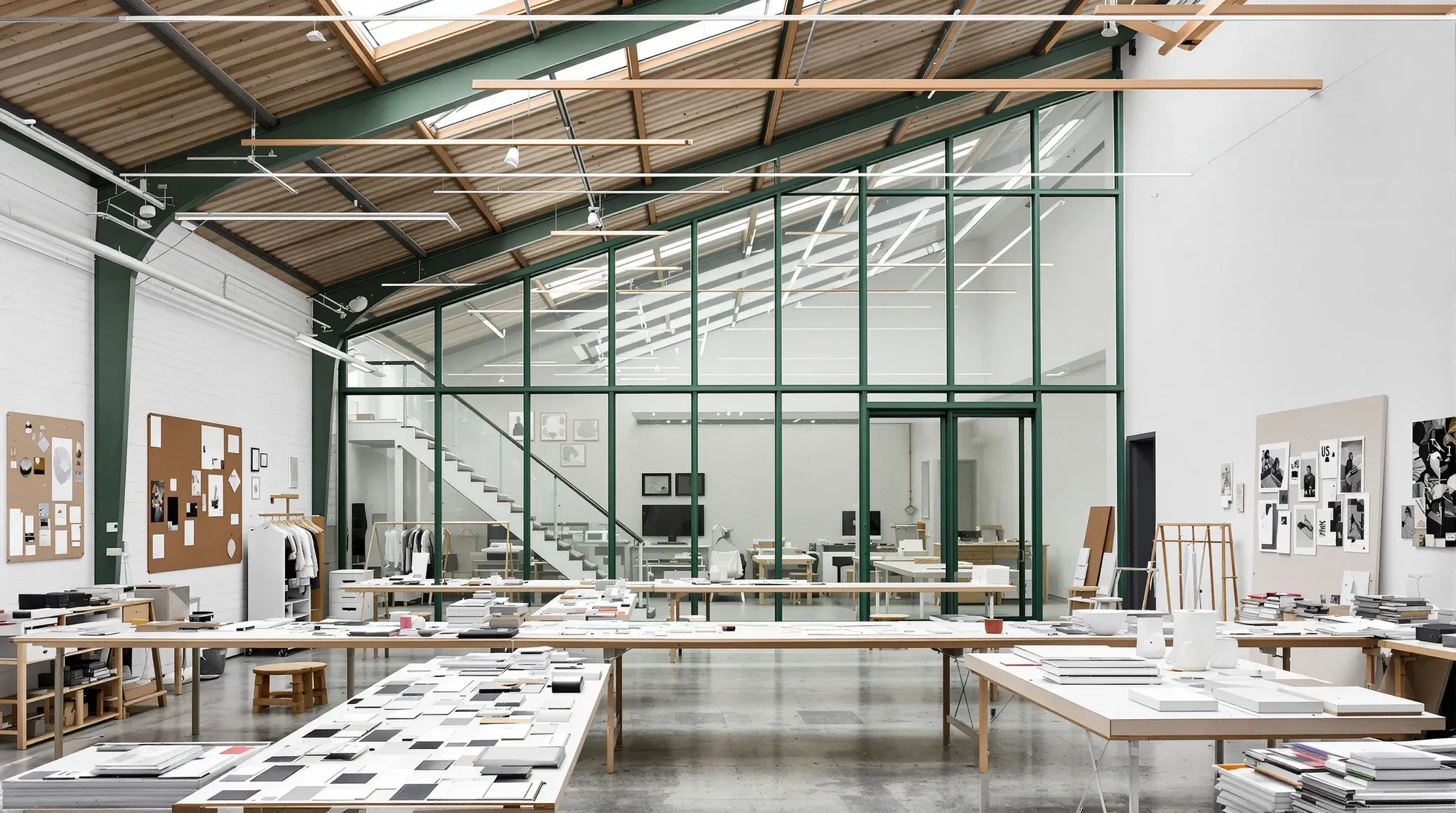
Black steel or powder-coated framing is more common in creative spaces than the silver or brushed aluminium that dominates corporate fitouts. The darker framing creates a stronger visual presence that reads as an intentional design element rather than a neutral background, which suits environments where the physical space is treated as part of the creative expression of the business. Industrial-style framing with visible bolts, thicker mullions, and exposed hardware also appears in studio fitouts, particularly in converted warehouse or industrial spaces where the partition aesthetic needs to complement raw concrete, exposed services, and brick walls.
Glass treatments in creative environments are often more expressive than in corporate settings. Instead of standard frosted bands for manifestation, studios may use digitally printed graphics, hand-painted elements, or adhesive vinyl treatments that incorporate brand colours, typography, or commissioned artwork. These treatments serve the compliance function of manifestation while turning the glass into a canvas that contributes to the visual identity of the workspace. Creative studio fitouts that integrate partition design with the broader interior concept produce environments that feel cohesive rather than assembled from separate elements.
Writable and Interactive Glass Surfaces
One of the most valued features of glass partitions in creative agencies is their potential as writable surfaces. Glass whiteboards and writable glass panels have become standard in creative environments because they combine the functional benefit of a brainstorming surface with the spatial benefit of a glass partition. A meeting room with glass walls that double as whiteboards provides a surface for sketching, mapping, and note-taking that is visible from outside the room, allowing the creative output of meetings to remain accessible to the wider team after the meeting ends.
Writable glass surfaces require specific treatment. Standard glass can be written on with dry-erase markers, but untreated glass may ghost over time, retaining faint marks that are difficult to remove completely. Dedicated writable glass coatings prevent ghosting and provide a smoother writing surface, but they add cost and need to be specified at the time the glass is manufactured. Retrofitting a writable coating to an existing glass partition is possible but less durable than a factory-applied treatment.
The positioning of writable glass surfaces matters in studio environments. Glass walls that face main circulation routes or team workstation areas are the most valuable positions for writable surfaces because they allow the content to be seen and engaged with by the broadest audience. Glass walls that face utility areas or building cores have less value as writable surfaces because fewer people pass by them throughout the day.
How Studio Layouts Differ From Corporate Layouts
Creative agencies typically organise their floor plans differently from corporate offices, and the glass partition strategy needs to reflect those differences. Where corporate offices tend to have clearly defined rooms with standard sizes and consistent partition heights, studio layouts are often more fluid, with zones rather than rooms and partition heights that vary across the floor plan.
Half-height glass partitions are more common in creative environments than in corporate offices. These partitions, typically 1,200mm to 1,500mm high, provide visual definition between zones without enclosing them fully. They reduce noise transmission at ear height while allowing conversation and visual connection above the partition line. In studios where the culture favours open interaction, half-height glass achieves the right balance between functional separation and visual continuity.
Sliding glass panels and moveable glass walls also feature more frequently in creative spaces. These systems allow the studio to shift between an open, collaborative configuration and a more enclosed, focused configuration depending on the work being done. Sliding walls and glass partitions each have different strengths, and in creative environments the ability to open up or close down spaces in response to the day’s needs is often more valuable than the acoustic performance of a fixed wall.
Managing Noise in Open Creative Environments
While creative agencies generally tolerate higher noise levels than corporate offices, there are specific activities within a studio that require acoustic separation. Client calls, video production, voiceover recording, focused writing, and client presentations all benefit from enclosed spaces that isolate them from the ambient noise of the studio.
Glass phone pods and focus rooms serve this function without removing the visual connection to the studio. A compact glass-enclosed phone booth positioned within the open studio allows an art director to take a client call in relative quiet while remaining visually part of the team. The glass enclosure does not need to achieve the same acoustic performance as a corporate boardroom because the conversations are shorter and the expectation is for adequate, not perfect, privacy.
Larger meeting rooms and presentation spaces in creative agencies do benefit from higher-specification glass when they are used for client presentations, pitch meetings, or video calls where background noise needs to be minimised. In these rooms, the glass specification should reflect the acoustic demands of the specific use rather than defaulting to the studio’s general tolerance for ambient noise. Offices designed for teams with high call volumes need targeted acoustic treatment even in environments that are otherwise comfortable with open-plan noise levels.
Display and Exhibition Integration
Creative agencies frequently use their office space as a showcase for past and current work, and glass partitions can integrate with this display function in ways that solid walls cannot. Glass surfaces can be used to mount translucent prints, backlit displays, or adhesive graphics that present portfolio work to clients as they move through the studio. This dual function, partition plus display, is particularly effective in reception and waiting areas where clients spend time before meetings.
The practical consideration with display integration is the impact on light transmission and the maintenance implications of changing displays regularly. Adhesive-mounted displays can be changed without damaging the glass, but repeated application and removal of adhesive materials can leave residue that affects the glass clarity over time. Planning the display strategy as part of the partition design, including specifying glass with appropriate coatings for adhesive resistance, prevents this from becoming a maintenance issue.
In studios where the work is primarily digital, screens mounted behind glass partitions can create a living portfolio wall that changes dynamically. The glass separates the screen from the physical environment while maintaining the visual connection, and the backlit quality of the screen through the glass creates a visual effect that is distinctive and impactful.
Budget Considerations for Studio Glass
Creative agencies and studios often operate on tighter fitout budgets than corporate offices, which affects the glass partition specification in practical ways. The good news is that the generally lower acoustic expectations in creative environments mean that less expensive glass specifications are often adequate. Standard 10mm toughened glass in framed systems provides the transparency and light transmission that studios value at a cost point that fits within modest budgets.
The budget allocation for glass in creative environments is best directed at the specific rooms that need higher performance rather than distributed as a blanket specification across the floor. Client meeting rooms, presentation spaces, and recording rooms justify the investment in thicker glass, better seals, and more refined hardware. Open-plan dividers, focus pods, and internal screens can use lighter, less expensive glass configurations because the acoustic and aesthetic demands are lower.
The creative treatment of the glass, including manifestation graphics, writable coatings, and custom finishes, should also be budgeted as part of the partition package rather than treated as an afterthought. These treatments turn functional glass into a design feature that contributes to the studio’s identity, and they are more cost-effective when specified and applied during the initial installation than when retrofitted later. Glass partition specifications for creative spaces benefit from a targeted approach that puts the budget where it has the most impact.
If you are fitting out a creative agency or studio and want glass partitions that support the way your team works without blowing the budget, we can design a partition strategy that balances openness, acoustic function, and visual identity for your specific space.
Call us on 1300 60 93 93