
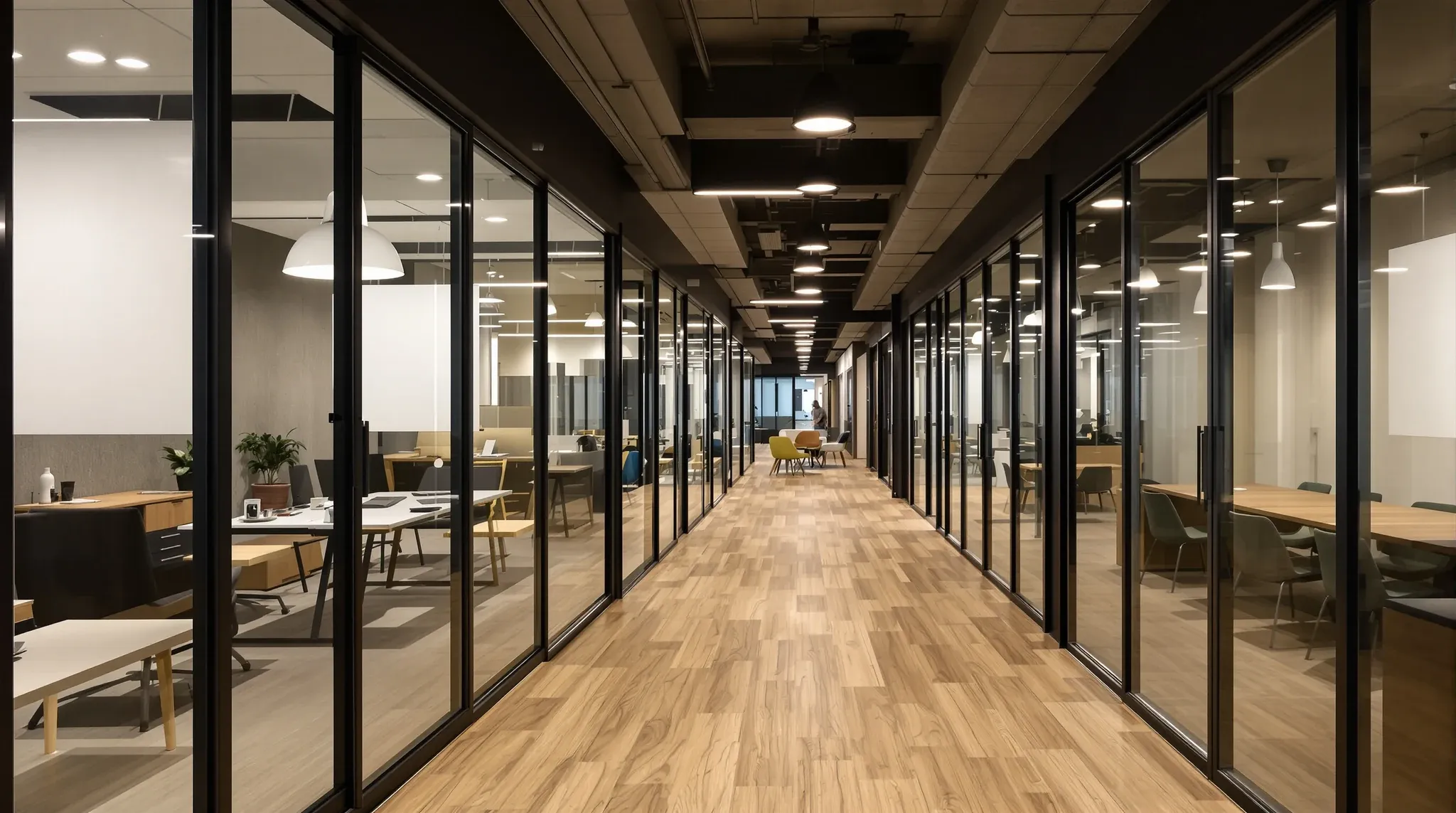
Glass partitions in shared office environments face a fundamentally different set of demands than glass in single-tenant offices. When one business controls an entire floor, the team develops shared norms around noise, movement, and room use that evolve naturally over time. When multiple businesses share a floor, or when a single tenancy houses teams with different functions, schedules, and noise profiles, those norms never fully stabilise. The glass system has to compensate for this instability with physical performance rather than relying on people to manage their behaviour around the partition’s limitations. This is what “stronger rules” means in practice: not signage or policies, but stricter specification, more durable hardware, and more deliberate placement that delivers consistent performance regardless of who is on the other side of the wall.
This article covers why glass partitions in shared office environments need to be specified, installed, and maintained differently from glass in conventional single-tenant offices, and where the standard approach most commonly falls short.
Why Standard Office Specifications Fall Short in Shared Environments
Most glass partition specifications are developed for single-tenant offices where the fitout team understands the business, knows how the rooms will be used, and can design around predictable conditions. The specification assumes a certain ambient noise level, a certain pattern of movement through the floor, and a certain degree of consistency in how rooms are occupied throughout the day. In a shared environment, none of these assumptions hold reliably.
The ambient noise level fluctuates as different tenants operate on different schedules. Movement through shared corridors is less predictable because the people using them belong to different organisations with different routines. Meeting rooms may be used back-to-back by teams with very different expectations of what constitutes a normal speaking volume. A specification that performs adequately in a single-tenant office with stable conditions may underperform noticeably in a shared environment where the conditions shift throughout the day. The specification needs to account for the worst-case acoustic and visual exposure the room is likely to face, not the average.
The Acoustic Floor That Multi-Tenant Spaces Demand
In a single-tenant office, the fitout team can design the acoustic environment holistically. They know what happens in the room next to the meeting room because they designed both rooms. In a shared environment, the activity on the other side of the glass may change when a neighbouring tenant moves out and a different business moves in. A quiet accounting practice may be replaced by a recruitment firm running phone calls all day. The acoustic conditions that the glass was specified for no longer exist, but the glass remains.
This is why shared environments need a higher acoustic floor than single-tenant offices. The glass specification cannot target the current conditions because the current conditions are temporary. It needs to target a reasonable worst case that remains functional across different neighbour profiles over the lease term. In practice, this means thicker glass, better seals, and full-height construction to the slab rather than stopping at the ceiling grid. The cost difference is modest at installation but the performance difference compounds over years of use as the neighbouring tenancies turn over and the acoustic environment changes around the glass.
Durability under high-traffic conditions is a related concern because shared environments generate more corridor traffic, more door operations, and more incidental contact with partition surfaces than single-tenant offices where the same people use the same routes every day.
Hardware and Seals Under Shared-Use Conditions
Glass partition hardware in a single-tenant office with 15 staff operates under relatively gentle conditions. The doors are opened and closed by people who use them daily and develop habits around how much force to apply and how to manage the closer. In a shared environment, the same hardware is operated by a wider range of people with different habits, different levels of care, and no ownership stake in the system’s longevity. Visitors, delivery personnel, cleaning contractors, and neighbouring tenants all interact with the glass system in ways that are less predictable and less gentle than a stable in-house team.
Door closers, pivot hardware, and latch mechanisms all wear faster under shared use. Seal compression degrades more quickly when doors are operated more frequently and with more variation in how they are handled. The hardware specification that lasts five years in a single-tenant office may need servicing within two years in a shared environment, and if the maintenance is not done, the acoustic and thermal performance of the glass system deteriorates progressively. Selecting commercial-grade hardware rated for higher cycle counts at the outset is more cost-effective than replacing standard hardware repeatedly over the lease term.
Maintenance Responsibility at Shared Boundaries
One of the most common problems with glass in shared environments is ambiguity about who maintains it. In a single-tenant office, maintenance responsibility is clear: the tenant maintains the fitout. In a shared environment, glass partitions may sit at the boundary between two tenancies, along a shared corridor, or between a tenancy and a communal area. The question of who is responsible for cleaning, hardware adjustment, seal replacement, and cosmetic repair becomes complicated when the partition serves multiple parties but belongs to one.
This ambiguity leads to deferred maintenance, which degrades both the appearance and the performance of the glass over time. Seals that are not replaced when they lose compression allow more sound transfer. Hardware that is not adjusted when it loosens creates doors that do not close properly. Glass panels that are not cleaned regularly develop a film that makes the office look neglected. In shared environments, the maintenance framework needs to be established before the glass is installed, not discovered as an issue after the system starts showing wear. The lease or licence agreement should specify maintenance obligations clearly, and the glass specification should account for the likelihood that maintenance intervals will be longer than ideal.
How Lease Structures Complicate Partition Ownership
Shared office environments operate under a range of lease and licence structures that affect how partitions are treated commercially. In a co-working space, the glass may be owned by the operator and maintained as part of the base offering. In a multi-tenant building with shared corridors, the glass along the corridor may be part of the base building or part of the tenant’s fitout depending on the lease. In a strata-titled suite, the glass may be the lot owner’s responsibility or subject to by-laws that restrict modification.
These ownership structures matter because they determine who specifies the glass, who maintains it, and who bears the cost when it needs repair or replacement. Make-good obligations for glass partitions are more complex in shared environments because the partition may serve functions for multiple parties, and the cost of removing it at lease end may not align with the benefit the tenant received from it during the lease. Understanding these structures before specifying the glass prevents decisions that create commercial problems later even if they work technically from day one.
Behavioural Adaptation Is Not a Reliable Privacy Strategy
In single-tenant offices, behavioural adaptation is a legitimate part of how glass rooms function. Teams learn to lower their voices in glass meeting rooms. People develop habits around not lingering outside glass walls during meetings. These behaviours develop naturally because the team is stable, the culture is shared, and the social feedback loops that shape behaviour operate consistently.
In shared environments, these feedback loops do not function reliably. People from different organisations do not share the same behavioural norms. Visitors and short-term users have no incentive to adapt their behaviour to accommodate the glass system’s limitations. The result is that glass rooms in shared environments are exposed to behaviours that the specification assumed would not occur: loud conversations in adjacent corridors, people standing close to glass walls during phone calls, doors being held open for extended periods. Any privacy strategy that relies on people behaving in a particular way around glass will underperform in a shared environment. The glass system needs to deliver its required privacy level through physical performance alone, treating every behavioural interaction as unpredictable.
Conflicting priorities between landlords and tenants often surface in shared environments where the landlord’s interest in visual openness and the tenant’s interest in acoustic privacy pull in opposite directions, and the glass specification needs to satisfy both.
What Stronger Glass Rules Look Like in Practice
Stronger rules for glass in shared environments are not complicated, but they do require deliberate decisions that differ from standard single-tenant practice. The acoustic specification targets worst-case neighbour conditions rather than current conditions. The hardware is rated for higher use cycles and more variable handling. The seals are specified for durability under frequent operation rather than for minimum cost. The maintenance responsibility is documented before installation rather than assumed. The placement of glass rooms accounts for unpredictable corridor traffic and adjacent activity rather than the controlled conditions of a single-tenant floor.
These decisions add modest cost at installation but they prevent the pattern that makes glass problematic in shared environments: systems that perform well initially but degrade under shared use until the rooms they create are avoided for the conversations they were designed to contain. The shared offices that get this right are the ones where the glass performs consistently regardless of what happens on the other side of it, because the specification was set for the environment rather than for the ideal conditions the environment occasionally provides.
We deliver glass partition projects and complete office fitouts for shared and multi-tenant offices. If you need glass that performs reliably in a shared environment, we can help.
📞 Call us on 1300 60 93 93