
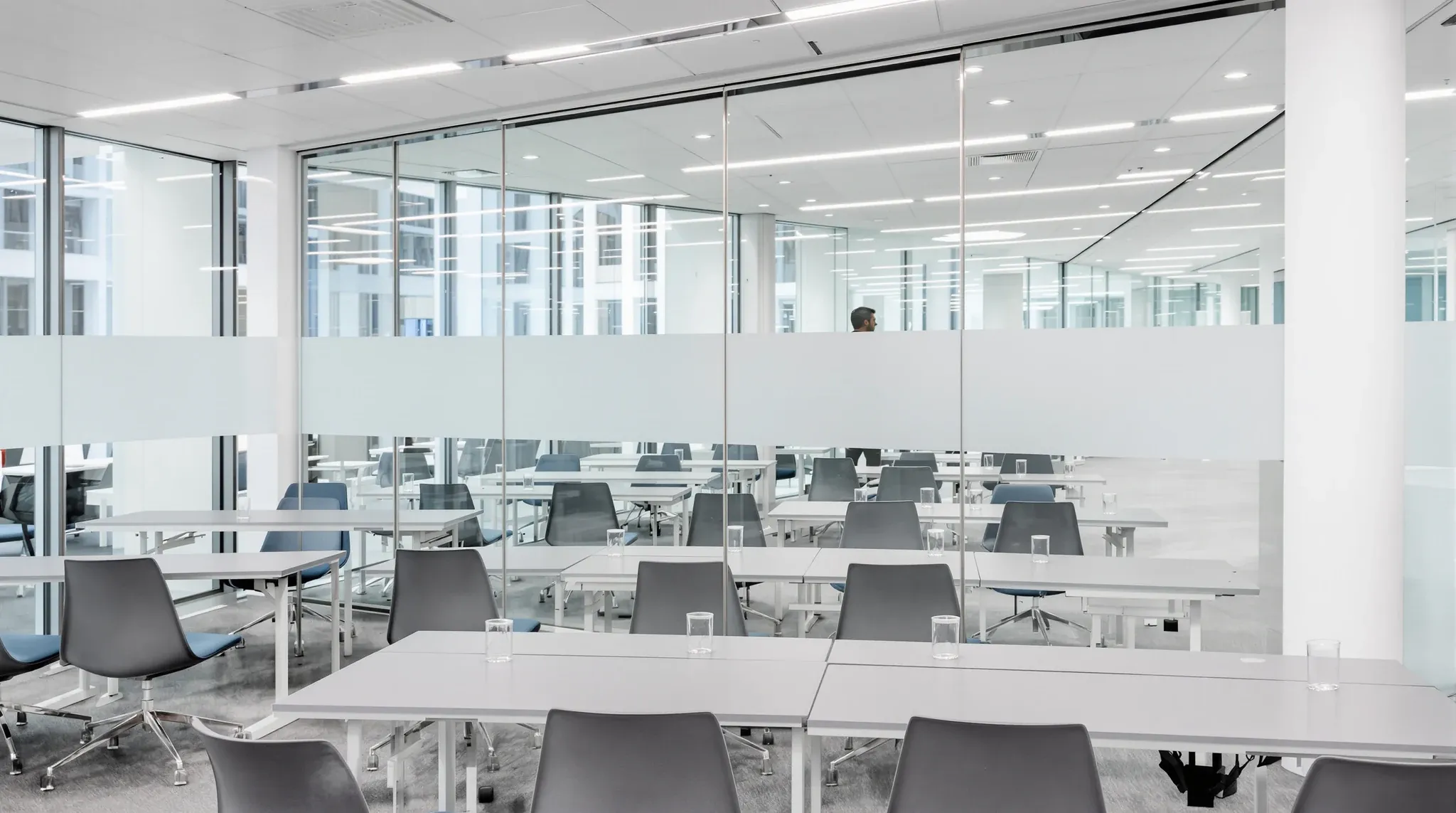
Shared learning and training environments present a specific set of problems for glass partitions that neither general shared office guidance nor standard training room design fully addresses. The participants change constantly. The session types vary from quiet seminars to energetic workshops. The people using the rooms have no established relationship with the space and no shared behavioural norms to draw on. In a dedicated in-house training room, the team adapts to the glass over time and the facilitator learns how to manage it. In a shared training environment, every session starts fresh with a group that has never used the room before, and the glass has to perform without the benefit of familiarity or adaptation.
This article covers why shared learning and training spaces need a different approach to glass than either standard offices or dedicated training rooms, and where the most common problems emerge.
Why Rotating Participants Change What Glass Needs to Do
In a dedicated training room used by the same organisation, the facilitator and the regular participants develop an intuitive understanding of the room. They know which seats have the best view of the screen. They know that the glass wall facing the corridor lets people see in. They adjust their behaviour accordingly, and over time the glass becomes part of the room’s character rather than a source of discomfort. This adaptation is real and it genuinely reduces the negative effects of glass in training settings.
Shared training environments do not benefit from this adaptation because the participants rotate. An external attendee arriving for a one-day certification course has no prior experience with the room. They do not know that the glass wall faces a busy corridor. They do not know that the frosting stops at seated head height. They discover these things during the session, and the discovery process is itself a distraction. Every new group goes through this adjustment period, and in a room that hosts different groups several times a week, the adjustment never completes because it resets with each new cohort.
Variable Session Types Create Variable Acoustic Demands
Shared learning environments host a wider range of session types than dedicated training rooms. A morning session might be a quiet presentation to 8 people. An afternoon session might be a workshop for 20 with breakout activities and group discussion. An evening session might be a certification exam conducted in silence. Each of these formats creates different acoustic conditions inside the room and generates different levels of noise that affect adjacent spaces.
Glass that is adequate for a quiet seminar may not contain the noise from a workshop where 20 people are talking simultaneously during a group exercise. Glass that was specified for normal speech levels may allow exam-condition silence to be broken by corridor activity that would have been masked during a busier session. The acoustic demand on the glass is not constant because the room’s use is not constant, and the specification needs to accommodate the full range of sessions rather than the most common one. Education and training environments that serve multiple user groups face this challenge more acutely than dedicated corporate facilities because the range of use is wider and less predictable.
External Attendees and the Unfamiliarity Factor
Many shared training environments host external attendees: clients, suppliers, industry participants, or members of the public attending professional development courses. These attendees have a different relationship with the space than internal staff. They are visitors, and their comfort and impression of the environment affects their assessment of the training provider, the course quality, and whether they return for future sessions.
External attendees are more sensitive to environmental discomfort than internal staff because they are comparing the experience to other training venues they have attended. A glass room that feels normal to internal teams who are accustomed to it may feel exposed or distracting to an external attendee who has no context for the layout and no familiarity with the people moving past the glass. The quality of the training environment becomes part of the product that the training provider is selling, and glass that creates discomfort for external attendees is undermining that product regardless of how it performs for internal use.
Scheduling Density and Back-to-Back Room Turnover
Shared training rooms are typically scheduled more intensively than dedicated facilities because they serve multiple users and the operator needs to maximise utilisation to justify the space. Back-to-back sessions with different groups create conditions that stress glass systems in ways that lighter scheduling does not. Doors open and close more frequently as groups arrive and depart. The corridor outside the room experiences peak activity between sessions as departing and arriving participants overlap. The room itself may not have time to be reset between sessions, and the residual noise from one group’s departure bleeds into the next group’s opening minutes.
Glass walls amplify these transitions because the arriving group can see the departing group through the glass, and the visual overlap creates a sense of rush and crowding that a solid wall would contain. The acoustic overlap is also more pronounced because the doors are open for longer during changeovers and the glass walls do not provide the buffer that plasterboard does when the door is open. High-density scheduling environments need partition systems that maintain their performance under sustained use with minimal recovery time between sessions, and glass systems that depend on the door being closed to achieve their acoustic rating are inherently less suitable for this pattern than solid systems that provide meaningful separation even when the door is temporarily open.
How Corridor Activity Peaks Between Sessions
The corridor outside a shared training room is not a steady-state environment. It is quiet during sessions and then extremely active during breaks and changeovers. This pattern creates two problems for glass. During sessions, the corridor is quiet enough that any incidental noise, a phone call, a conversation between people waiting for the next session, a delivery, is clearly audible through the glass because there is no ambient masking. Between sessions, the corridor is so active that the glass wall becomes a window onto a chaotic scene that is visible to participants who are still in the room or who have just arrived for the next session.
This peak-and-trough pattern is different from the relatively steady corridor activity in a general office, and it means that the glass system needs to perform well under both extremes. During sessions, it needs to prevent the quiet corridor’s occasional noises from entering the room. Between sessions, it needs to withstand the physical demands of heavy foot traffic, frequent door operation, and the occasional contact with bags, equipment, and furniture being moved in and out. Both demands are higher than what standard office glass typically encounters.
Privacy Expectations When Groups Do Not Know Each Other
When a training session involves people from different organisations or different backgrounds, the privacy dynamics change. Participants who do not know each other are more guarded about their contributions, more conscious of being overheard by people outside the room, and more sensitive to the feeling of being observed through glass walls. This guardedness is more pronounced in training that involves assessment, personal development, or professional skills where the participant feels vulnerable.
Surface treatments like frosting or film can reduce the visual exposure, but they do not eliminate it entirely and they do not address the acoustic dimension. A frosted glass wall that allows silhouettes and movement to be visible still signals to participants that they are in a semi-public space, and this perception affects their willingness to engage regardless of whether anyone is actually watching. In shared learning environments where the participant groups change constantly and the social dynamics start from zero each session, the glass system needs to provide privacy that does not depend on the participants believing they are private. It needs to provide privacy that they can verify by looking at the walls around them.
Designing Shared Training Spaces That Perform Across All Uses
The shared learning environments that work best over time are the ones designed for their most demanding session type rather than their most common one. If the room sometimes hosts silent exams, the acoustic specification needs to handle that silence. If the room sometimes hosts high-energy workshops, the specification needs to contain that noise. If the room sometimes hosts external attendees who are sensitive to environmental quality, the room needs to present well enough to meet their expectations. This means more solid construction than a standard glass meeting room, more considered placement of any glass elements, and a specification that prioritises reliability across variable conditions over aesthetics under ideal ones.
Glass can still play a role in shared training spaces. A narrow vision panel in the door or corridor wall provides the visual connection that operators need to monitor room status without exposing participants to full-height glass. A transom above a solid wall allows borrowed light without creating visual distraction at seated eye level. These targeted uses preserve the benefits of glass while respecting the specific demands that shared learning environments place on the room enclosure.
We deliver glass partition projects and complete office fitouts for offices that include shared training facilities. If you need a training space that works for every group that uses it, we can help.
📞 Call us on 1300 60 93 93