
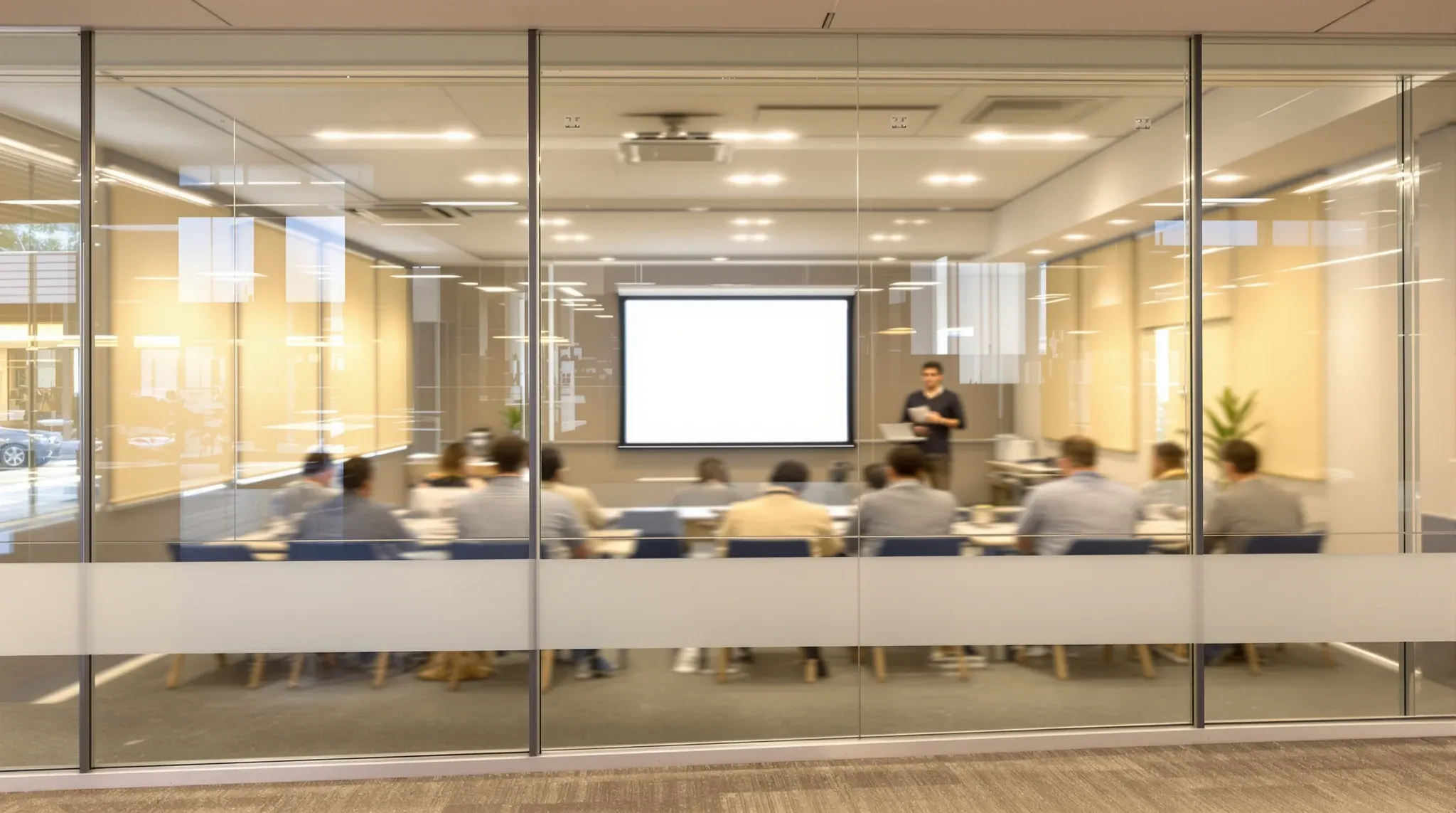
Training rooms are not meeting rooms, and the distinction matters for glass. A meeting room hosts conversations between people who are already engaged. A training room hosts learning, which requires sustained attention from people who may not be naturally engaged and whose focus can be disrupted by environmental conditions that a meeting participant would barely notice. Glass partitions in training rooms affect how people learn: their ability to concentrate over a two-hour session, their willingness to participate, their comprehension of instructional audio, and their comfort under the sustained visual exposure that glass creates. These effects are not theoretical. They are observable within the first session and they compound over time if the room is used for training regularly.
This article covers how glass partitions specifically affect training room performance and where the standard office glass approach needs to change to support instructional environments.
Why Training Rooms Present Different Demands Than Meeting Rooms
Meetings typically last 30 to 60 minutes. The participants are usually peers or colleagues who know each other. The content is conversational, and the level of sustained attention required is moderate because participants contribute and shift between listening and speaking. A meeting room with glass walls works well under these conditions because the sessions are short enough that visual distraction does not accumulate and the conversational format keeps people actively engaged.
Training sessions last longer, often two to four hours with breaks. The participants may not know each other. The format is typically one-to-many, with a facilitator delivering content to a group that is expected to absorb, process, and retain information. This format demands sustained one-directional attention, and any environmental factor that breaks that attention has a measurable effect on comprehension. Movement outside a glass wall that would be ignored during a 30-minute meeting becomes a repeated source of distraction during a three-hour training session because the brain cannot sustain the effort of ignoring peripheral visual stimuli indefinitely.
How Visual Distraction Accumulates During Sustained Sessions
Visual distraction through glass walls is not a single event. It is a cumulative process that erodes attention over the duration of a session. Each time movement outside the glass catches a participant’s eye, their focus shifts momentarily from the instructor to the movement and then back. This shift is brief and often unconscious, but it uses cognitive resources. Over two or three hours, these micro-interruptions accumulate and the participant’s effective attention degrades. By the end of a long session in a glass room facing an active corridor, participants report feeling more tired and recall less of the content than participants in the same session delivered in an enclosed room.
This effect is stronger when the movement outside the glass is unpredictable. A steady stream of people walking past in one direction is less distracting than intermittent movement that appears at irregular intervals, because the brain adapts to predictable patterns but continues to respond to unpredictable ones. Training rooms that face reception areas, lift lobbies, or shared kitchens are exposed to the most irregular movement patterns and create the most challenging conditions for sustained attention.
Audio Clarity and the Instructor’s Voice
Training delivery depends on the instructor’s voice reaching every participant clearly and consistently throughout the session. Glass surfaces reflect sound differently from plasterboard. In a room with three plasterboard walls and one glass wall, the acoustic character is noticeably different from a room with four plasterboard walls, and this difference affects how clearly the instructor’s voice is perceived at the back of the room and at the edges closest to the glass.
Glass reflects mid and high-frequency sound more efficiently than plasterboard, which absorbs a portion of these frequencies. In a training room, this can create a brighter, harder acoustic character that makes the instructor’s voice sound clear at close range but fatiguing over a long session. It can also create early reflections that interfere with speech intelligibility at certain positions in the room, particularly when the glass wall is opposite the instructor’s typical position. Lighting conditions in the room interact with this effect because overhead lighting designed for an open-plan area may create glare on the glass surface that adds visual strain to the acoustic fatigue, producing a combined discomfort that is difficult for participants to attribute to any single cause.
Participation and the Effect of Being Visible
Training sessions that involve group discussion, role play, or exercises where participants are expected to contribute actively are affected by glass walls in ways that purely lecture-format sessions are not. People who are asked to practice a skill, answer questions aloud, or participate in a group activity are more self-conscious when they know they can be seen by people outside the room. This effect is well documented in educational research and it applies in corporate training settings with equal force.
The visibility does not need to be constant or direct. Even the possibility of being observed by passing colleagues or visitors changes how people behave in the room. Participants speak more quietly, volunteer less, and manage their body language more carefully in glass rooms than in enclosed rooms. For training sessions where the objective includes developing confidence, practising communication skills, or working through uncomfortable scenarios, this self-consciousness works directly against the training outcome. The room environment is subtly discouraging the behaviour that the training is trying to develop.
Lighting, Glare, and Projection Compatibility
Many training sessions use projected content: slides, video, live demonstrations on shared screens. Glass walls create lighting challenges for projection because the light from outside the glass competes with the projected image and the glass surface itself can produce reflections that are visible to participants seated at certain angles. A training room with a glass wall facing a naturally lit area may need blinds or film to achieve adequate projection contrast, and if those treatments are not provided, the instructor is forced to choose between a bright room with poor projection quality or a darkened room that defeats the purpose of the glass.
Transparency fatigue is relevant in training rooms that are used daily because the cumulative effect of managing glare, projection quality, and visual exposure over repeated sessions creates an environment where the glass becomes something the room works around rather than benefits from. If the blinds are closed for every session because the projection requires it, the glass wall is providing no functional benefit during training hours but is still contributing to acoustic reflection and heat gain.
Glass Placement That Supports Training Without Undermining It
Glass can work in training room design, but its placement needs to account for the specific demands of instructional environments. Glass behind the instructor, where participants face it, creates the most visual distraction and should generally be avoided or treated with opaque film below seated eye height. Glass on the wall beside the participants, perpendicular to their sightline, produces less distraction because the movement is peripheral rather than directly in the field of view. Glass in the corridor wall that faces the training room entrance can provide visual connection that allows people to see whether a session is in progress without opening the door, which is a genuinely useful function that does not create distraction for the participants inside.
How the glass integrates with the ceiling system also matters in training rooms because the ceiling void above the glass is a common path for sound transfer, and training rooms that need reliable acoustic separation from adjacent spaces require the glass to extend to the slab or to be sealed at the ceiling junction with the same care as plasterboard partitions. A glass wall that stops at the ceiling grid allows instructional audio to leak into adjacent spaces and corridor noise to enter the training room through the void, and both effects are more problematic in training than in general office use because the audio clarity standards are higher.
Where Solid Construction Serves Training Better
The training rooms that perform best over years of use are typically enclosed rooms with plasterboard walls that provide consistent acoustic separation, predictable lighting control, and freedom from visual distraction. Glass can be incorporated as a sidelight next to the door, a narrow strip at high level for borrowed light, or a viewing panel that allows external observation without exposing participants to full visual contact with the corridor. These elements provide the light transfer and visual connection that glass is valued for without compromising the enclosed, focused environment that training delivery requires.
The decision about how much glass to include in a training room should start with how the room will be used rather than how the office will look. A training room that hosts a weekly team briefing has different requirements from a room that hosts full-day certification courses for external attendees. The first can tolerate more glass because the sessions are short and the participants are familiar. The second needs more enclosure because the sessions are long, the participants are unfamiliar, and the training outcomes depend on conditions that glass tends to undermine when it is used extensively.
We deliver glass partition projects and plasterboard partitions for offices that include training spaces. If you need a training room that works for learning, not just for meetings, we can help.
📞 Call us on 1300 60 93 93