
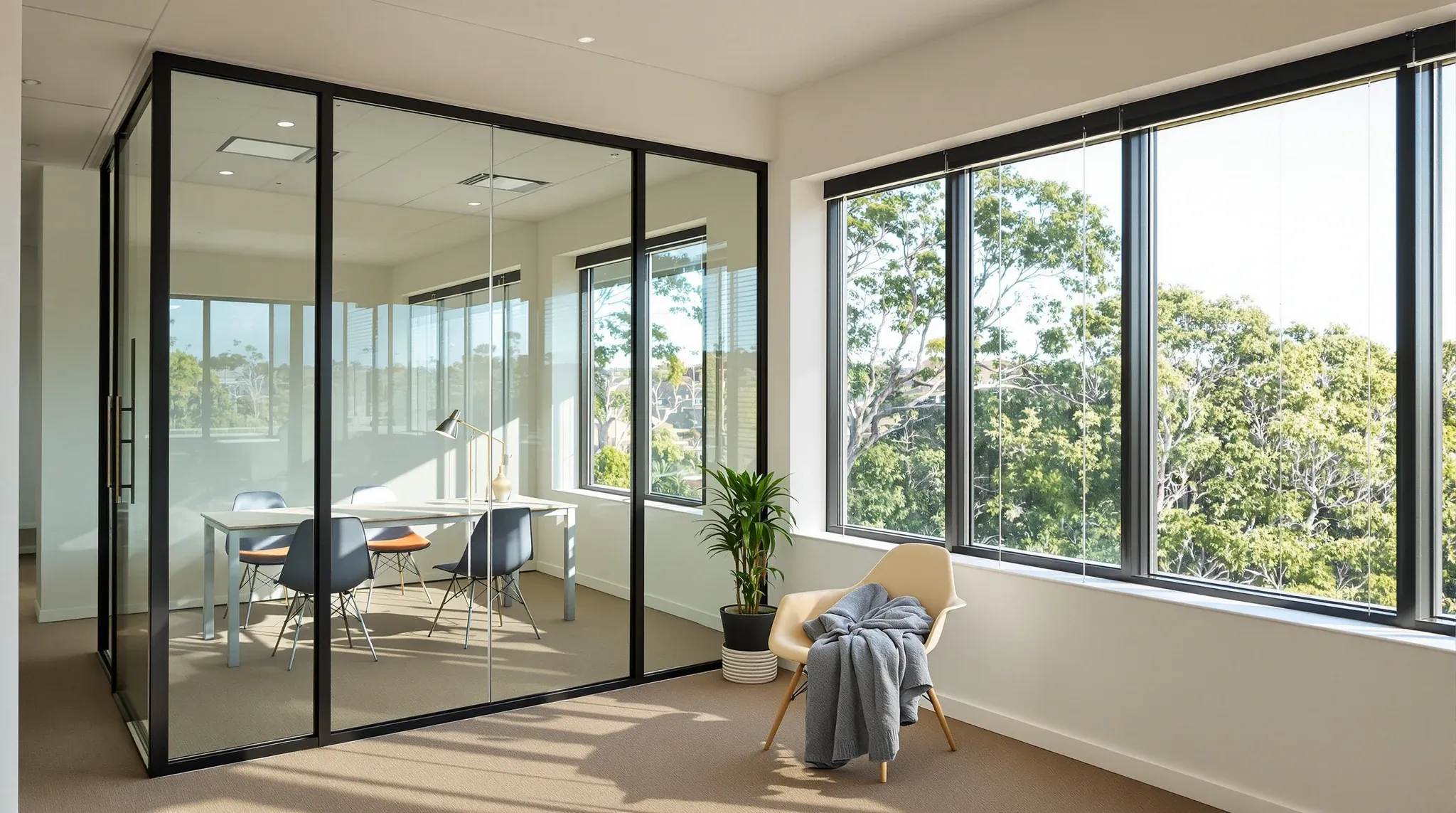
Northern Beaches offices operate at a different pace and in different buildings than Sydney’s CBD or inner-suburban commercial precincts. The tenancies tend to be smaller, the businesses more lifestyle-aligned, and the buildings lower-rise and closer to natural light. Glass partitions work well in these conditions because the things glass does best, distributing light, creating openness, and giving small offices a sense of space, align naturally with what Northern Beaches businesses want their offices to feel like. But glass on the Northern Beaches still needs to be specified and positioned for the specific conditions of the building and the business, not just selected because it matches the aesthetic.
This article covers how glass partitions perform in Northern Beaches offices and where they add the most value for the types of businesses that operate in the region.
Why Glass Suits the Northern Beaches Office Market
Northern Beaches commercial buildings are typically low-rise, with good natural light from multiple exposures and smaller floorplates that keep most rooms within reach of a window. Glass partitions in this context amplify an advantage that already exists. They allow light from the perimeter to penetrate through enclosed rooms and into corridors, creating a sense of brightness and openness that reinforces the environmental quality of the building. In an office where the windows are close and the natural light is strong, glass walls feel genuinely transparent rather than decorative, and the connection between the interior and the outdoor environment reads as natural rather than forced.
Flexible workspace design is common on the Northern Beaches because many businesses in the region operate with smaller teams, variable schedules, and a culture that favours openness over enclosure. Glass partitions support this by creating rooms that feel connected to the broader office rather than separated from it. A glass meeting room on a Northern Beaches floor feels like part of the office rather than a sealed box, and for businesses that value collaboration and visual contact between team members, this connection is a genuine benefit rather than just an aesthetic one.
Acoustic Expectations in Smaller, Quieter Offices
Northern Beaches offices are typically quieter than CBD offices. The teams are smaller, the background noise is lower, and the ambient masking that a busy open-plan CBD floor provides does not exist in the same way. This changes the acoustic demands on glass partitions because sound transfer that would be masked by background activity in a CBD office becomes clearly audible in a quiet Northern Beaches tenancy. A glass meeting room that performs adequately in a busy 50-person office may not perform as well in a 10-person office where the ambient noise level is significantly lower.
This does not mean glass cannot work acoustically on the Northern Beaches. It means the specification needs to account for the lower background noise and the closer proximity of rooms on smaller floorplates. Better door seals, full-height construction to the slab rather than stopping at the ceiling grid, and appropriate gasket compression at the base and head all contribute to acoustic performance that is adequate for the quieter conditions. Real estate offices, which are common on the Northern Beaches, need meeting rooms where client conversations are confidential, and the acoustic specification of the glass in those rooms needs to reflect this requirement regardless of the building’s general character.
Where Glass Works Best on the Northern Beaches
Glass delivers its greatest value on the Northern Beaches in areas where light and visual connection are the priorities: reception areas, corridor walls, meeting room fronts facing open-plan areas, and any partition that separates enclosed space from naturally lit zones. In these locations, glass preserves the light quality and spatial openness that Northern Beaches offices are known for, and the acoustic demands are manageable because the rooms are used for general meetings, collaborative work, and client-facing functions where background conversation is normal.
Glass is less effective in rooms where concentrated individual work happens, where phone calls with sensitive content are common, or where the room is positioned close to the main entry or a shared kitchen where unpredictable noise occurs. In these locations, plasterboard walls with a glass element, such as a sidelight or a transom, provide the light transfer that the floor needs without the acoustic compromise that full glass walls create. The Northern Beaches aesthetic does not require every wall to be glass. It requires the office to feel open and light, and this can be achieved with a mix of materials that preserves the feeling while delivering the performance each room needs.
Coastal and Mixed-Use Building Considerations
Some Northern Beaches commercial buildings are in coastal or near-coastal locations where salt air, humidity, and temperature variation are more significant than in inland offices. Glass partition systems in these environments need hardware and seals that are rated for the conditions. Standard hardware that performs well in a climate-controlled CBD tower may corrode or degrade faster in a Northern Beaches building with less consistent environmental control, particularly in buildings that rely on natural ventilation for part of the year or that have loading areas or entries that expose the interior to outside air.
Strategy matters more than style in these conditions because the long-term performance of the glass system depends on hardware selection and seal specification as much as it depends on the glass itself. Anodised or marine-grade hardware finishes, corrosion-resistant channel systems, and seals that maintain their compression under humidity variation all contribute to a glass installation that performs consistently over the lease term rather than degrading in ways that affect both appearance and acoustic function.
Combining Glass With Solid Construction
The Northern Beaches offices that age best are not the ones with the most glass. They are the ones that use glass where it genuinely supports the way the office is used and solid construction where privacy, durability, or acoustic isolation is the priority. This typically means glass in the front half of the office where clients are received and first impressions are formed, and plasterboard in the working areas where staff need quiet, focus, and the ability to have private conversations without managing the glass around them.
The transitions between glass and plasterboard need to be handled so the office reads as one consistent design rather than two different fitout approaches joined together. On a Northern Beaches floor where the total number of rooms is smaller and each room has a larger visual impact on the whole, the junction quality between glass and plasterboard is more noticeable than on a large floor where the transitions are distributed across more walls. Getting these junctions right during design and installation is a small detail that has an outsized effect on how the finished office feels.
Durability and Maintenance on the Northern Beaches
Northern Beaches businesses often lease for medium to long terms and expect the fitout to maintain its quality without frequent intervention. Glass partitions on the Northern Beaches need to be specified for this expectation, with hardware that maintains its function and appearance over years of daily use and seals that do not degrade in the local environmental conditions. Framed glass systems generally outlast frameless ones in Northern Beaches conditions because the frame protects the glass edges from impact, distributes movement and thermal expansion across the system, and provides accessible mounting points for hardware that may need adjustment over the lease term.
Cleaning requirements are also worth considering. Northern Beaches offices may experience more dust from coastal winds and construction activity in surrounding areas, and glass walls show dust and marks more readily than painted plasterboard. A maintenance-conscious approach to glass placement, using glass where it delivers the most visual impact and is easiest to clean, and plasterboard where it is less visible and less likely to require regular attention, keeps the office looking its best with a realistic maintenance effort.
Getting Glass Right on the Northern Beaches
Glass partitions are a natural fit for the Northern Beaches office market. The light conditions, the building types, and the business culture all favour transparency, openness, and connection to the environment. But getting the best result means specifying glass for Northern Beaches conditions rather than applying a generic commercial specification, positioning glass where it adds the most value and the acoustic trade-offs are manageable, and combining glass with plasterboard where the room function requires more reliable enclosure than glass alone can provide.
The offices that achieve this balance feel distinctly Northern Beaches: light, open, and unhurried, while still delivering the acoustic privacy and professional function that every commercial office needs regardless of its postcode. The businesses that operate from these offices report that the environment contributes to staff retention and client confidence in ways that are difficult to quantify but clearly felt. In a market where talent competes across the city and clients have choices about which local provider to trust, the quality of the working environment is a competitive advantage that the right glass strategy helps create and the wrong one quietly undermines.
We deliver glass partition projects and plasterboard partitions for Northern Beaches offices. If you want glass that works for the way your office operates, we can help.
📞 Call us on 1300 60 93 93