
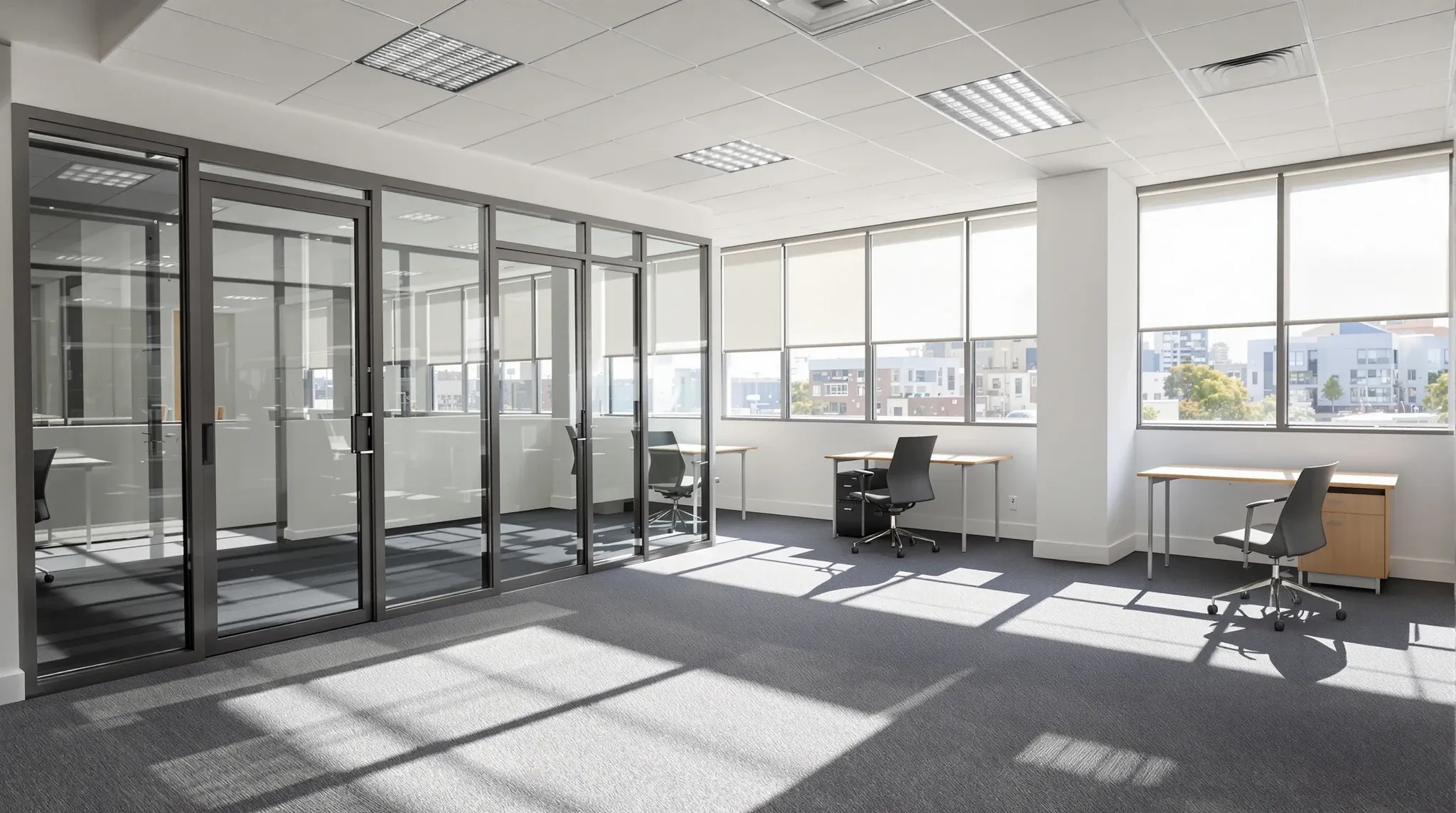
Small offices face a persistent design challenge: how to make a compact space feel open, bright, and comfortable when the floor area is limited and the available natural light may be constrained by the building’s configuration. A small office with poor light and a cramped feel discourages staff attendance, creates a negative impression on visitors, and makes the space harder to use productively throughout the day. Conversely, a small office that maximises light and spatial perception can feel considerably larger and more pleasant than its actual dimensions suggest.
The strategies for maximising natural light and spatial perception in small offices are well established, and most of them involve design decisions that are made during the fitout rather than structural changes to the building. The ceiling treatment, partition type, colour palette, furniture selection, and layout configuration all contribute to how much light enters the space and how spacious it feels.
How Partitions Affect Light Distribution
Partitions are the single most significant factor in how natural light travels through a small office. A full-height plasterboard partition between the window perimeter and the interior of the office creates a hard light boundary, leaving the interior spaces in permanent shade regardless of how much sunlight hits the external glazing. Replacing even some of those solid partitions with glass partitions transforms the light distribution by allowing daylight to pass through to areas that would otherwise be dark.
The effect is most dramatic when the partitions enclosing perimeter offices or meeting rooms are changed from solid to glass. A perimeter office with plasterboard walls traps the window light inside a single room. The same office with glass partitions shares that light with the open-plan workspace beyond, brightening two zones instead of one. In a small office where every source of natural light matters, this single design change can transform the character of the interior spaces.
Partially glazed partitions, with glass above desk height and solid panels below, offer a compromise that maintains some visual privacy while still allowing light to pass over the partition into adjacent areas. Frosted or textured glass provides privacy without blocking light transmission, making it suitable for meeting rooms and offices where the occupants need visual screening but the light contribution to the surrounding space is valuable.
Ceiling Design and Its Impact on Perceived Space
The ceiling has a significant influence on how spacious a small office feels. A low, dark ceiling compresses the sense of vertical space and makes the room feel smaller than it is. A light-coloured ceiling at maximum height, or an exposed ceiling that reveals the full slab-to-slab dimension, creates a sense of vertical openness that counteracts the horizontal constraints of a small floor area.
In buildings with standard 2700mm floor-to-ceiling heights, maximising the ceiling height means either installing the suspended ceiling as high as the services allow or removing the suspended ceiling entirely to expose the slab above. Exposed ceilings typically add 300 to 500mm of perceived height, which in a small office makes a noticeable difference to the spatial experience. The trade-off is that exposed ceilings require painting, cable management, and acoustic treatment that a suspended ceiling provides automatically.
Light-coloured ceiling systems reflect natural light back into the room, amplifying the effect of whatever daylight reaches the ceiling surface. White or near-white ceiling tiles are the standard for light reflection, and they work effectively in small offices by bouncing light deeper into the space than a dark or coloured ceiling would. In rooms where the only natural light comes from a distant window, the ceiling’s reflective contribution to the overall brightness can be substantial.
Colour and Material Choices That Expand Perceived Space
The colour palette of a small office directly affects how large or small the space feels. Light, neutral colours on walls, floors, and furniture create a visual continuity that makes surfaces recede, expanding the perceived boundaries of the room. Dark colours absorb light and make surfaces advance visually, which compresses the sense of space and can make a small office feel claustrophobic.
This does not mean every surface needs to be white. A palette of light greys, warm whites, pale timbers, and soft neutrals creates enough visual interest to feel designed rather than clinical, while maintaining the light-reflective and space-expanding properties that small offices need. Accent colours can be introduced through furniture, artwork, and small decorative elements without affecting the overall brightness of the space.
Material choices contribute to the perception of space alongside colour. Reflective surfaces like glass, polished stone, and gloss finishes bounce light around the room and create visual depth. Matte surfaces absorb light and create a softer, more contained feel. In a small office, using reflective materials selectively, on the reception desk, the kitchen splashback, or the feature wall behind the entry, adds brightness and depth without making the space feel clinical or hard.
Furniture Selection and Layout for Small Spaces
Furniture in a small office needs to be scaled to the space. Oversized desks, heavy storage units, and bulky meeting tables consume floor area and visual space that a compact office cannot afford. Selecting furniture that is proportionate to the room, with clean lines and open bases, maintains the sense of space while providing the functional capacity the team needs.
Desks with slender legs or cantilever bases are visually lighter than desks with solid panel ends, allowing the eye to travel under and around the furniture rather than stopping at a solid wall of material. Similarly, storage units with open shelving or glass doors feel less imposing than solid-front credenzas, and wall-mounted shelving preserves floor area completely.
The layout should prioritise clear sightlines from the entry point through to the window wall. A clear visual path from the door to the source of natural light creates a sense of depth and openness that makes the space feel larger than it is. Placing tall storage or solid partitions across this sightline blocks both the light and the visual depth, compressing the perceived size of the space. Small business fitouts benefit from furniture planning that prioritises spatial perception alongside functional capacity.
Lighting Design That Supplements Natural Light
Even with all the design strategies above, small offices often have areas that natural light does not reach adequately. Internal rooms, alcoves, and zones far from windows need artificial lighting that supplements the daylight and maintains a consistent brightness level across the space.
The key to effective supplementary lighting in a small office is matching the colour temperature of the artificial light to the daylight. Cool-white fluorescent tubes alongside warm natural daylight create a visible colour mismatch that makes the artificially lit areas feel separate from the daylit zones. Using LED panels or linear fittings in a daylight-matching colour temperature, typically around 4000 to 4500 Kelvin, blends the artificial and natural light so the transition is seamless.
Indirect lighting, where the light source is directed upward or against a wall rather than downward into the room, creates a softer, more diffused illumination that feels like natural light rather than artificial illumination. Cove lighting along the ceiling edge, wall-wash fittings that illuminate vertical surfaces, and pendant lights with upward light components all contribute to an ambient brightness that makes the space feel naturally lit even when the actual daylight contribution is limited.
Using Mirrors and Reflective Elements Strategically
Mirrors and reflective surfaces can amplify both light and spatial perception in small offices when used with restraint. A large mirror on a wall opposite a window effectively doubles the perceived depth of the room and reflects daylight back into the space. Mirrored or high-gloss panels used as feature elements on joinery or partition walls create visual depth without structural modification.
The key is subtlety. A wall of mirrors feels like a gym or a dance studio, not an office. A single large mirror in a strategic position, a glass-fronted display unit, or a reflective surface treatment on the back wall of a reception area adds depth and light without overwhelming the design. The goal is to extend the visual boundaries of the space and bounce light into dark corners, not to create a hall-of-mirrors effect.
Bringing It All Together
The strategies for maximising light and space in a small office work best in combination. Glass partitions allow light to travel through the space. A light-coloured, high ceiling reflects that light downward. Neutral colours and reflective materials amplify the effect. Appropriately scaled furniture keeps the floor area open. And supplementary lighting fills the gaps where natural light cannot reach. Each strategy contributes incrementally, and together they can transform a small, dark office into a space that feels open, bright, and genuinely pleasant to work in.
The cost of these strategies is typically modest relative to the overall fitout budget. Glass partitions may cost more than plasterboard, but the light they admit reduces the need for artificial lighting and improves the quality of the workspace. A considered colour palette costs no more than a random one. And appropriately scaled furniture is often less expensive than oversized alternatives. A small business owner’s fitout roadmap should include these light and space strategies as integral design decisions rather than optional aesthetic enhancements.
If you are fitting out a small office and want to maximise the natural light and spatial perception within your floorplate, we can design a fitout that makes the most of the space you have.
Call us on 1300 60 93 93