
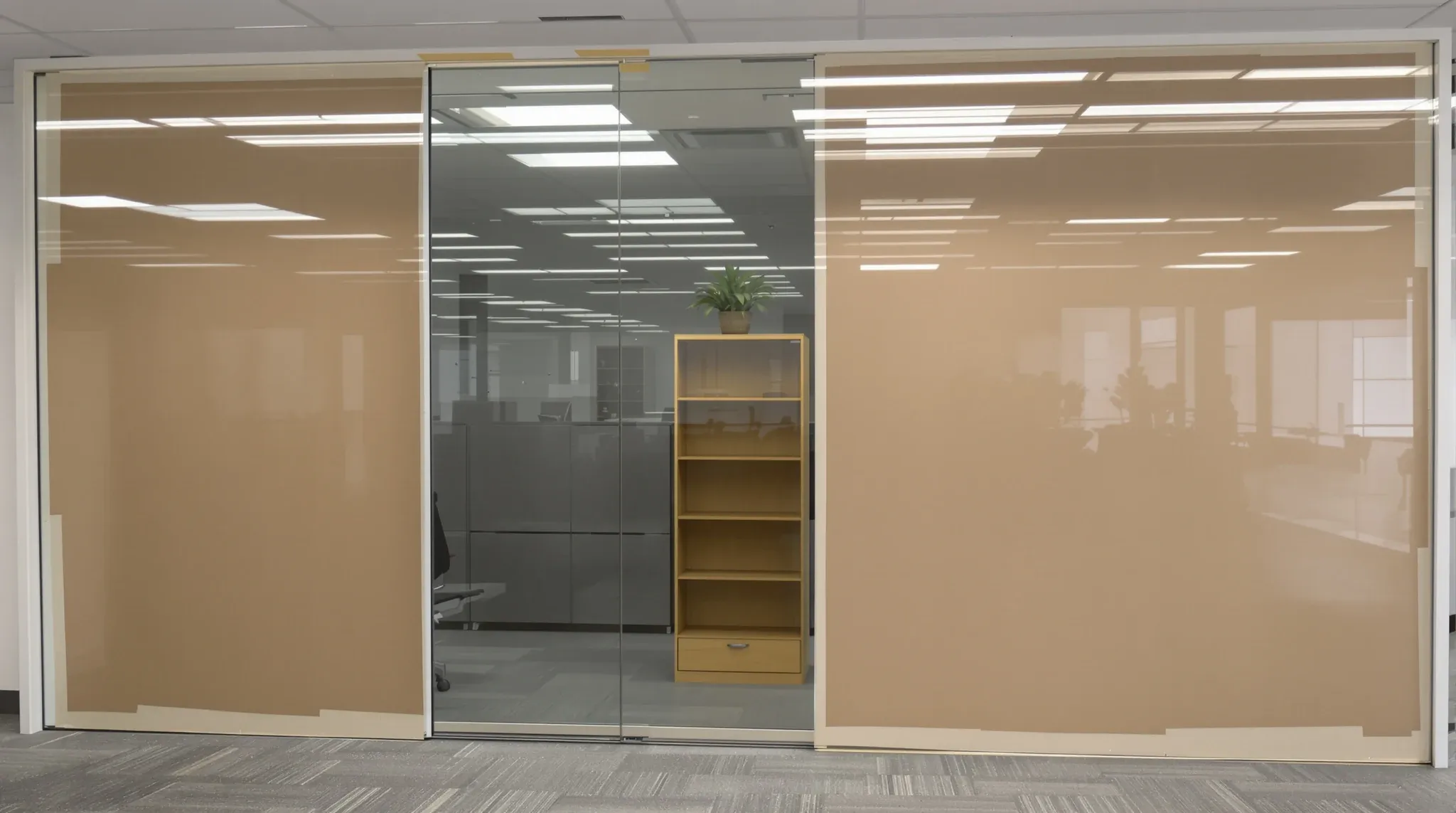
Glass partitions are good at what they do: transmitting light, creating visual connection, and making offices feel open and contemporary. The problem is that they are frequently installed in rooms where the primary requirement is not light or openness but privacy, and in those rooms the glass actively works against the outcome the business needs. A glass meeting room where confidential conversations are clearly audible from the next desk is not a room with a minor specification shortfall. It is a room that cannot perform its core function, and the tenant is left choosing between expensive remediation, behavioural workarounds, or simply accepting that the room does not provide what it was built to provide.
Knowing when glass is the wrong choice is as commercially important as knowing when it is the right one, because the cost of installing glass where it does not belong is not just the installation cost. It includes the lost utility of the room, the remedial treatments applied after the fact, and the ongoing behavioural compromise the business accepts for the life of the lease.
Rooms Where Conversations Must Stay Inside the Room
The clearest indicator that glass is the wrong choice is when the room’s primary purpose is containing sensitive spoken content. HR conversations about performance, remuneration, or disciplinary matters. Legal discussions involving client privilege or litigation strategy. Board meetings where commercial decisions are debated before they become public. Medical or counselling consultations in offices that include a clinical or advisory function. In each of these situations, the consequence of a conversation being overheard is not mild embarrassment. It is a professional, legal, or commercial problem.
Glass can reduce sound transmission, and higher-specification glass, laminated or double-glazed with commercial seals and a solid door assembly, can reduce it substantially. But the reduction is always less than what a properly built plasterboard wall achieves, and the gap is widest at the speech frequencies that carry intelligible content. Plasterboard with cavity insulation provides mass, absorption, and decoupling that glass physically cannot replicate at any price point. For rooms where the overheard word is the risk, plasterboard is the more reliable choice because its acoustic performance depends on its construction, not on the condition of its seals.
Offices Where Perception of Privacy Matters as Much as Measured Privacy
Acoustic privacy is measured in decibels. Perceived privacy is measured in behaviour. A glass room might achieve an acoustic rating that technically qualifies as speech-private, meaning that someone outside the room cannot make out individual words at normal speaking volume. But the person inside the room does not know the room’s rating. They know they can see people outside, people outside can see them, and the psychological certainty that comes from being inside four solid walls is absent. The result is that people modify their behaviour: they speak more quietly, censor their language, shorten difficult conversations, or avoid the room altogether for discussions that need genuine frankness.
This perception gap is highest in rooms that host emotionally charged conversations. Performance reviews where the employee can see colleagues watching through the glass. Salary negotiations where body language is visible to the open plan. Disciplinary meetings where the mere fact of being in the glass room signals to the floor that something serious is happening. In these contexts, the glass provides adequate acoustic isolation but inadequate psychological privacy, and the room underperforms not because of the glass specification but because of the glass itself.
Spaces Adjacent to Persistent Noise Sources
A glass room positioned next to a kitchen, a high-traffic corridor, a collaboration zone, or any area that generates sustained ambient noise faces an acoustic challenge that glass specification alone cannot overcome. The noise source is persistent, not intermittent, which means the glass is under constant acoustic load rather than occasional peaks. The cumulative effect is that conversations inside the room must compete with the external noise, people speak louder to be heard, the louder speech transmits more energy through the glass, and the cycle produces a room where both the occupants and the people outside are less comfortable than they would be if the room were built from solid construction.
Reducing noise in open offices helps at the source, but the glass room itself remains the weaker barrier. A plasterboard wall next to the same noise source would provide substantially more isolation because the mass and cavity absorption block a broader frequency range with less dependence on seal integrity. The glass room in the noisy location requires continuous high performance from every seal, every junction, and the door assembly to maintain adequate privacy, while the plasterboard room provides adequate privacy even if one seal is imperfect because the wall construction carries the majority of the acoustic load.
Rooms That Need Visual Discretion, Not Just Acoustic Isolation
Some rooms need to conceal not just what is said but who is present and what is happening. A manager meeting with an employee about a termination does not want the floor watching the conversation unfold through glass. A lawyer meeting with a client in distress does not want passing colleagues to observe the interaction. A business owner meeting with a potential acquirer does not want staff to see the visitor and speculate about what the meeting means.
Glass with frosting or film addresses this partially, but frosted glass still transmits silhouettes, movement, and the general character of the meeting. People outside can tell how many people are in the room, whether the conversation is animated or still, and how long the meeting lasts. This level of visibility is acceptable for routine meetings and entirely inadequate for situations that require genuine visual discretion. Professional services offices where client confidentiality is foundational to the business cannot rely on frosted glass to provide the discretion their clients expect and their professional obligations require. Solid walls provide complete visual privacy without compromise or qualification.
Environments Where Maintenance Will Not Sustain Glass Performance
Glass partition acoustic performance depends on seal integrity. Door seals compress over time. Gaskets at the head and base lose elasticity. Hardware develops play that creates gaps. Each of these degradations reduces the room’s acoustic performance incrementally, and restoring performance requires periodic inspection, adjustment, and seal replacement that most small to mid-sized tenancies do not include in their maintenance routines.
A business that will not realistically maintain glass partition seals over the lease term should not rely on glass for rooms where acoustic privacy is critical, because the performance the room provides at handover will not be the performance it provides at year three or year five. Plasterboard walls do not have seals, gaskets, or adjustable hardware. Their acoustic performance is set by their construction and does not degrade with use. For businesses that want acoustic certainty without ongoing maintenance, plasterboard is the more honest specification because it delivers consistent performance without requiring the maintenance commitment that glass demands.
When the Budget Cannot Stretch to the Glass Specification the Room Needs
The glass specification required for genuine speech privacy in a meeting room or private office is not the entry-level specification. It requires laminated or acoustic-rated glass, commercial-grade framing with tight tolerances, high-quality perimeter seals, and a door assembly with hardware and seals rated for commercial acoustic duty. This specification costs significantly more per square metre than standard single-glazed glass, and the total room cost, including the upgraded door, is often comparable to or higher than a plasterboard room that provides better acoustic performance.
When the budget is fixed and the glass specification the room requires exceeds what the budget allows, the choice is between installing a lower-specification glass that does not achieve the room’s privacy requirements or building the room in plasterboard that achieves the privacy requirements within the available budget. Installing glass that underperforms the room’s function because the budget could not cover the specification the room needed is the worst outcome, because the business pays for glass and receives neither the acoustic performance of plasterboard nor the visual quality of properly specified glass.
How Hybrid Approaches Avoid the All-or-Nothing Problem
The choice between glass and solid walls does not need to be binary. Hybrid approaches that use glass selectively, one face of a room rather than all four, a sidelight beside a door rather than a full glass wall, a transom above head height rather than floor-to-ceiling glazing, deliver much of the light and visual connection that glass provides while maintaining the acoustic and visual privacy that the solid walls provide. A plasterboard meeting room with a glass sidelight beside the door transmits light, provides visual awareness that the room is occupied, and maintains solid-wall acoustic performance on the walls that matter most.
The businesses that get the best results from their partition investment are the ones that use glass where it adds genuine value, reception walls, corridor fronts, low-sensitivity rooms, and solid construction where privacy is the priority. Treating every room as a glass-or-solid decision rather than a how-much-glass decision produces better outcomes and avoids the common pattern of installing glass everywhere, discovering it underperforms in the rooms that need privacy, and retrofitting frosting, acoustic panels, or secondary walls to compensate for a material choice that should have been different from the start.
We deliver glass and plasterboard partition projects matched to what each room actually needs. If you need to get the glass-versus-solid balance right, we can help.
📞 Call us on 1300 60 93 93