
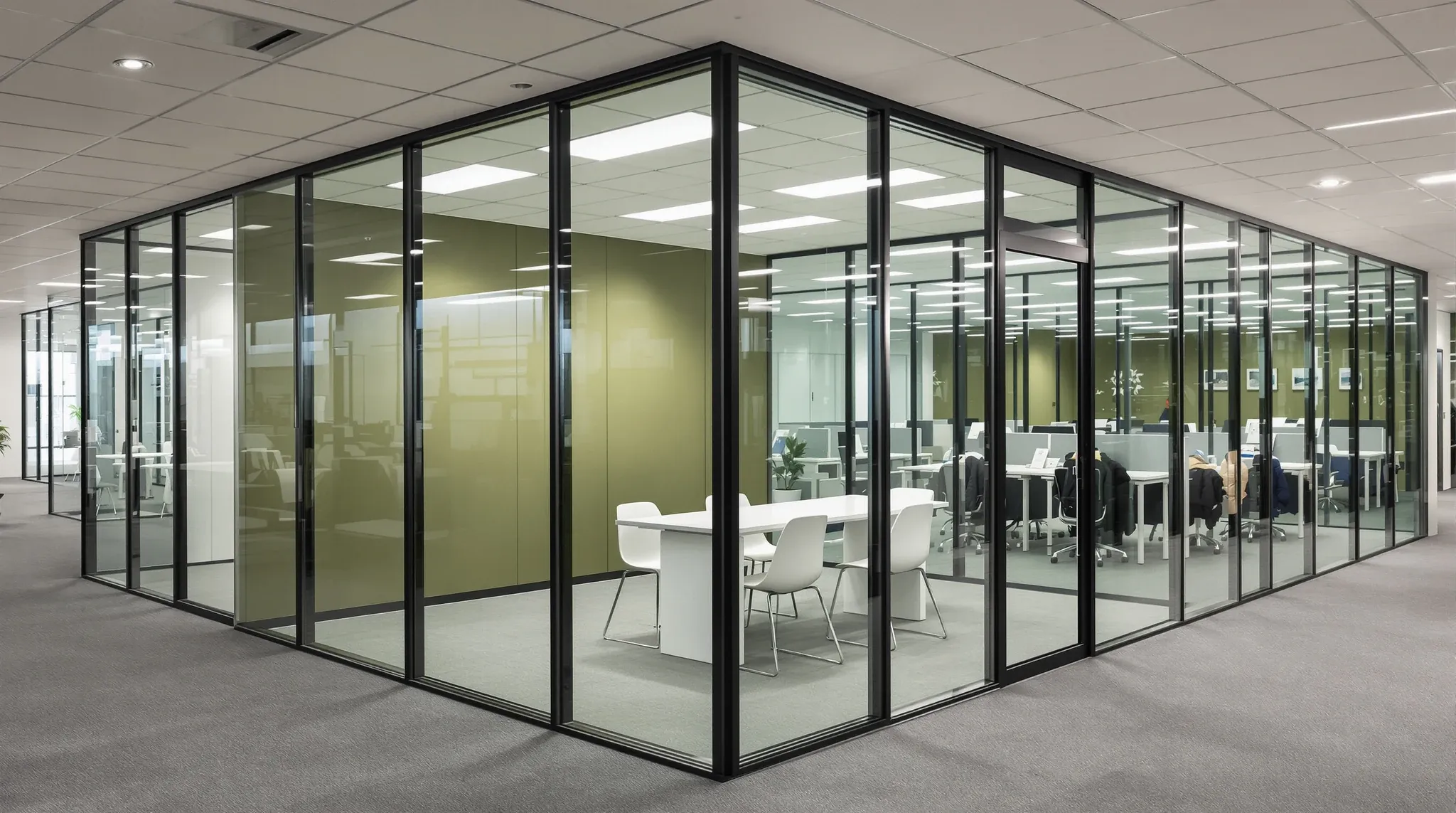
On a floor plan, a glass meeting room with one glazed wall and a glass meeting room with four glazed walls look like variations of the same idea. In practice, they behave so differently that they might as well be different products. A glass wall, one face of a room that is otherwise bounded by solid construction, performs as part of a system where the solid walls do the heavy acoustic and thermal work and the glass provides openness and light on the face where it is most valuable. A glass box, a room enclosed entirely or predominantly in glass, carries the full burden of acoustic isolation, thermal management, and visual privacy on a material that was never designed to do all three simultaneously. The distinction matters because the choice between a glass wall and a glass box determines whether the room works the way people expect it to, not just on the day it opens but every day after.
Most offices benefit from glass. Fewer benefit from glass boxes. Understanding why helps businesses avoid spending more for a room that performs worse.
What Makes a Glass Wall Different From a Glass Box
A glass wall is typically one face of a room, usually the front wall that faces the corridor, the open-plan area, or the reception. The remaining walls are plasterboard, which provides mass, cavity insulation, and acoustic absorption that glass cannot match. The glass delivers visual transparency and light transfer where people see it and benefit from it. The plasterboard delivers acoustic privacy and thermal stability where the room needs it. The two materials are working together, each doing what it does best.
A glass box replaces the plasterboard with more glass. Every wall is transparent, every surface is hard and reflective, and the room relies entirely on the glass to provide acoustic isolation, thermal performance, and visual character. There are no solid walls to absorb sound internally, no cavity construction to reduce transmission, and no opaque surfaces to provide visual relief. The glass is not supported by other materials. It is doing everything alone, and the limits of glass as a material become apparent in ways they never do when glass is combined with solid construction.
How Full Glass Enclosure Changes Room Behaviour
A room with four glass walls has different acoustic, thermal, and psychological characteristics than a room with one glass wall. Acoustically, the interior of a glass box is highly reverberant because all four walls are hard and reflective. Sound bounces between parallel glass surfaces rather than being absorbed, which makes conversations inside the room louder and harder to follow, particularly when multiple people are speaking. The acoustic discomfort inside the room often surprises tenants because they expected the glass to perform like a solid room with windows, when in reality it performs like a room made entirely of windows.
Thermally, a glass box accumulates heat faster than a partially glazed room because there are more glass surfaces transmitting radiant heat, less mass to buffer temperature fluctuations, and no insulated cavity construction to moderate heat flow. Offices designed for flexible use need rooms that maintain comfortable conditions across varied occupancy patterns, and glass boxes are the least tolerant of occupancy variation because their thermal response is fast: they heat up quickly when full and cool down quickly when empty, creating temperature swings that the mechanical system may not track smoothly.
The Visual Exposure Problem in Fully Glazed Rooms
Transparency is the purpose of glass, and in a glass box, transparency is total. Everyone outside the room can see everyone inside: who is in the meeting, what their body language communicates, whether the conversation looks tense or relaxed, and whether someone arrived late or left early. This level of visibility is acceptable in some contexts and deeply uncomfortable in others. Performance reviews, salary discussions, disciplinary meetings, sensitive client conversations, and personal phone calls all require a degree of visual discretion that a glass box does not provide.
The common remedy is frosting, film, or blinds applied to some or all of the glass surfaces. This works functionally but defeats the purpose of the glass. A frosted glass box provides neither the openness of clear glass nor the privacy of a solid wall. It occupies an uncomfortable middle ground where the room is translucent rather than transparent, which means light enters but visual connection is lost, and the business has paid for glass construction to achieve an outcome that plasterboard with a sidelight would have delivered at lower cost with better acoustic performance.
A room with one glass wall avoids this problem because the glass face can remain clear, providing genuine transparency and light, while the solid walls provide visual privacy from the sides and rear. The occupants are visible from the front but not exposed from every angle, which creates the openness that glass is valued for without the fishbowl effect that glass boxes produce.
Why Glass Boxes Are Harder to Cool and Ventilate
Glass transmits radiant heat more readily than plasterboard, and a room with four glass walls has four times the glass area of a room with one glass wall. The thermal load on the air conditioning system is correspondingly higher, and the room’s temperature is more sensitive to occupancy changes because there is less thermal mass to buffer the heat generated by bodies, laptops, and lighting.
Ventilation is also more challenging because the room is fully sealed by glass, which means the return air strategy needs to be designed specifically for the enclosed volume rather than relying on the passive air paths that partially open rooms can use. A room with one glass wall and three plasterboard walls can incorporate a transfer grille through one of the solid walls, providing a return air path without compromising the glass face. A glass box has no solid walls to route the transfer through, which means the return air must come through the ceiling, through a dedicated duct, or through the door assembly, each of which adds complexity and cost that the single-wall configuration avoids.
Acoustic Challenges Multiply With Every Glass Face
Sound transmission through a glass partition occurs across the full area of the glass. A room with one glass wall has one transmission path. A room with four glass walls has four, and each path transmits sound independently into the surrounding spaces. The room’s overall acoustic isolation is determined by its weakest element, and with four glass faces, the total sound leakage is the sum of all four rather than just one.
The way partitions shape how people work goes beyond acoustic numbers. People in adjacent desks can hear more from a glass box than from a glass-fronted room because the sound escapes in every direction rather than primarily through one face. The glass box radiates sound into the surrounding office like a speaker, while the glass-walled room directs most of its sound leakage through the single glass face, which can be managed with layout buffers and corridor separation.
Inside the room, the reverberation from four hard parallel surfaces makes the acoustic environment less comfortable than a room with at least one absorptive wall. Conversations are harder to follow, people speak louder to compensate, and the louder speech increases the sound transmitted through the glass to the spaces outside. The cycle reinforces itself, and the room earns a reputation as the meeting room where you can hear everything, which reduces its usefulness for any conversation that needs privacy.
How People Use Glass Boxes Differently From Glass-Walled Rooms
Behavioural research and practical observation consistently show that people use fully glazed rooms differently from partially glazed rooms. Glass boxes are used for shorter meetings because the visual exposure and the acoustic discomfort both encourage people to finish quickly. They are avoided for sensitive conversations because the visual transparency makes discretion impossible. They are often booked but used with the door open because the thermal and acoustic conditions with the door closed are less comfortable than the open-plan environment outside.
Over time, glass boxes that were designed as premium meeting rooms transition to informal use: quick stand-ups, phone calls, or overflow space. The room’s actual utilisation pattern diverges from its designed purpose, and the investment in full glass enclosure delivers less value than a more modest room that is used confidently for its intended function. Professional services offices are particularly sensitive to this dynamic because their meeting rooms host client interactions where comfort, privacy, and confidence all affect the business relationship.
Where Glass Boxes Work and Where They Create Problems
Glass boxes work well when the room is designed specifically for the conditions that full glass enclosure creates and the business accepts those conditions deliberately. A phone booth or a one-to-two person focus pod that is used for brief, individual tasks can work as a glass box because the occupancy is low, the duration is short, and the thermal and acoustic demands are modest. A leadership office that is positioned in a low-traffic area and supported by dedicated air conditioning can work as a glass box because the visual exposure is controlled by the location and the services are designed for the enclosure.
Glass boxes create problems when they are used for larger meetings in standard office locations without the services, layout, and acoustic design to support full glass enclosure. A six-person meeting room built as a glass box in the centre of an open-plan floor is the configuration most likely to produce complaints about noise, temperature, visual exposure, and utilisation. The same room with one glass wall facing the corridor and three plasterboard walls would deliver better acoustics, better thermal comfort, equivalent visual connection from the primary sightline, and lower cost.
The decision between glass walls and glass boxes should be based on what the room needs to achieve functionally, not on how much glass the budget can afford. More glass is not necessarily better glass. It is simply more glass, and in many cases less glass, used strategically, delivers a better room.
We deliver glass partition projects where the level of glass enclosure is matched to how each room is actually used. If you want glass rooms that people use confidently rather than avoid quietly, we can help.
📞 Call us on 1300 60 93 93