
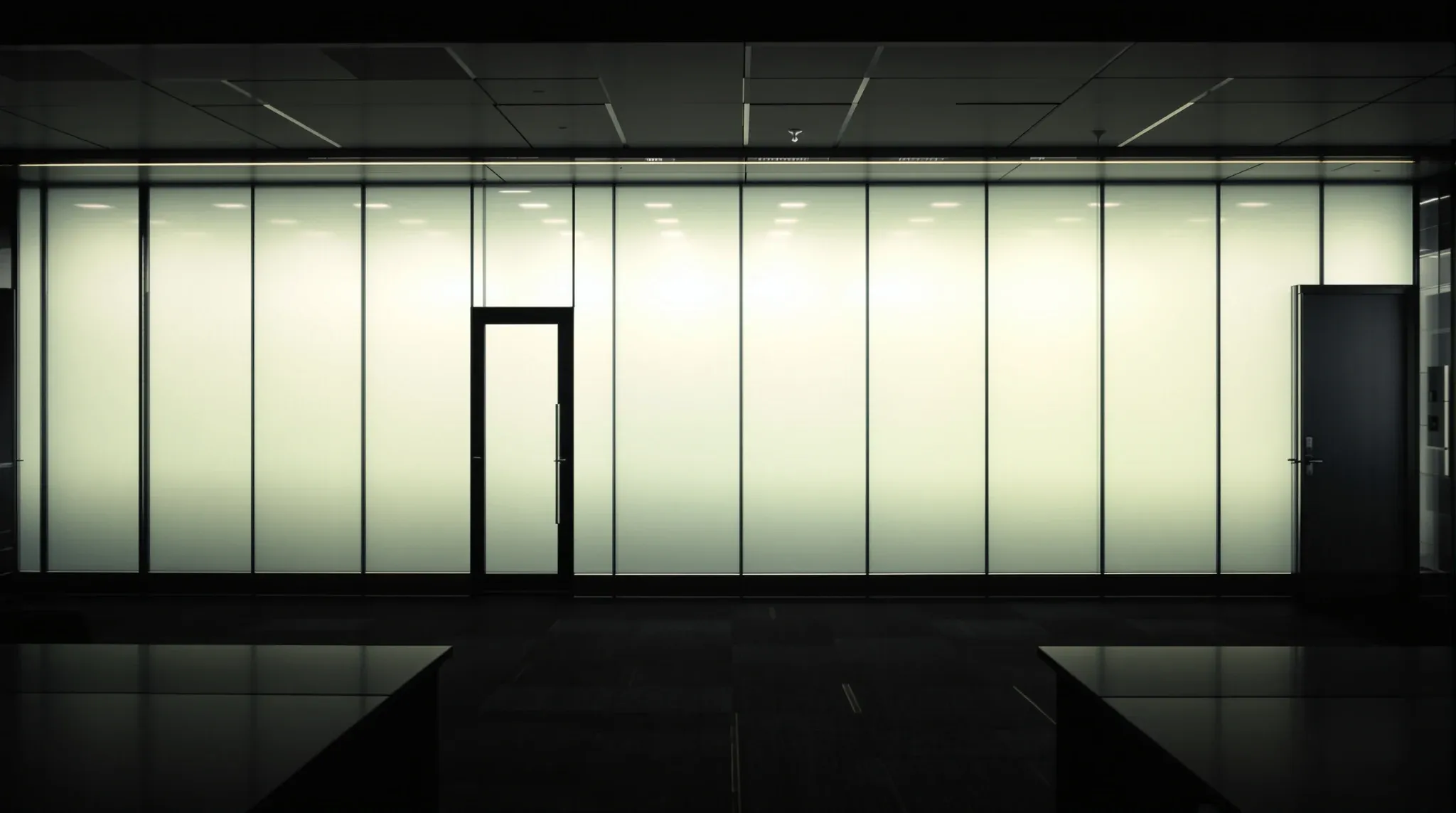
Switchable glass does one thing no other partition can: it flips from clear to opaque on command. That capability is impressive, and in two specific rooms it earns its premium. Almost everywhere else, the product disappoints the fit-out budget it was meant to elevate. The commercial question is not whether switchable glass is a good idea. It is whether the room being considered is one of the two rooms where the numbers land, or one of the many rooms where they do not.
The spend on switchable glass tends to get signed off on the strength of a product demonstration and a client-facing meeting room shortlist. Both are the wrong filters. The product is being evaluated as a feature. It should be evaluated as a piece of infrastructure with a decade-long cost, a maintenance path, a warranty window that is shorter than most leases, and a usage pattern that has to line up with how people run rooms in practice. When those questions are asked in order, the answer tends to isolate to a handful of rooms rather than to a general specification line across the tenancy.
How switchable glass is being sold, and the assumption behind the pitch
The sales pitch is easy to follow. The panel is clear when the room is open, opaque when the room needs privacy, and flips between states on a wall switch or a mobile app. In a showroom, that is an undeniable party trick. The implied offer is that the tenant gets a wall of light and a wall of privacy from the same piece of glass, depending on the moment. On paper, every executive office, boardroom, and meeting room in the tenancy is a candidate for it.
The assumption the pitch rests on is that switching behaviour inside a working building will resemble switching behaviour in the showroom. In the showroom, someone flips the state every thirty seconds. In a working building, the state gets flipped at the start of a meeting, if it gets flipped at all, and the room tends to settle into whichever setting the last user left behind. The gap between showroom behaviour and workplace behaviour is the single biggest reason switchable glass underdelivers as a general specification, and it is rarely the thing the specification is tested against before the commitment is made.
The price premium, unpacked
The headline price per square metre of switchable glass runs several times higher than standard double-glazed frameless glass. That number is only the first layer. Behind it sits the switchgear, the transformer, the cabling run from the partition back to a control point, the integration with any smart lighting or BMS systems where those are in scope, and the coordination time with the electrical trade so that the cable pathways are ready when the panels arrive. None of that electrical work is priced on a partition line in a normal fit-out quote, and none of it is inside the partition installer’s standard scope.
Warranty is the price layer tenants miss most consistently. Most switchable glass warranties land below the length of a typical Australian commercial lease, which means the tenant carries some of the lifecycle risk from around year five onwards. Replacement is not a glazier’s job by itself. It is an electrical and glazing job, and the room has to come out of service while the panel is swapped. On an infrastructure view, the honest cost of switchable glass is not the day-one installed price. It is the day-one price, plus a provision for replacement of at least one panel during the lease, plus a provision for electrical service calls, plus the downtime those service calls impose on the rooms they affect.
Electrical and control: it stops being just glass
A switchable glass panel is a glazing element and a piece of low-voltage electrical infrastructure at the same time. That changes how it has to be installed, maintained, and eventually decommissioned. Standard frameless glass needs a glazier on site for an hour or two to replace a damaged pane. A switchable glass panel needs an electrician and a glazier together, because the wiring has to be disconnected before the panel comes out and reconnected when it is replaced. Tenants used to thinking of partitions as passive elements find the repair and service path slower and more expensive than they budgeted for.
Control is the other part of the electrical story. Some rooms use a simple wall switch. Others integrate the panel with room booking systems, with BMS events, or with presence detection that sets the state based on who is in the room. Each additional layer of control adds hardware, wiring, programming, commissioning, and long-term maintenance. None of these decisions are unreasonable on their own, but each one moves the partition further from the simple glass element the original brief described, and further from the commercial logic that sat behind the brief.
How the product ages, and what a failed panel looks like
Switchable glass is an electro-mechanical product inside a sheet of glass, and like any electrical product it ages. The common ageing patterns are cosmetic rather than catastrophic: the clear state stops looking perfectly clear, the opaque state develops faint banding or patches, the response to the switch becomes slightly less uniform. None of those break the product. All of them break the premium feel that the premium price was bought for, which is a meaningful failure on a showcase installation.
The harder failure modes are electrical. A transformer failure takes the panel out entirely until it is replaced. A wiring fault upstream of the panel can strand it in the opaque state, which is the state it defaults to when power is not connected. Neither is common, but both are the kind of fault that a tenant only notices when the room is needed for its intended use, and the repair path is not quick. The switching lifespan of the panels themselves is finite and counted in cycles rather than years. In a high-use training room, a panel can reach its rated lifespan before the lease does, at which point the replacement conversation starts in earnest.
Who switches it, and how often
The most underestimated question at the briefing stage is who toggles the glass in daily operation, and how often. The product only delivers value when it is being switched deliberately. In most offices, meeting rooms are used back to back, the person walking in inherits whatever state the previous user left behind, and adjusting the glass is a step that only gets taken if someone remembers and cares. Over a few weeks, teams settle into leaving the panel in whichever state causes the least friction, and the switching feature drops out of daily use altogether.
Either the room becomes “usually private”, in which case the glass sits opaque through the day and behaves like a permanently frosted partition, or the room becomes “usually open”, in which case it sits clear through the day and behaves like a standard clear partition. Either way, the switching feature stops earning the premium it was bought for. The rooms where the product holds its value are the ones where a deliberate, attended state change is part of how the room is used, and those rooms are rarer in a typical tenancy than the original specification assumed.
What switchable glass does not solve: the acoustic reality
Turning a pane of glass opaque does not change how it handles sound. Switchable glass is acoustically a pane of glass, and the level of acoustic privacy a glass partition can deliver depends on the thickness, seals, door, and junction detailing, not on the opacity. A room that goes private visually with the flip of a switch still lets voices through the door head and through any acoustic gaps around the partition if those were not specifically designed for.
That matters because the rooms where switchable glass is most often pitched, boardrooms, executive offices, confidential meeting rooms, are exactly the rooms that need meaningful acoustic privacy. A tenant specifying switchable in the expectation that it will solve the privacy problem is solving only the visible half of it. The audible half still needs double glazing where appropriate, acoustic seals, an acoustic door, and correct junction detailing. Once those layers are added on top of the switchable specification, the budget for one room can land higher than a properly specified conventional boardroom with a traditional blind and no switchable glass at all.
Where the spend actually lands, and where it quietly does not
Switchable glass earns its price in a small set of conditions that have to hold at once. The room is used occasionally rather than daily. Each use involves a deliberate switch that is part of the experience of the meeting rather than an admin chore at the start of it. The visual impact of the transition is doing marketing or client-facing work that a cheaper alternative cannot match. And the acoustic question has been solved separately through the other layers of the partition, so the switchable element is adding privacy theatre on top of a room that is already acoustically sound.
Boardrooms in client-facing businesses are the main room type where all of those conditions line up. A client boardroom used for a small number of meetings a month benefits from the theatrical state change at the moment the meeting begins. The use pattern suits the switching lifespan. The visual impact contributes to a brand moment the tenant is already paying for elsewhere in the reception and foyer finishes. In that room, switchable glass earns its price. A reception feature wall is the other place it lands, not as a privacy product but as a brand element that happens to change state a few times a day.
Everywhere else, the product underperforms the money. Standard meeting rooms running back to back rarely recover the cost. Training rooms age the panels faster than the ROI can catch up with. Open-plan zones do not have the room-level use case at all. For most privacy-versus-daylight problems in an office, a partial frost band at seated head height, a composite system with a solid base and glass above, or a blind set properly into the glass system delivers more usable privacy for a fraction of the cost. A well-specified double-glazed glass partition with a good blind setup is the benchmark switchable glass is actually competing against in most rooms, and the comparison rarely favours the switchable panel.
If you are considering switchable glass for a boardroom, a feature wall, or a specific room where the theatrical state change is part of the experience, we can help you work through whether the ten-year cost lands on the right side of the decision for your tenancy. Where switchable sits inside a broader glass scope, we handle it together with the rest of the partition package through our glass partition delivery, so the switchable element is coordinated with the rest of the fit-out rather than bolted onto it afterwards.
📞 Call us on 1300 60 93 93