
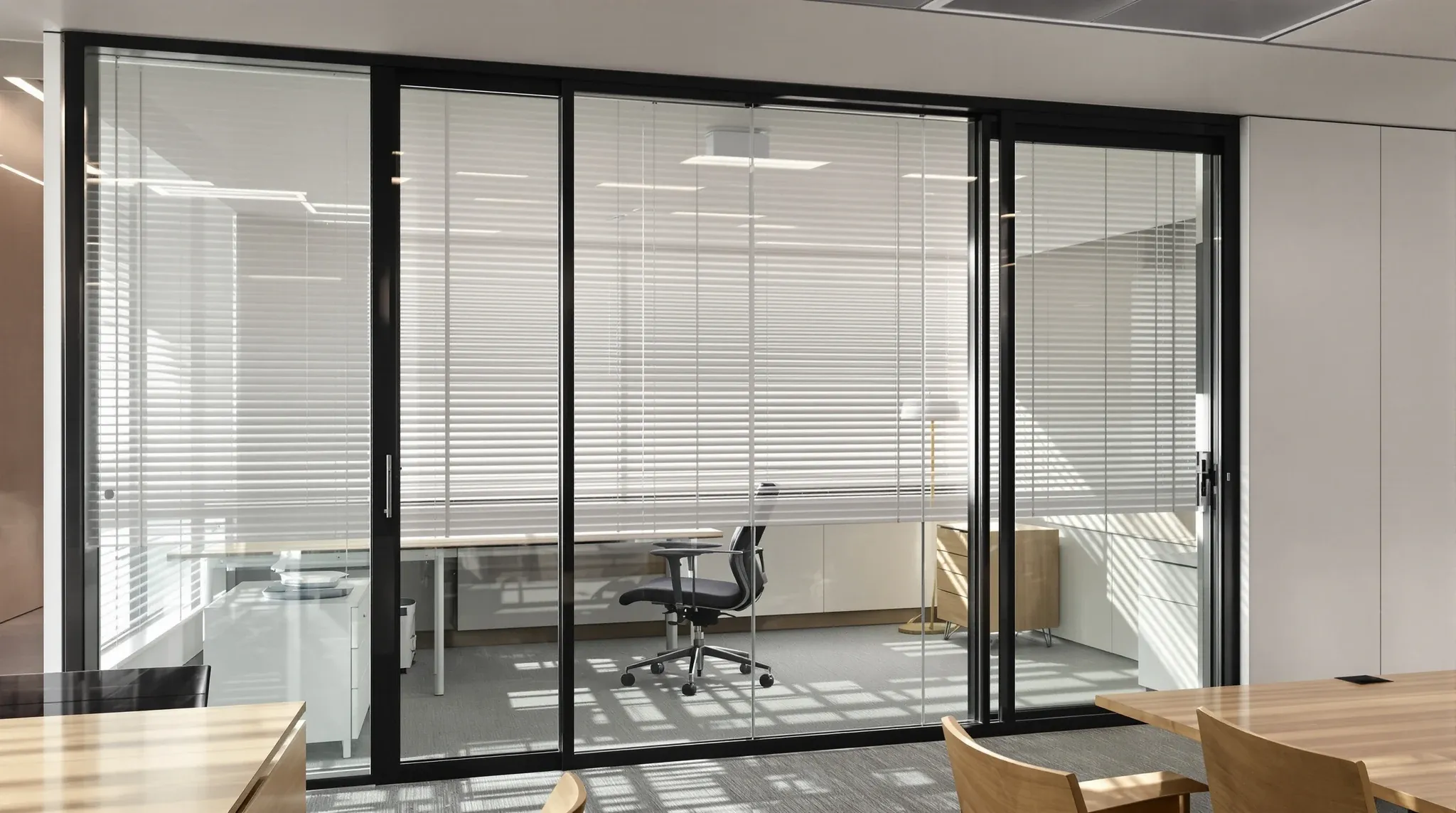
Blinds are one of the most requested additions to glass partitions in commercial offices, and for good reason. Glass delivers transparency and natural light, but without some form of visual control, meeting rooms and private offices can feel exposed. The challenge is that adding blinds to a glass partition system is not acoustically neutral. Depending on the blind type, how it is mounted, and where it sits relative to the glass, it can either leave the acoustic performance unchanged or quietly undermine it.
The decision to include blinds usually comes from a practical need for visual privacy during sensitive meetings, reducing screen glare, or simply giving occupants a sense of control over their environment. None of those objectives conflict with acoustic performance on their own. The conflict arises in the detail of how the blind is integrated, because some mounting methods introduce gaps that did not exist before, while others compress or displace seals that were doing acoustic work the tenant never noticed.
Why Blinds Change the Acoustic Equation
A glass partition achieves its acoustic rating as a sealed system. The glass panel, the framing, the door seals, and the junctions at the ceiling and floor all work together to block sound. When a blind system is added, it introduces new hardware, new penetrations, and sometimes new gaps into that sealed envelope. Even a small change to the perimeter seal or a new channel cut into the frame for a blind track can reduce the effective acoustic performance of the partition.
The effect is not dramatic in most cases, but it can be enough to shift a room from adequate speech privacy to noticeable voice transfer. In a meeting room where the glass system was already performing at the lower end of what the occupants need, a few decibels of degradation from a poorly integrated blind system can tip the balance. The occupants will not know that the blinds caused the problem. They will simply perceive the room as acoustically poor.
What makes this issue difficult to diagnose after the fact is that the acoustic degradation from blind integration is rarely tested in isolation. The blinds go in, the room is used, and if there are noise complaints, the assumption is that the glass specification was wrong rather than that the blind installation compromised the system. Understanding how different blind types interact with the acoustic envelope helps avoid this outcome.
Integrated Blinds vs Externally Mounted Systems
Integrated blinds, sometimes called blinds-between-glass, sit inside a sealed double-glazed unit. The blind mechanism is enclosed between the two glass panes, operated by a magnetic or mechanical control on the outside of the unit. Because the blind is sealed within the glazing unit itself, it has no effect on the acoustic seal of the partition. The glass faces remain intact, the perimeter seals are unmodified, and the blind mechanism does not create any new penetrations.
This makes integrated blinds the safest option from an acoustic perspective. They add visual control without touching the acoustic envelope. The trade-off is cost. Integrated blind units are substantially more expensive than externally mounted blinds, and they require the glass specification to be a double-glazed unit from the outset. Retrofitting integrated blinds into an existing single-glazed partition is not possible without replacing the glass entirely.
Externally mounted blinds, which include roller blinds, venetian blinds, and panel blinds mounted on the room side of the glass, are the more common and more affordable option. These systems are fixed to the glass frame, the adjacent wall, or a head track above the partition. They work well for visual privacy and light control, but their mounting method and the hardware they introduce can affect the acoustic seal if not detailed carefully.
How Venetian Blinds Affect Sound Transmission
Venetian blinds mounted on the inside face of a glass partition have a minimal direct effect on sound transmission through the glass panel itself. The blind slats are too light and too widely spaced to absorb or block meaningful sound energy. Their effect on acoustics is indirect, through the mounting system rather than the slats.
The acoustic risk with venetian blinds comes from the head rail mounting. If the head rail is fixed directly to the partition frame using screws that penetrate the framing profile, those screw holes can compromise the acoustic seal at the head of the partition. In systems where the frame relies on a continuous gasket or sealant line to maintain its acoustic rating, even small penetrations can allow sound to bypass the glass through the frame rather than through the panel.
The other consideration is the tilt and lift mechanism. Cord-operated and wand-operated venetians are mechanically simple and do not require any modification to the partition frame beyond the head rail fixing. Motorised venetians, which are increasingly popular in commercial-grade glass partition systems, require wiring that passes through or behind the frame. If that wiring route introduces a new penetration in the acoustic seal, the performance of the partition can be affected. Routing the wiring outside the acoustic envelope, through the ceiling void or behind the adjacent bulkhead, avoids this issue entirely.
Roller Blinds and Acoustic Film Alternatives
Roller blinds are the most commonly specified blind type for glass partitions in Sydney offices, largely because they are clean, simple, and relatively inexpensive. A roller blind mounted on the room side of the glass provides full visual privacy when lowered and disappears into a compact cassette when not in use. From an acoustic perspective, the roller fabric itself has negligible effect on sound transmission, but the cassette and bracket mounting can introduce issues.
The cassette housing is typically fixed to the partition head channel or to the ceiling directly above the glass. If fixed to the partition head channel, the brackets penetrate the frame in the same way as venetian head rails, with the same risk of compromising the acoustic seal. If fixed to the ceiling, the cassette is independent of the partition system and the acoustic seal remains intact. Ceiling-mounted roller blinds are the preferred approach where acoustic performance is a concern, because they keep all the blind hardware outside the partition’s acoustic envelope.
Acoustic film and frosting treatments applied directly to the glass offer an alternative approach to visual privacy that avoids the blind integration question altogether. These treatments are permanent rather than adjustable, which is a limitation, but they do not introduce any new hardware, penetrations, or gaps. For rooms where the privacy requirement is constant rather than occasional, film or frosting can be a simpler solution that eliminates the acoustic risk entirely.
The Seal Problem When Blinds Are Added After Installation
The most common scenario for acoustic problems with blinds is retrofit installation after the partition is already in place. When blinds are added during the original fitout, the partition installer can coordinate the mounting method to avoid compromising the acoustic seal. When blinds are added later, often by a separate blind supplier who is not aware of the partition’s acoustic detailing, the risk of accidental seal damage increases.
A blind installer drilling into a partition frame to mount a bracket will not necessarily know that the frame contains an acoustic gasket or that the screw penetration creates a flanking path for sound. The bracket goes in, the blind works perfectly, and the acoustic performance of the room degrades without anyone making the connection. This is particularly common in offices where blinds are specified as a tenant fitout item rather than part of the base partition installation.
The practical way to avoid this is to specify the blind type and mounting method at the same time as the partition system, even if the blinds themselves are not installed until later. This allows the partition installer to pre-provision for the blind mounting, either by providing dedicated fixing points that do not penetrate the acoustic seal or by leaving clearance for a ceiling-mounted system. Maintaining the integrity of glass partition systems over time requires this kind of forward thinking, because retrofitted additions are where most of the damage is done.
Balancing Privacy, Light Control, and Acoustic Performance
The reason blinds are so popular in glass offices is that they solve two problems at once: they provide visual privacy on demand and they reduce glare from sunlight or adjacent artificial lighting. The occupant can close the blinds for a confidential meeting and open them again afterwards, which gives the room more versatility than a permanently frosted panel. The acoustic dimension adds a third consideration to what is already a balance between privacy and openness.
In practice, the acoustic performance of a well-sealed glass partition with properly mounted blinds should be almost identical to the same partition without blinds. The issue is not that blinds inherently degrade performance. It is that poor integration creates new weak points in a system that was acoustically functional without them. Getting the balance right means choosing a blind type and mounting method that delivers the privacy and light control the occupants need without introducing gaps or penetrations that undermine the acoustic seal.
For rooms where privacy is needed only occasionally, roller blinds ceiling-mounted outside the partition envelope are typically the best option. For rooms where privacy is required most of the time and acoustic performance is critical, reconsidering whether glass is the right partition type at all may be the more honest conversation to have. A plasterboard room with a glazed sidelight or vision panel can deliver both visual connection and high acoustic performance without needing blinds to compensate for the transparency.
Getting Blind Specification Right at the Design Stage
The most reliable way to integrate blinds into glass partitions without acoustic compromise is to make the decision early. If blinds are part of the brief, the partition system can be specified to accommodate them from the outset. That means selecting a frame profile that allows ceiling-mounted or integrated blind systems, pre-provisioning wiring routes for motorised options, and ensuring that the blind installer works from the same acoustic detail as the partition installer.
When blinds are left as an afterthought, the partition system is designed and installed as a sealed acoustic unit, and then someone adds hardware to it that was never part of the original specification. The result is not always an acoustic problem, but it introduces a risk that could have been avoided entirely with earlier coordination.
For offices where multiple rooms will have different blind requirements, mapping out which rooms need blinds, which need permanent frosting, and which can remain clear at the start of the fitout design process saves time and money. It also ensures that the acoustic performance of each room is designed as a complete system rather than assembled from separate decisions made at different stages by different trades.
If you are specifying glass partitions and need to include blinds without compromising acoustic performance, we can help coordinate the partition and blind systems so both work as intended from day one.
Call us on 1300 60 93 93