
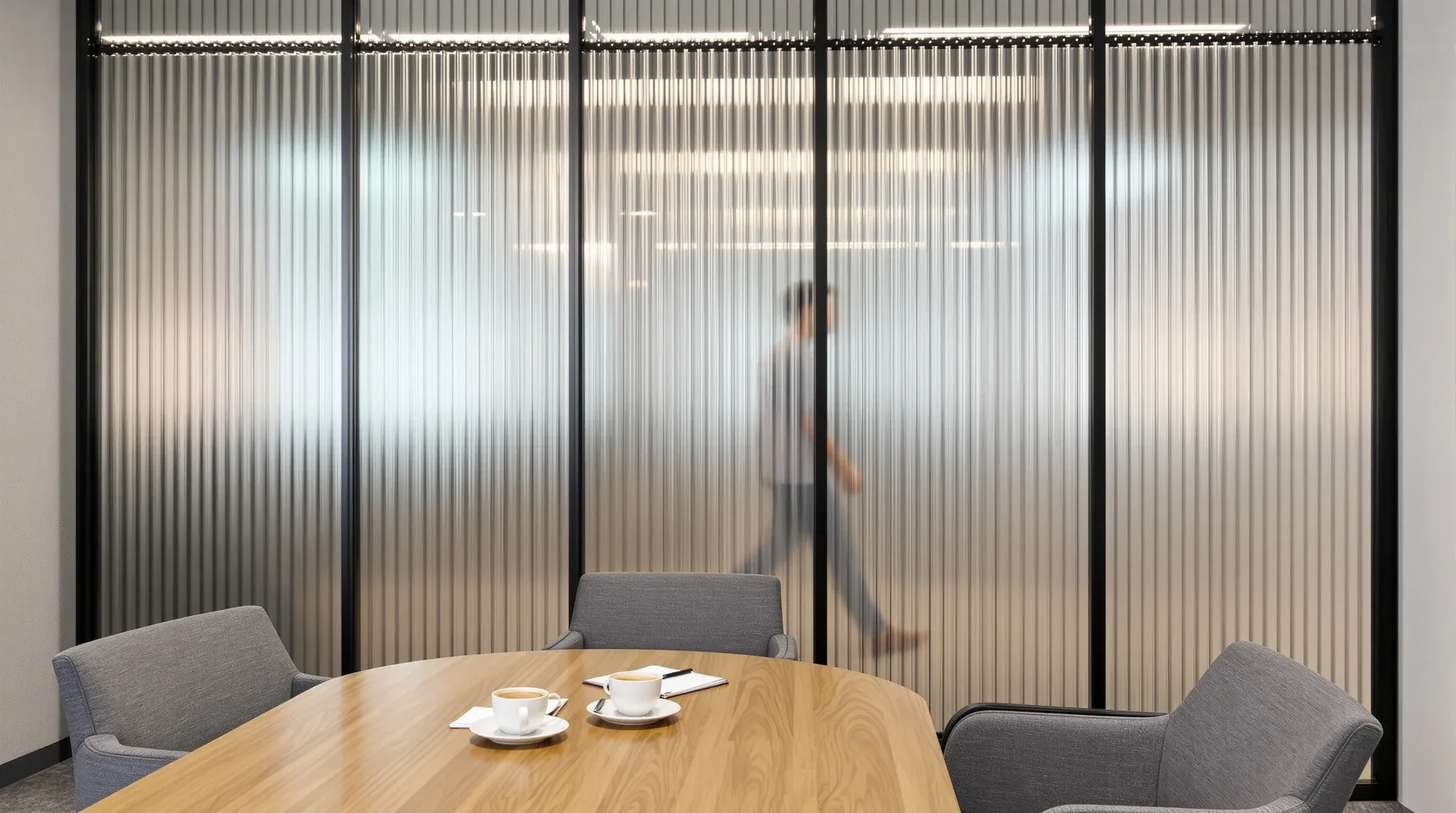
A reeded glass partition uses toughened glass with fine parallel ribs rolled into one face. The ribs bend the light passing through, so the room stays bright while faces, screens and desk clutter on the other side break up into soft vertical bands. That makes it a good fit for meeting rooms, offices and reception fronts that need to feel enclosed without closing off the floor.
What changes the build is the glass itself. Reeded glass comes in fewer thicknesses than clear glass, the pattern runs in one direction, and one face is ribbed instead of flat. Between them they decide the partition system, the panel layout and the edge details, so we settle them with the glass supplier before anything is ordered.
What Reeded and Fluted Glass Are
Reeded glass is a patterned glass. Hot glass passes between rollers with the pattern cut into them, and the texture is pressed into the surface as the sheet forms. Nothing is printed or applied, so the ribs are part of the glass and do not wear away.
Reeded and fluted describe the same idea at different scales. Reeded usually means narrow, closely spaced ribs with a finer texture, while fluted usually means wider, rounder channels that read more strongly from across the room. Suppliers use the terms loosely, so we confirm the actual product name and rib spacing on the drawing instead of relying on the word.
Most reeded glass is textured on one face and flat on the other. It can be toughened to meet safety glass requirements, and some products are also offered laminated or made into a double glazed unit. That puts reeded glass in the wider group of patterned glass options for office partitions, with the difference that its effect comes from the shape of the glass itself.
How Much a Reeded Partition Hides
Reeded glass softens a view without hiding it completely. From a few metres back, people inside a room read as colour and movement. Someone standing close to the glass is easier to make out as a silhouette, and strong light behind them sharpens that outline further.
The blur is also directional. Vertical ribs smear shapes sideways, so a person walking along a corridor stays visible as movement while their face and screen do not. For a meeting room off a busy floor, that level of screening often suits the brief, because people outside can still see the room is in use.
The ribs are a visual treatment and are not an acoustic one. Speech privacy in a glazed room comes from the glazing build-up, the seals and the door, and reeded glass changes none of those on its own. Where a room hosts sensitive conversations, the same limits apply as for any glass partitions for confidential meetings, whether the glass is reeded or clear.
Thickness Decides Framed or Frameless
The first thing we check is which thicknesses the chosen pattern comes in. Clear toughened glass is readily available in the heavier thicknesses frameless partitions use, while many reeded patterns are made in thinner sheets. One major Australian glass manufacturer lists its narrow reeded pattern in 6 mm only and notes it is not recommended for frameless applications.
Some suppliers do offer reeded glass in 10 mm, which makes frameless and semi-frameless systems worth checking with the system supplier. Sheet sizes vary by product and thickness, and the ribs run along one direction of the sheet, so the largest panel available can be smaller than the room height and module the design assumed. That choice between aluminium framed and frameless systems often gets made by the glass supply before anyone weighs up the look.
When we price glass partitions with reeded panels, we confirm the product, thickness, maximum sheet size and toughening lead time with the supplier first, then choose the partition system around it. Lead times depend on stock and processing, and a specialty pattern can take longer than clear glass, so the order date is set early in the programme.
Rib Direction and Panel Set-Out
The pattern is directional, so every panel has to be cut with the ribs running the same way. Vertical ribs are the usual choice because they suit tall panels and draw the eye upward. Horizontal ribs change the character of the wall and turn the sheet sideways, which can limit how tall a panel can be.
Across a run of panels, the ribs should look continuous. The panel joins are set out on the drawings so each junction lands cleanly, and a narrow offcut panel at the end of a run is avoided where the module allows. On a long reception front or boardroom wall, this set-out is what makes the glass read as one surface.
Doors need the same thought. A clear door in a reeded wall stands out as the one place people can see straight through, so we usually carry the reeded glass into the door leaf. The door glass then has to come in a thickness the door system and hardware accept, which we confirm with the frame and hardware suppliers before the door is ordered.
Sealing a Ribbed Face in the Frame
A flat pane sits evenly against a gasket or a bead of silicone along its full edge. A ribbed face presents a wavy profile to the frame instead, so the glazing channel and seal have to be checked against the real shape of the edge. Some suppliers also nominate reeded glass thickness at the thinner part of the rib, so the glass at the peaks is thicker than the number on the order.
We work these details out with the supplier and the frame system before fabrication. That covers which face goes into the channel, the gasket or wedge that suits the real profile, and whether the edge is sealed with silicone instead. The same principles apply as for any glass partition corner and junction detail, with the extra step of checking each junction against a textured face.
Where two reeded panels meet in a butt joint, the ribs on each side need to line up and the joint has to seal across a textured edge. We mark the rib alignment on the shop drawings so the panels arrive cut to match and the joint closes neatly on site.
Marking the Glass for Visibility
Clear glass walls usually need a visible marking band so people do not walk into them. The glazing standard recognises that some glass is already made visible by its framing or by a decorative treatment such as patterning. A strongly textured reeded panel may therefore meet the visibility intent without an applied band, depending on the building.
That outcome is not automatic. Pattern strength, the room's lighting and any accessibility provisions that apply to the building all affect it, and some buildings call for a contrasting band regardless of the glass. We confirm the approach with the certifier at design stage. Where a band is still needed, it follows the same manifestation rules for glass partitions as a clear wall, and we set its height and finish so it sits comfortably against the ribs.
Real Reeded Glass or Reeded Film
A reeded film is printed or embossed to mimic ribs and is applied to a flat pane. It costs a fraction of real reeded glass, can be installed quickly on existing partitions and can be removed later. For a tenant refreshing a floor of clear glass partitions, film gives a reeded look with no glazing works at all.
Real reeded glass gets its effect from its shape. The ribs refract light through the pane and the view shifts as you walk past, which good film imitates closely at a glance. The difference is that the texture cannot peel or lift at the edges, and it stays in place for the life of the partition.
The trade-off also shows up at the end of the lease. Film can usually be removed during make good, while reeded glass is a permanent part of the wall. For partitions expected to stay through more than one lease, that permanence weighs the same way it does when comparing frosting, film and digital print on clear glass.
There is a middle path on an existing floor. Where the partition frames are sound and their glazing channels accept the thickness of the reeded glass, selected panels can be swapped for reeded glass without replacing the frames. We check the frame system and the channel size on site before pricing that option, because a thicker or textured pane will not suit every frame.
Cleaning and Where It Suits on a Floor
The channels in reeded glass collect dust and cleaning residue, and a quick wipe across the ribs leaves marks sitting in the grooves. Cleaners work along the grooves with a microfibre cloth and a mild cleaner instead. On a meeting room front this is minor, while on a busy entry touched at hand height it adds to the cleaning routine.
Reeded glass works best where a room needs softened sightlines and daylight together. Meeting rooms off open floors, private offices along a corridor and reception fronts are the usual places, often paired with clear glass on the rooms that need no screening. Where the brief is full confidentiality, strong acoustic separation or the lowest possible cost, a solid wall, an acoustic glazing build-up or a film on clear glass is usually the better fit.
When a floor mixes reeded and clear glass, we keep the reeded panels to the rooms that need them. That keeps the pattern purposeful and limits the specialty glass order to where it does its job.
We price reeded glass and reeded film side by side for the same partition line, then confirm the glass thickness and rib set-out before we order and install it.
📞 Call us on 1300 60 93 93