
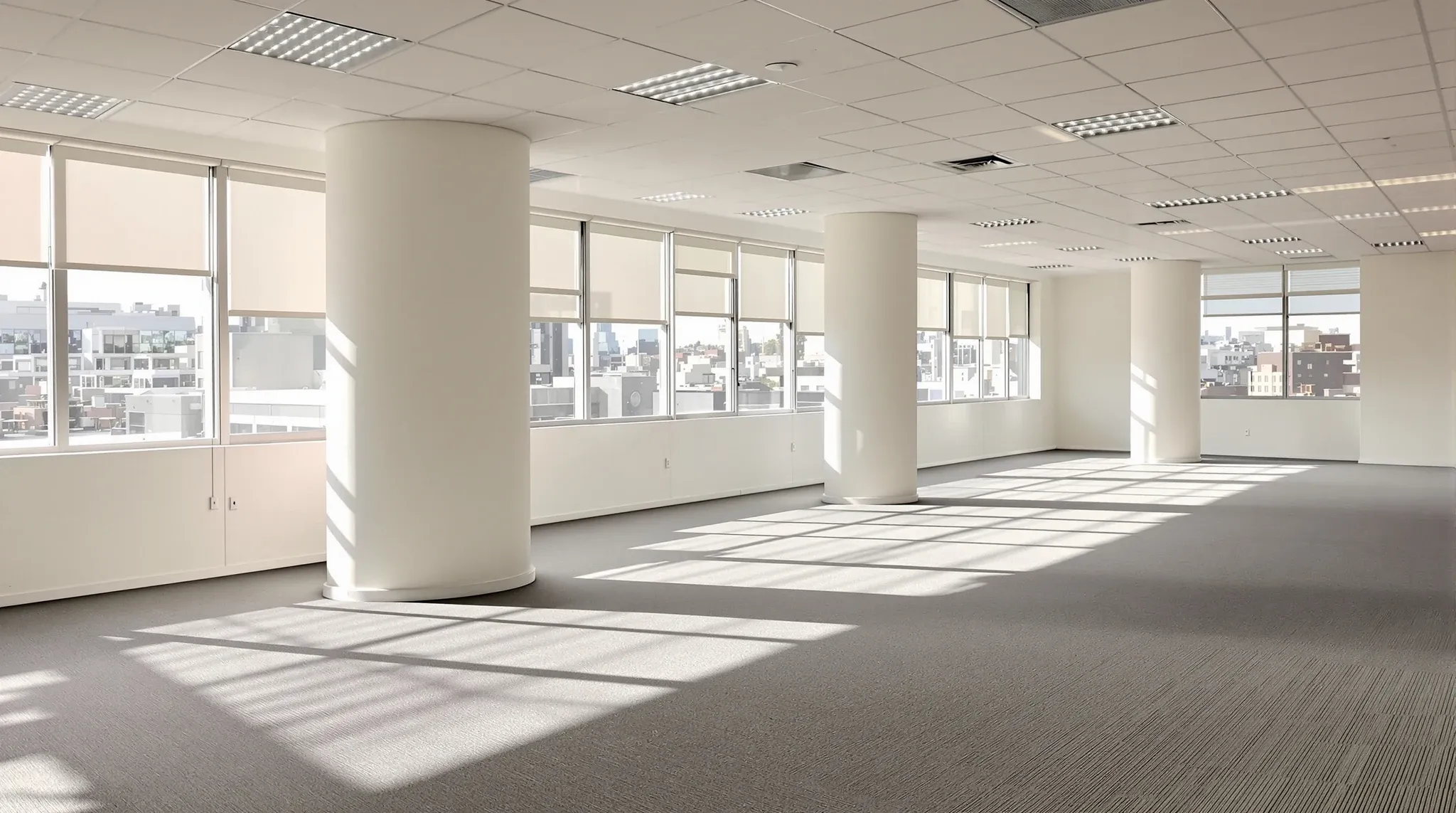
A floor that shows well leases faster, and the gap between a stripped tenancy and a lettable one is a defined package of make good and light refurbishment works. Getting the ceiling, the floor finish and the wall lines back to a neutral, presentable state is what a property manager is really buying.
When a tenant hands back a floor, the strip-out leaves it functional but rarely lettable. There are patched ceilings, marked walls, worn or mismatched flooring and the scars of where partitions stood. A property manager preparing the floor for the next tenant is buying the works that turn that raw handback into a space a prospective tenant can walk into and picture their own fitout in.
What the re-leasing works actually are
The package is a combination of make good completion and light refurbishment. Make good brings the floor back to the condition the lease required, and light refurbishment lifts it from merely compliant to genuinely presentable. The two overlap, but they are not the same: a floor can satisfy a make good obligation and still show poorly, and a property manager re-leasing it cares about how it shows.
The works typically cover the ceiling, the floor finish, the wall lines and the paint. The aim is a neutral, well-presented shell that a prospective tenant reads as ready, not as a problem to solve. This is the build-side of defit and make good, focused on the landlord’s outcome of a lettable floor rather than the outgoing tenant’s obligation. The distinction between getting a floor back to a baseline and lifting it for the market is the difference between make good and refurbishment, set out in office renovations versus make good works.
Assessing the floor the tenant handed back
The works start with an honest assessment of what the handback actually left. A property manager walks the floor and records the real condition: where the ceiling grid was patched or left incomplete, where the floor finish is worn or mismatched after partitions came out, where walls are marked or damaged, and what state the paint is in. That assessment is the basis of the scope.
The assessment also separates what is genuinely the outgoing tenant’s make good responsibility from what is the landlord’s refurbishment to make the floor lettable. Some of what shows poorly is the tenant’s to fix under the lease, and some is the wear that any floor carries that the landlord refreshes between tenancies. Drawing that line accurately decides who pays for what, and it leans on understanding what base building condition really means in practice. The condition the floor is actually in, not the condition it was meant to be in, is what the scope is built from.
It is worth doing this assessment before the outgoing tenant fully releases the floor, because some of what needs fixing is theirs to put right and is cheaper to capture while their make good is still in play. Once the tenant has gone and the bank guarantee is released, anything left becomes the landlord’s cost. A property manager who walks the floor with the tenant’s make good still open can have genuine defects rectified under that obligation, then scope only the discretionary refurbishment on top. Leaving the whole assessment until after handback quietly converts tenant obligations into landlord spend.
What lifts a floor from stripped to lettable
The works that make the difference are usually the visible surfaces. A fresh, consistent ceiling reads as cared-for, where a patchwork of old and new tiles reads as neglected. A clean, even floor finish lets a prospect imagine their layout, where worn carpet with partition scars draws the eye to the floor’s history. Neutral, freshly painted walls present as a blank canvas.
The ceiling is often the biggest single lift, because a tenant’s strip-out frequently leaves the grid patched around where walls and services were. Bringing it back to a clean, consistent finish is a defined piece of work, and whether it needs a full reinstatement or a patch is the judgement set out in ceiling reinstatement and the choice between rebuild and patch. The floor finish is the next, because nothing dates a tenancy faster than tired, mismatched flooring. A neutral repaint ties it together. None of this is heavy construction, but together it is what turns a handback into a floor that shows.
There is a judgement about how far to take the refurbishment, and it turns on what the floor will let for and how the building presents. A floor in a premium building competing for quality tenants justifies a fuller refresh than a floor in a secondary building where tenants expect to start from a basic shell and build their own fitout. The property manager who matches the spend to the market avoids both traps: over-refurbishing a floor whose tenants will strip it out anyway, and under-presenting a floor that has to compete on first impressions. Lighting is part of this read too, since a floor lit unevenly or with dated fittings looks tired regardless of how clean the ceiling and floor are.
The order the works run in
The sequence follows the surfaces from the top down. Any outstanding strip-out or make good completion happens first, so the floor is a clean shell before refurbishment starts. The ceiling is brought back next, because working on the ceiling after the floor is finished risks marking new flooring. Then the walls are repaired and painted, and the floor finish goes in last so it is not damaged by the work above it.
Running the works in this order keeps each trade working into a prepared surface and protects the finishes that go in last. It is the same logic as any fitout sequence, where the floor finish is protected until the messy work above is done, set out in the correct order to build an office fit-out. Doing it out of order, finishing the floor and then working on the ceiling above it, is how a property manager ends up paying to protect or redo a finish that was completed too early.
Because the floor is vacant, the sequence has none of the staging constraints that slow an occupied refurbishment, which is the one advantage of working between tenancies. The trades can run continuously without after-hours restrictions or zone-by-zone hoarding, so the works finish faster and cheaper than the same scope on a live floor. The property manager’s job is to use that clear run well by having the scope settled and the trades booked before the floor empties, so the works start the moment it does rather than after weeks of the floor sitting idle while the package is still being priced.
What the re-leasing package costs
The cost is driven by how far the handback fell short and how high the floor needs to present for its market. A floor handed back in good order with a sound ceiling and serviceable flooring needs little more than paint and a clean, while a floor stripped roughly with a patched ceiling and worn flooring needs a full refresh of every surface. The starting condition is the biggest single variable.
The ceiling and floor finish are the two largest lines, because they are the most visible and the most likely to need real work after a strip-out. Paint is modest by comparison. The cost drivers that move a make good number apply here too, and they are set out in commercial office make good cost drivers in Sydney. A property manager pricing the package weighs the spend against how fast and how well it helps the floor lease, because an underdone floor sits empty longer and a polished floor lets faster.
The cost of an empty floor sitting unlet is the figure that justifies the works in the first place. Every month a tired floor stays on the market is a month of lost rent, so a refurbishment that brings a tenant forward by even a few weeks often pays for itself against the holding cost. Reading the package as an investment against vacancy, rather than a pure expense, is what tells a property manager how much to spend and how quickly to get the works done.
Scoping the floor for the next tenant
The way to prepare a vacated floor well is to assess its real condition, separate the tenant’s make good from the landlord’s refurbishment, scope the ceiling, floor and paint as the works that lift it to lettable, and run them in the right order so the finishes hold. The goal is a neutral, well-presented shell that a prospect reads as ready.
A floor scoped this way leases faster because it shows well, and the spend is targeted at the surfaces that prospective tenants actually see and judge. A property manager who treats the gap between handback and lettable as a defined works package, rather than leaving it to chance, gets a floor that competes for the next tenant instead of waiting for one willing to look past its condition.
If you have a vacated floor to get back to a lettable state, we can price and run the make good and refurbishment works that make it show well.
📞 Call us on 1300 60 93 93